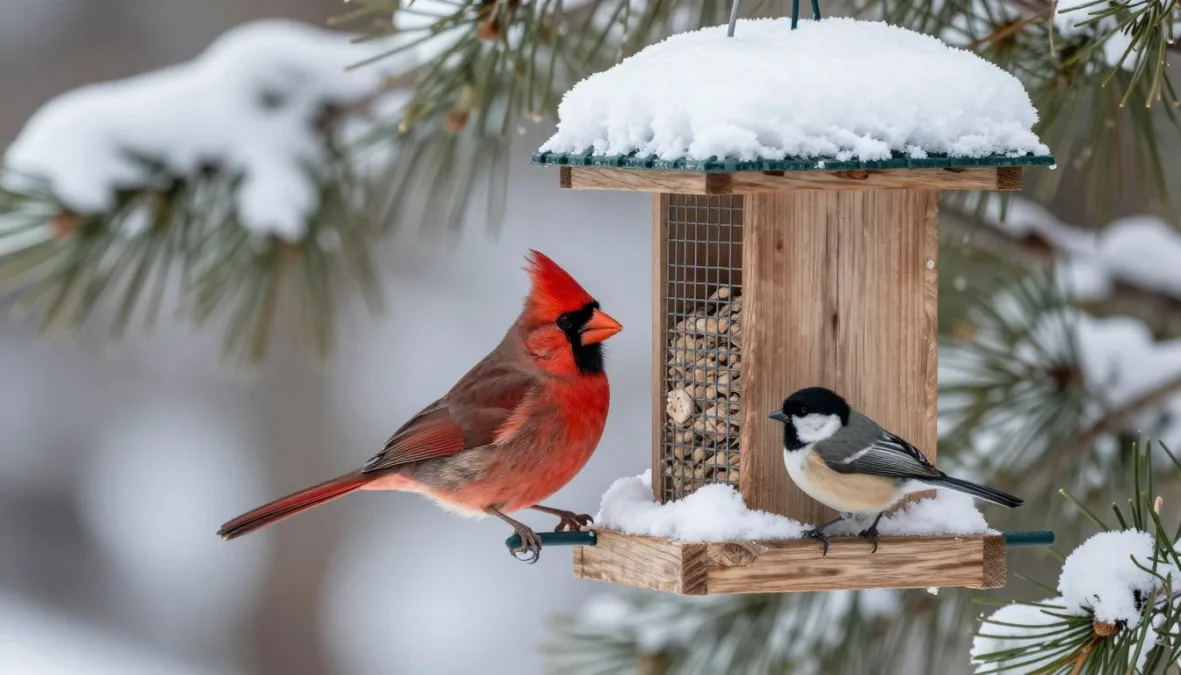
The Top 10 Winter Backyard Birds to Spot in the Northeastern USA 2026 share specialized cold-hardy adaptations, relying on high-calorie seeds, supplemental suet, and evergreen shelter to endure sub-freezing temperatures. Across New York, New England, and Pennsylvania, providing consistent feeding stations creates dependable winter habitats for resident songbirds and northern visitors alike.
Local habitat structure, feeder design, and regional weather patterns decide which species visit a given property. Setting out diverse feeding stations helps birdwatchers observe vibrant wildlife activity throughout the coldest months of the year.
Practical Backyard Feeder Setup for Northeast Winters
Northeastern winter storms bring deep snow, freezing rain, and prolonged cold snaps that restrict natural foraging. Successful winter bird feeding depends on offering nutrient-dense foods in protected feeder locations.
A mix of feeding styles accommodates the differing physical traits of clinging birds, perching songbirds, and ground foragers. Weather baffles placed over stations prevent moisture from spoiling seed blends during heavy blizzards.
- Install covered hopper and tube feeders filled with black oil sunflower seeds to feed active perching birds.
- Hang wire-caged suet feeders from sturdy branches to provide essential animal fats for clinging insect-eaters.
- Scatter millet and cracked corn along ground platforms sheltered by evergreen boughs for low-foraging sparrows.
- Provide an open, heated birdbath to offer liquid drinking water when natural streams and puddles freeze solid.
- Clean feeders weekly by brushing away wet seed residue and wiping perches dry to support flock health.
Placing feeding stations close to natural windbreaks, such as hemlock groves or dense deciduous thickets, reduces wind exposure. These sheltered corridors allow birds to conserve vital body heat between feeding bouts.
Top 10 Winter Backyard Birds to Spot in the Northeastern USA 2026
The bird species frequenting northeastern backyards represent a mix of year-round residents and northern migrants that travel south from Canadian breeding grounds. The following overview details the primary foods, feeder placements, and general habitat associations for the top ten backyard birds observed across the region.
| Bird Species | Primary Food | Feeder Style | Winter Habitat Notes |
| Northern Cardinal | Sunflower seeds | Hopper feeder | Common in suburban thickets and wooded borders. |
| Black-capped Chickadee | Seeds and suet | Tube feeder | Abundant throughout mixed northern forests. |
| Tufted Titmouse | Peanuts and seeds | Platform feeder | Frequents mature deciduous woodlots and gardens. |
| White-breasted Nuthatch | Suet and nuts | Suet cage | Gleans food from large trunk bark surfaces. |
| Dark-eyed Junco | Small seeds | Ground tray | Gathers in open fields, lawns, and woodland edges. |
| White-throated Sparrow | Millet and seeds | Low platform | Stays near dense brush piles and forest floors. |
| Mourning Dove | Cracked grain | Open ground | Forages along open agricultural margins and yards. |
| Downy Woodpecker | Rendered suet | Hanging cage | Visits small backyard trees and overgrown gardens. |
| Hairy Woodpecker | Suet and peanuts | Tree mount | Prefers tracts of mature woodland with dead wood. |
| House Finch | Nyjer and seeds | Perch tube | Common around towns, parks, and suburban feeders. |
Winter flocking behavior increases foraging efficiency. Chickadees, nuthatches, and downy woodpeckers frequently join loose multispecies foraging flocks, sharing vigilance against neighborhood predators while moving between feeding stations.
Core Resident Songbirds and Nuthatches
Year-round residents maintain established territories throughout the Northeast, visiting yards consistently regardless of seasonal temperature swings. These birds rely heavily on local feeding stations to supplement their natural insect, berry, and seed caches.
1. Northern Cardinal
The northern cardinal brings brilliant crimson color to snowy landscapes. The adult male displays bright red feathers, a distinct head crest, and a black face mask surrounding a heavy, seed-crushing orange bill. The female exhibits soft warm brown tones with delicate reddish highlights on her wings, tail, and crest.
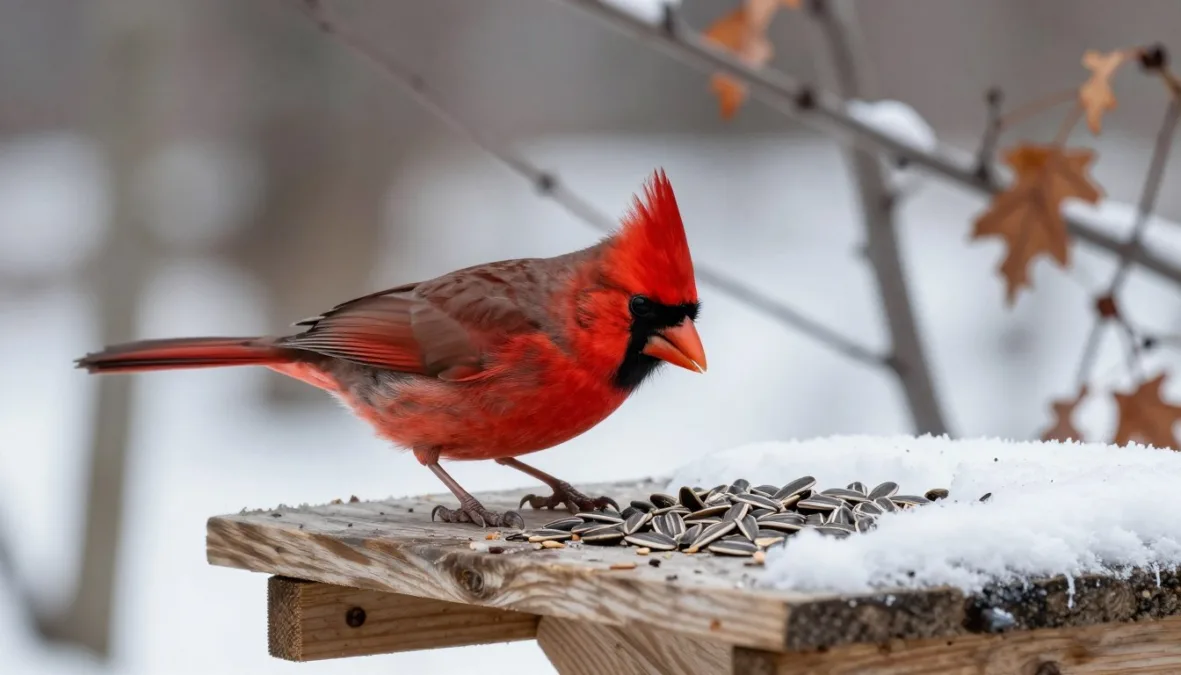
The northern cardinal utilizes its heavy bill to crack hard seed hulls during dawn and dusk feeding visits.
In winter, cardinals forage in small social groups rather than defending strict nesting territories. They prefer feeding early in the morning and again at twilight, showing a strong affinity for stationary platform feeders and broad hoppers filled with black oil sunflower seeds or safflower seeds. Cardinals rarely feed from small swaying tube feeders because their body shape requires a firm, wide landing surface.
Cardinals are common across the lower elevations of New York, Connecticut, Rhode Island, Massachusetts, and Pennsylvania. While historically rare in northern New England, their range has expanded into suburban valleys across Vermont, New Hampshire, and coastal Maine over recent decades.
2. Black-capped Chickadee
The black-capped chickadee is an unmistakable regional icon celebrated for its remarkable cold tolerance. This tiny songbird features a clean black cap and bib, white cheeks, a soft gray back, and buff-tinted flanks. Its plump, round profile allows it to trap pockets of warm air beneath its downy feathers during freezing nights.
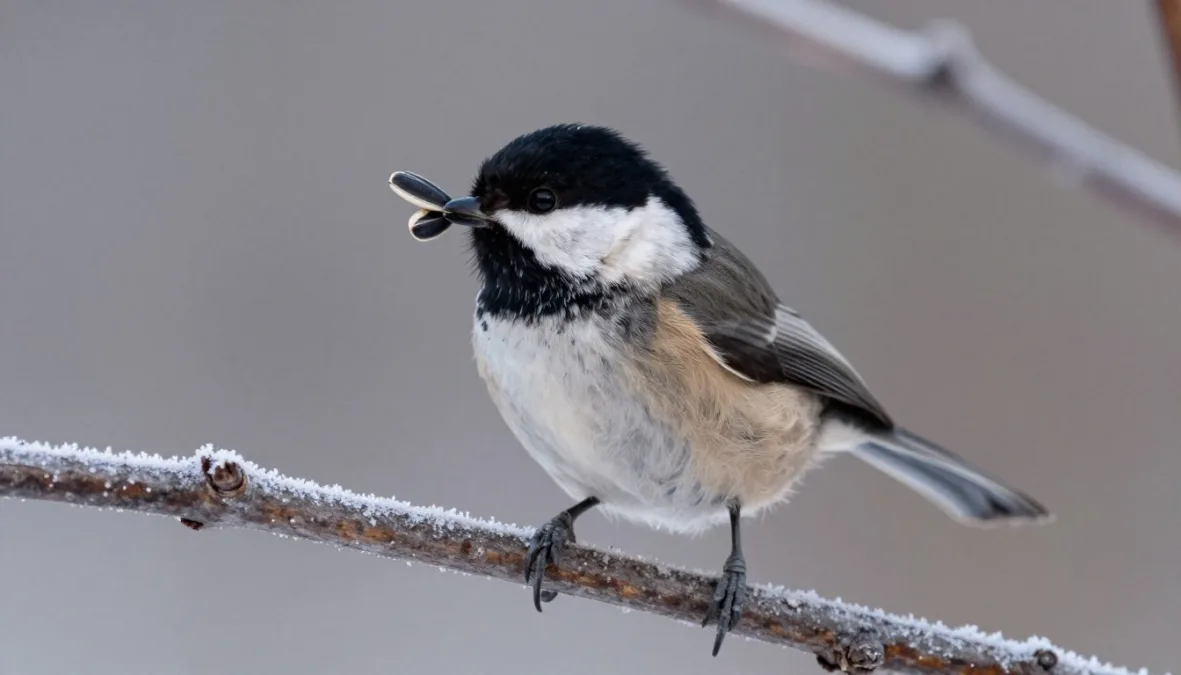
Black-capped chickadees quickly grab seeds from feeders to cache them beneath tree bark for later consumption.
Chickadees display dynamic foraging behavior, darting in to seize one seed at a time before flying to a nearby branch to crack it open. They readily visit tube feeders, hanging suet cages, and mesh peanut holders, frequently hanging upside down with exceptional agility. Each bird caches hundreds of seeds daily across tree crevices to retrieve when winter conditions deteriorate.
This species resides universally across every state in the Northeast, from mountain wilderness areas to central city parks. They remain among the most reliable winter visitors at feeders throughout northern forests and coastal plains.
3. Tufted Titmouse
The tufted titmouse is a vocal, inquisitive bird that travels in close association with chickadee flocks. Identified by a prominent silvery crest, large dark eyes, slate-gray upperparts, and a warm peach wash along its lower flanks, this bird brings lively activity to feeding stations. It also features a small black patch directly above its stout bill.
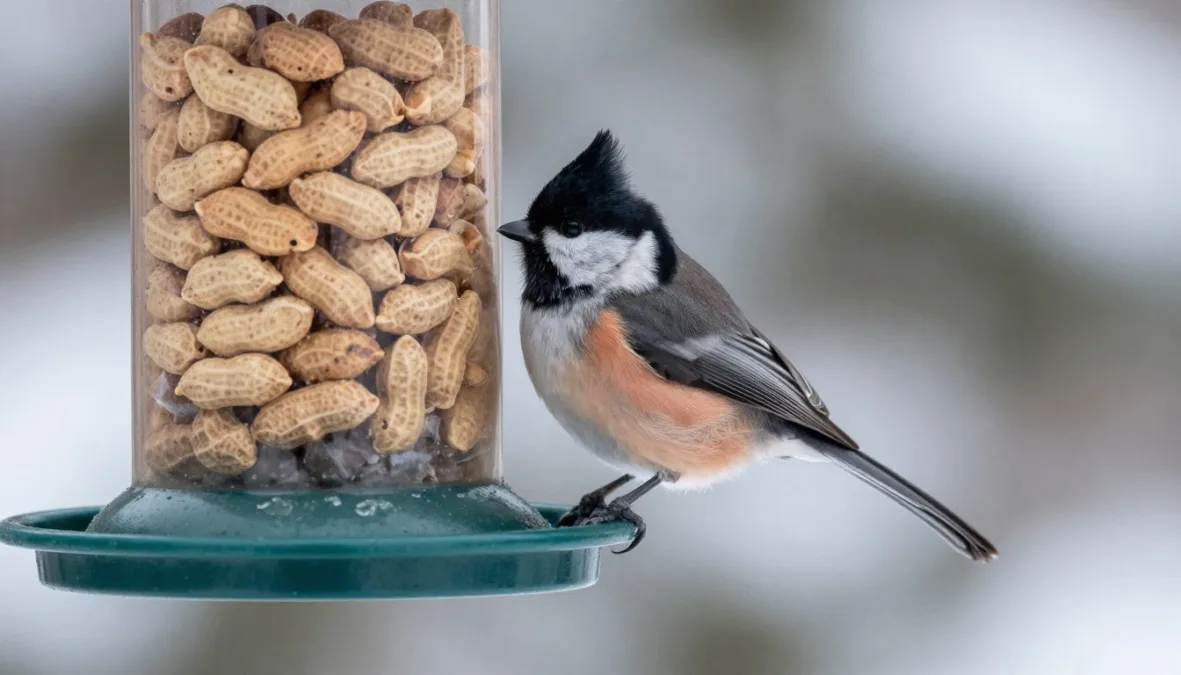
Tufted titmice use their strong feet to pin large seeds against branches while hammering them open.
Titmice show a distinct preference for whole peanuts, peanut hearts, and large sunflower seeds. Like chickadees, a titmouse takes a single large seed, flies to a protected branch, and holds the food item firmly with its feet while hammering the shell with its bill. They readily investigate new feeding stations and will use sturdy hanging feeders as well as flat trays.
Titmice are common across Pennsylvania, New Jersey, southern New York, and southern New England. In northern Vermont, New Hampshire, and interior Maine, they are primarily restricted to lower river valleys and suburban neighborhoods where deciduous trees predominate.
4. White-breasted Nuthatch
The white-breasted nuthatch is easily recognized by its distinctive habit of walking headfirst down vertical tree trunks. It displays clean blue-gray upperparts, a crisp white face and chest, a contrasting dark crown, and rich chestnut coloring around the lower belly. Its long, slightly upturned bill is adapted for probing bark furrows.
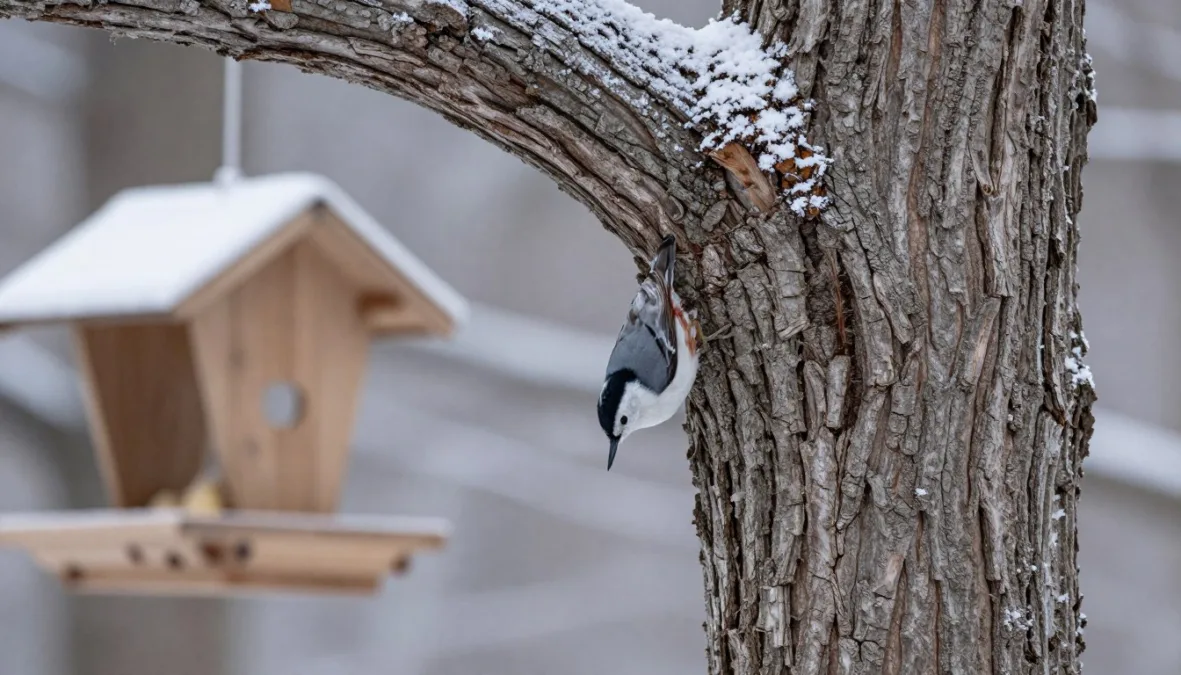
Nuthatches walk headfirst down tree trunks to inspect bark crevices from an angle other birds miss.
Nuthatches feed heavily on rendered suet cakes, raw peanuts, and sunflower seeds. They frequently wedge large food items into deep crevices in mature tree bark, using their bills to hatch or break them into manageable pieces. Unlike woodpeckers, nuthatches do not use their tail feathers for balance, relying entirely on their strong, wide-spreading toes.
This bird is widespread across deciduous and mixed woodlands throughout the entire Northeastern United States. Properties featuring mature oak, maple, and beech trees experience the highest visitation rates throughout the winter season.
Ground-Foraging Birds and Winter Sparrows
While many species feed high in the canopy, a substantial portion of winter bird activity takes place on or near the ground. Providing food at ground level or on low platform stations supports these low-foraging visitors during heavy snow accumulation.
5. Dark-eyed Junco
The dark-eyed junco is affectionately known across the Northeast as the snowbird because its sudden arrival in backyards coincides with late autumn frosts. In the Northeast, the slate-colored form dominates, featuring a smooth charcoal-gray hood and back contrasting sharply with a pristine white belly. Its pale pink bill and flashing white outer tail feathers provide immediate visual markers during flight.
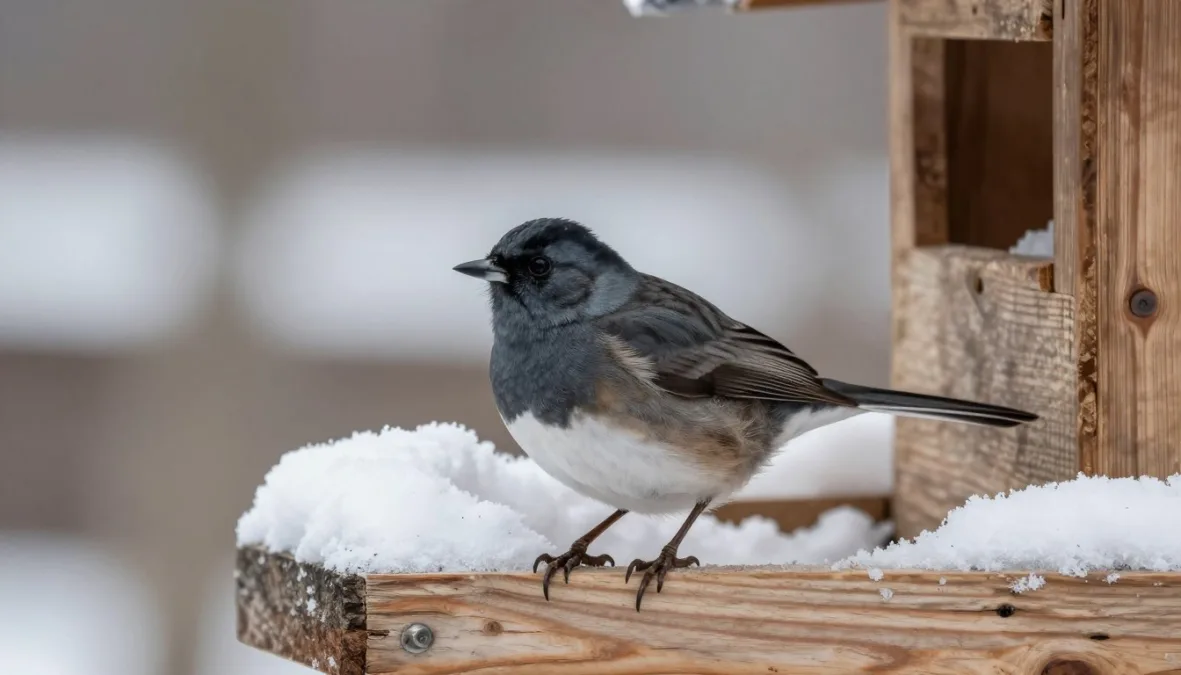
Dark-eyed juncos flash white outer tail feathers as they hop across crusted snow searching for fallen seeds.
Juncos rarely perch on narrow tube feeder pegs, preferring to scratch along the ground or forage on wide, low trays. They hop rapidly over snow crusts, consuming white proso millet, fine cracked corn, and fallen sunflower seed hearts. When snow falls deeply, sweeping a cleared patch under shrubs provides them with an accessible foraging surface.
Juncos breed in northern boreal forests and high Appalachian elevations, migrating into backyards across every northeastern state each winter. They remain abundant from late autumn until early spring before returning north.
6. White-throated Sparrow
The white-throated sparrow is a handsome, hardy ground dweller easily identified by its bright white throat patch and vibrant yellow lores between the eye and bill. The head features bold stripes that appear either crisp black and white or subtle tan and brown depending on the bird’s genetic color morph. The back displays rich streaked brown and rust tones.
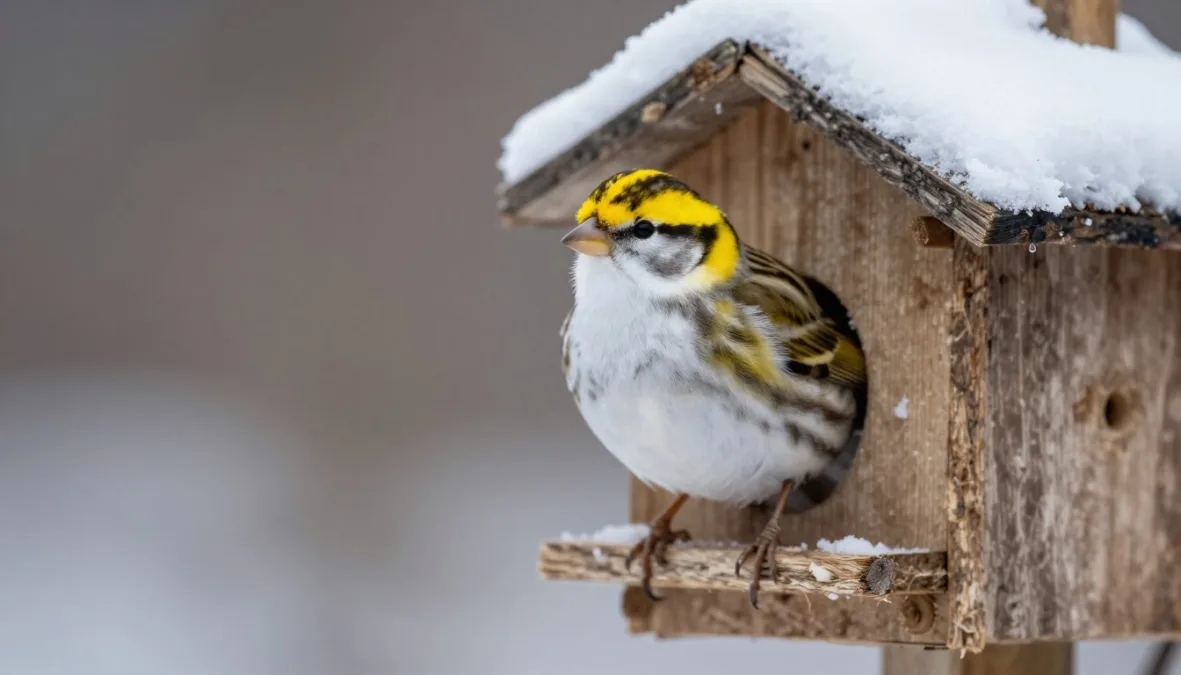
The bright yellow lores and sharp white throat patch distinguish the white-throated sparrow from other winter sparrows.
This sparrow spends most of its time scratching through fallen leaves, mulch beds, and low undergrowth beneath feeders. It employs a distinctive two-footed backward scratching motion to expose buried seeds. White-throated sparrows readily consume millet, hulled sunflower chips, and native grass seeds scattered near protective shelter.
While some breed across the northern woods of Maine and New York, wintering populations gather heavily in the lower Hudson Valley, coastal New England, and Pennsylvania. Their numbers taper off in mountainous northern areas experiencing prolonged, severe snowpack.
7. Mourning Dove
The mourning dove is a familiar, gentle visitor that frequents backyards in small, quiet flocks. It features soft grayish-tan plumage, delicate black spotting on the wings, a pale pinkish breast wash, and a long, pointed tail bordered with white tips. A small black crescent mark rests below each eye.
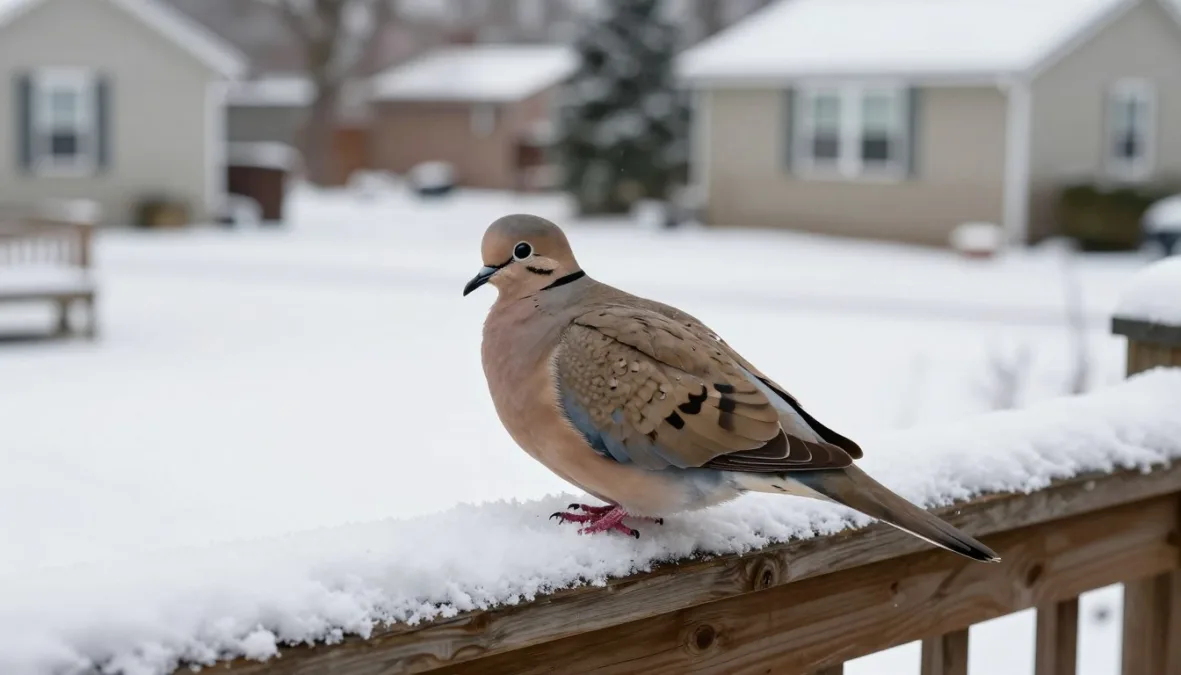
Mourning doves gather in small flocks to consume fallen grains from open platforms and ground areas.
Because their feet cannot grip wire cages or small perches, mourning doves feed almost exclusively on flat surfaces, broad platforms, or open ground. They swallow seeds whole, storing them inside an internal crop before flying to a secure perch to digest. They favor cracked corn, millet, safflower, and sunflower seeds.
Mourning doves are common across agricultural landscapes, suburban subdivisions, and urban parks throughout the Northeast. During extreme blizzards, they often roost together in dense spruce or pine groves to avoid wind exposure.
Ground-feeding birds face heightened risk from domestic predators and deep snow. Placing ground seed trays near dense evergreen branches or constructing a simple backyard brush pile provides vital escape cover from roaming cats and hunting hawks.
Clinging Woodpeckers and Backyard Finches
Woodpeckers and finches bring diverse foraging techniques to northeastern feeding stations. Specialized feeder designs, such as suet cages and fine-mesh dispensers, cater directly to their unique bills and clinging anatomy.
8. Downy Woodpecker
The downy woodpecker is the smallest and most common woodpecker in North America. It displays bold black-and-white patterning, featuring a clean white back patch, checkered wings, white underparts, and black-striped facial markings. The male carries a small, vivid red spot on the back of his head, while the female lacks red coloration entirely.
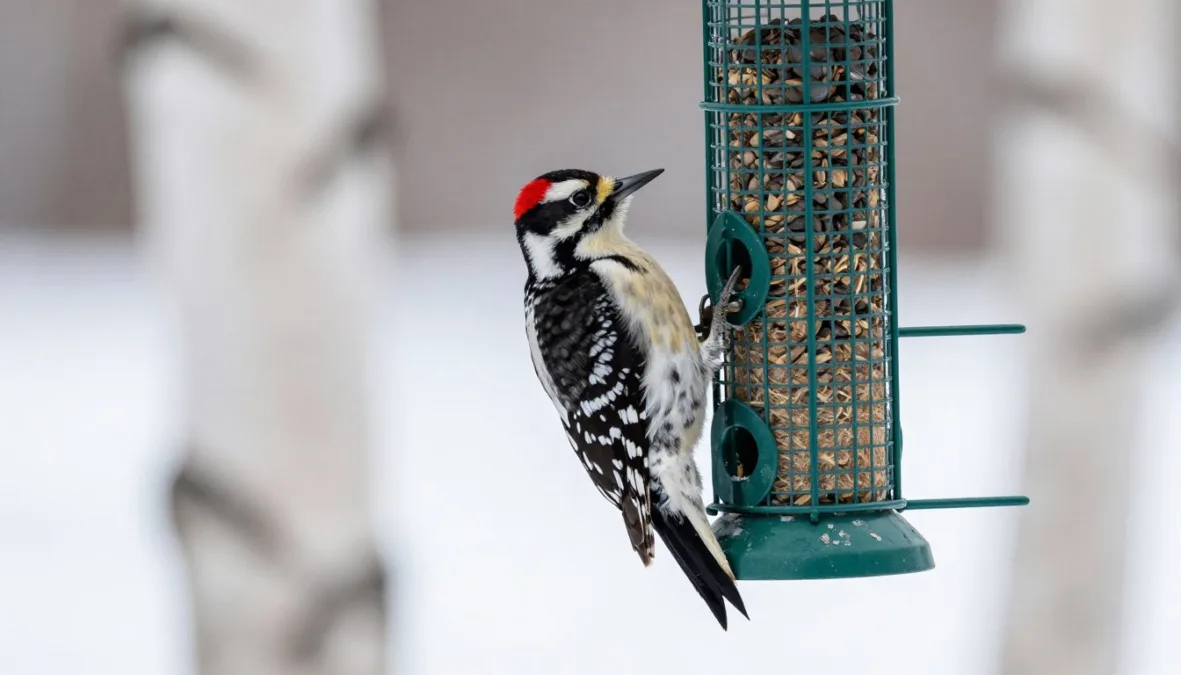
The downy woodpecker uses its short, chisel-like bill to extract calorie-rich suet from wire cages.
Downy woodpeckers exhibit calm, confident behavior around backyard stations, frequently visiting suet cages, peanut feeders, and hopper perches. Their small stature allows them to forage comfortably on slender branches, weed stalks, and lightweight feeders where larger woodpeckers cannot land. They consume high-fat suet blocks eagerly during freezing weather.
This adaptable bird lives year-round in every northeastern state, thriving in suburban neighborhoods, orchard edges, and rural woodlands alike. It is among the easiest woodpeckers to attract to a home feeding station.
9. Hairy Woodpecker
The hairy woodpecker shares almost identical plumage markings with the downy woodpecker, causing frequent identification confusion. It exhibits a white back patch, black checkered wings, and an identical head pattern, with the male bearing a red nape patch. However, it is distinctly larger and stockier, possessing a long, formidable bill roughly equal in length to its head.
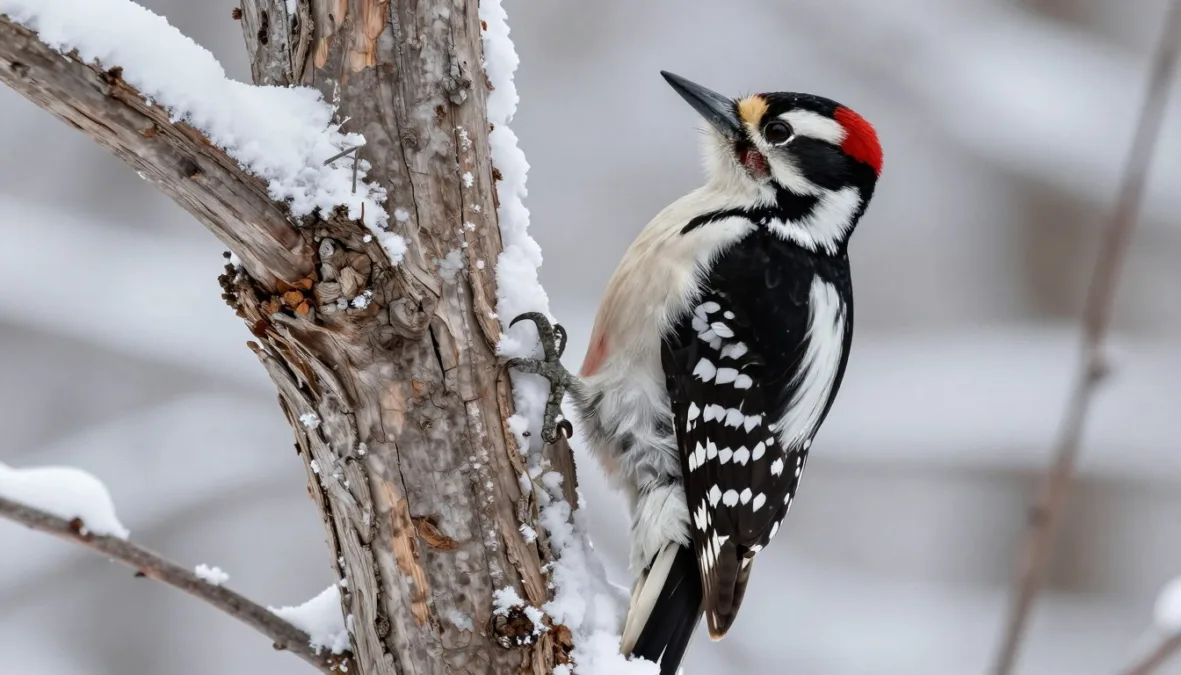
The heavy bill of the hairy woodpecker measures nearly the same length as its head, distinguishing it from the downy.
Hairy woodpeckers are more cautious and solitary than downy woodpeckers, spending less time lingering on exposed feeders. They prefer tree-mounted suet cages, peanut feeders, and large platform stations where they can anchor their bodies using their stiff tail feathers. They also feed on wood-boring beetle larvae excavated from dead tree limbs.
While present across the entire Northeast, hairy woodpeckers favor mature forest tracts over open suburban lawns. Properties that border extensive woodlands or retain standing dead trees observe them with greater regularity.
10. House Finch
The house finch is a cheerful, adaptable finch commonly seen at northeastern perching feeders throughout winter. The adult male features rosy-red plumage over the crown, throat, and upper breast, complemented by a brownish back and heavily streaked brown-and-white flanks. Females show overall plain grayish-brown plumage with thick, blurry streaks running down the underparts.
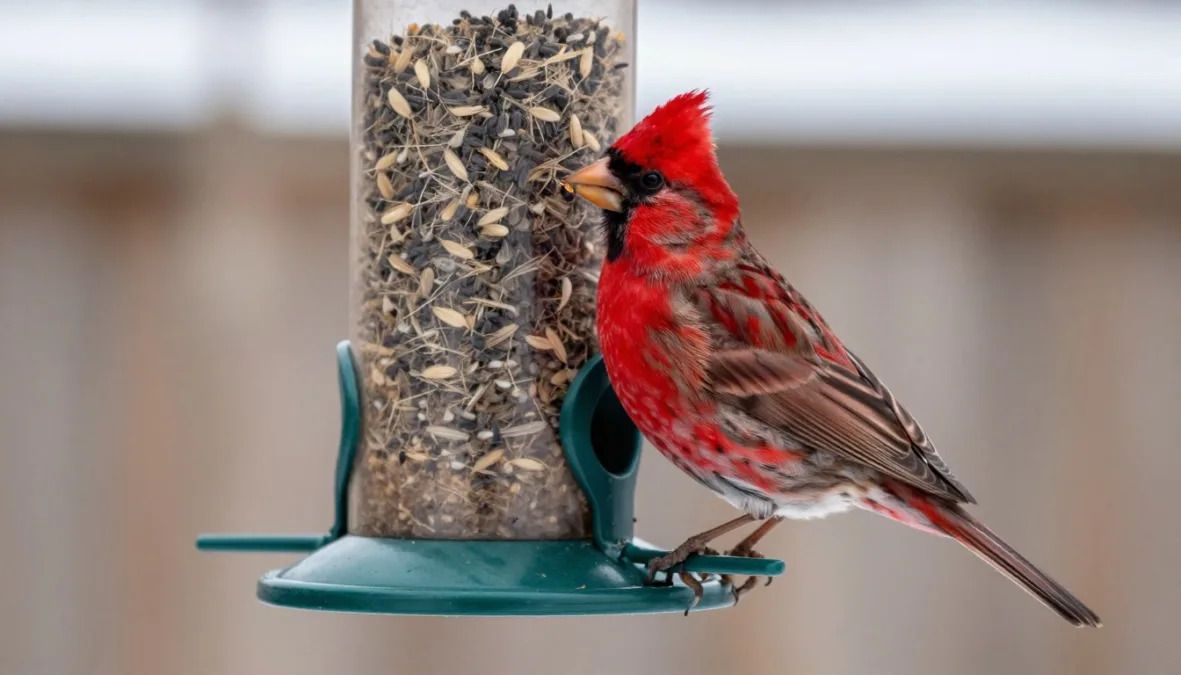
House finches gather in lively winter flocks to feed on small seeds from multi-port tube feeders.
House finches visit feeders in active flocks, chattering constantly while occupying perches on tube feeders and hoppers. They are strictly vegetarian, feeding heavily on nyjer, black oil sunflower seeds, and hulled sunflower chips. They possess a curved, conical bill capable of stripping thin seed coatings with rapid dexterity.
Introduced to the eastern United States decades ago, house finches are now permanent, widespread residents across all northeastern states. They are especially abundant around towns, cities, and suburban feeding stations.
Distinguishing Lookalike Species and Regional Variations
Several winter bird species in the Northeast share overlapping visual traits, presenting identification puzzles for observers. Knowing which field marks and physical proportions to check first clarifies challenging sightings.
- Bill length is less than half the total head width.
- Overall body length matches that of a standard sparrow.
- Outer white tail feathers feature distinct black bars or spots.
- Clings comfortably to slender twigs and small feeder cages.
Downy Woodpecker Markers
- Bill length nearly equals the total length of the head.
- Overall body size approaches that of an American robin.
- Outer white tail feathers appear completely clean and unspotted.
- Prefers broad tree trunks and large, heavy suet mounts.
Hairy Woodpecker Markers
A similar comparison exists between the house finch and the native purple finch. Male purple finches display a rich raspberry wash that covers the back, wings, and head like dipped fruit, while male house finches retain plain brown backs with red concentrated on the head and chest. Female purple finches display a bold white eyebrow stripe that female house finches lack entirely.
Regional geography shapes backyard bird diversity across the Northeast. Northern zones, including Maine, northern New Hampshire, Vermont, and the Adirondacks of New York, feature dense boreal forests where black-capped chickadees and hairy woodpeckers thrive, while southern species like cardinals remain localized. In southern Pennsylvania, New Jersey, and coastal New York, milder winter temperatures support larger flocks of mourning doves, white-throated sparrows, and visiting northern finches.
Backyard birders throughout the region contribute valuable population data each February by participating in the Great Backyard Bird Count. Tracking winter feeder visitors supports wildlife conservation organizations in monitoring seasonal shifts, winter irruptions, and changing regional distributions across North America.
Frequently Asked Questions
What foods attract the widest variety of winter birds in the Northeast?
Black oil sunflower seeds attract the widest variety of species because their thin shells and high fat content provide accessible energy for chickadees, cardinals, finches, and nuthatches. Pairing sunflower seeds with rendered beef suet cakes and white proso millet satisfies both tree-clinging birds and ground foragers.
How can feeders be protected during freezing rain and heavy snowfall?
Installing wide, clear weather domes above hanging feeders protects seed ports from clogging with ice and snow. Placing ground trays beneath overhanging deck roofs or evergreens also keeps food dry and accessible during blizzards.
Do winter backyard birds need supplemental water when snow is present?
Birds benefit significantly from open water because melting snow internally forces them to expend valuable body heat. Using an electric birdbath de-icer keeps drinking and bathing water open without freezing solid during sub-zero cold spells.
Why do some species visit feeders in groups while others feed alone?
Flocking species like house finches and juncos gain greater safety from predators through communal vigilance while feeding in open areas. Solitary visitors like hairy woodpeckers rely on camouflage and protective tree bark, defending single food sources rather than sharing them.
Which winter visitors migrate out of the Northeast during summer?
Dark-eyed juncos and white-throated sparrows largely vacate suburban northeastern backyards as spring approaches, traveling north to breed in Canadian boreal forests or high mountain elevations. Resident birds like chickadees, cardinals, and downy woodpeckers remain in the same neighborhoods throughout the entire summer nesting season.
Supporting Backyard Birds Throughout the Northeast Winter
Maintaining diverse feeder stations, nutrient-rich foods, and reliable shelter transforms any northeastern yard into a thriving winter wildlife sanctuary. Careful observation of bill shapes, feeding postures, and plumage markers allows birders to identify core species with confidence. Enjoying these resilient feathered visitors brings vibrant life and color to the quietest months of the year.

Priyanka Pandey
Senior Research Editor · Top10Sense
Priyanka specializes in tech, consumer products, and digital trends. She combines hands-on testing, vendor interviews, and database research to create trustworthy “Top 10” rankings. Her work has been referenced by industry blogs and brand report pages.