
The artificial intelligence landscape has transformed dramatically over recent years. By 2026, a select group of companies has emerged as clear leaders in AI innovation and market influence.
These organizations are not just developing cutting-edge technology. They’re reshaping entire industries through advanced AI models, platforms, and revolutionary products.
This comprehensive analysis examines the top 10 AI companies in the world 2026. We’ll explore their technological achievements, market position, and unique capabilities that set them apart from competitors.
Download the Complete 2026 AI Companies Report
Get detailed analysis, market share data, investment trends, and expert predictions for all top AI companies. This comprehensive 50-page report includes exclusive insights you won’t find anywhere else.
How We Evaluated the Top AI Companies
Our ranking methodology considers multiple critical factors. We analyzed technological innovation, market performance, research contributions, and real-world impact.
Each company was assessed on specific criteria. These include AI model capabilities, platform robustness, user adoption rate, and annual recurring revenue growth.
Quantitative Metrics
- Market valuation and financial performance
- Annual recurring revenue from AI products
- Number of active users and platform adoption
- Research publications and patent filings
- Training data quality and volume
Qualitative Factors
- Technological breakthrough significance
- Industry influence and thought leadership
- Product innovation and user experience
- Competitive advantages and market position
- Future growth potential and strategy
We also examined how these companies leverage cloud infrastructure and data centers. The ability to scale AI systems efficiently has become a critical competitive advantage.
Competition in the AI sector intensified throughout early 2026. Our analysis reflects the most current market dynamics and technological developments.
1. Google DeepMind: Pioneering AI Research and Development

Google DeepMind maintains its position as the leading AI research organization globally. The company has consistently delivered breakthrough innovations that advance the entire field of artificial intelligence.
Key Technologies and Products
The Gemini family of models represents DeepMind’s most significant achievement in 2026. These advanced systems demonstrate unprecedented capabilities across multiple domains.
Google Cloud integration has made DeepMind’s technology accessible to businesses worldwide. The platform enables companies to leverage state-of-the-art AI models without massive infrastructure investment.
Gemini Ultra 2.0
The flagship model powering next-generation AI applications with multimodal understanding and generation capabilities.
- Processes text, images, video, and audio simultaneously
- Achieves human-level performance on complex reasoning tasks
- Powers Google’s consumer and enterprise products
AlphaFold 3
Revolutionary protein structure prediction system transforming drug discovery and biological research.
- Predicts complex molecular interactions with high accuracy
- Accelerates pharmaceutical research timelines
- Used by research institutions worldwide
Gemini Code Assist
Advanced AI-powered development tools that enhance programmer productivity across multiple languages.
- Generates production-ready code from natural language
- Understands entire codebases for contextual assistance
- Integrated across Google Cloud development platforms
Market Position and Impact
Google DeepMind’s research output remains unmatched by competitors. The team publishes groundbreaking papers regularly and advances fundamental AI science.
The company raised significant investment in early 2026 to expand its data center infrastructure. This positions DeepMind to train even larger and more capable models.
“Google DeepMind continues to push the boundaries of what’s possible with artificial intelligence. Their combination of fundamental research and practical application is unmatched in the industry.”
2. OpenAI: Democratizing Advanced AI Technology

OpenAI has fundamentally changed how people interact with artificial intelligence. The company’s ChatGPT platform reached unprecedented user adoption rates in 2026.
The organization balances cutting-edge research with practical product development. This approach has created tools that millions of users rely on daily.
Revolutionary Products and Services
ChatGPT evolved significantly throughout recent years. The latest versions demonstrate remarkable improvements in reasoning, creativity, and task completion.
OpenAI’s GPT-5 model family powers a vast ecosystem of applications. These new models excel at understanding complex instructions and generating high-quality content.
- ChatGPT Pro serves over 100 million active users worldwide
- GPT-5 models available through API for business integration
- DALL-E 4 generates photorealistic images from text descriptions
- Codex Pro assists developers with advanced programming tasks
- Voice synthesis technology enables natural conversations
Business Model and Growth
OpenAI achieved remarkable financial success with its subscription model. The company’s annual recurring revenue exceeded industry expectations in 2026.
Enterprise adoption drove significant growth. Large organizations integrate OpenAI’s platform into their business workflows and customer-facing systems.
Annual Recurring Revenue Milestone
OpenAI’s annual recurring revenue surpassed $10 billion in early 2026, making it one of the fastest-growing software companies in history. The platform serves enterprises, small businesses, and individual users across 180 countries.
The company raised substantial funding to expand infrastructure. New data centers support the computational demands of training increasingly sophisticated models.
Competitive Advantages
OpenAI’s brand recognition provides significant competitive advantage. ChatGPT has become synonymous with AI assistance for many users.
The company’s research team continues publishing influential papers. Their work on alignment and safety sets industry standards for responsible AI development.
Strengths
- Massive user base and brand recognition
- Strong enterprise adoption and partnerships
- Continuous model improvements and innovation
- Robust API ecosystem and developer tools
- Leadership in AI safety research
Challenges
- High infrastructure and operational costs
- Increasing competition from tech giants
- Regulatory scrutiny in multiple markets
- Balancing openness with safety concerns
3. Anthropic: Setting New Standards for AI Safety

Anthropic has emerged as a major player in the AI industry. The company’s commitment to safety and reliability distinguishes it from competitors.
Claude, Anthropic’s flagship AI assistant, gained significant market share in 2026. Users appreciate its helpful, harmless, and honest approach to interactions.
Technology and Innovation
Anthropic developed Constitutional AI, a breakthrough approach to model training. This methodology ensures AI systems behave according to specified principles and values.
The Claude 3.5 model family demonstrates exceptional performance on complex tasks. These systems excel at analysis, writing, coding, and mathematical reasoning.
Natural language understanding reached new levels with Claude’s latest versions. The models grasp nuanced context and maintain coherent long-form conversations.
Market Strategy
Anthropic focused on enterprise customers seeking reliable AI solutions. Many businesses choose Claude for sensitive applications requiring high accuracy and safety.
The company raised $7.3 billion in funding to accelerate development. This valuation reflects investor confidence in Anthropic’s technical approach and market potential.
Enterprise Trust Factor
Over 60% of Fortune 500 companies now use Claude for internal operations, customer service, or product development. Anthropic’s emphasis on reliability and safety has made it the preferred choice for risk-conscious organizations.
4. Microsoft: Integrating AI Across the Enterprise

Microsoft has successfully integrated AI throughout its product ecosystem. The company’s partnership with OpenAI accelerated its artificial intelligence capabilities significantly.
Azure AI services power countless business applications worldwide. Microsoft provides comprehensive tools for companies building custom AI solutions.
Key AI Products and Platforms
Microsoft 365 Copilot transformed workplace productivity. The AI assistant helps users with writing, data analysis, presentations, and countless other tasks.
GitHub Copilot revolutionized software development workflows. Developers worldwide rely on this tool to write code faster and more efficiently.
Consumer AI Products
- Bing Chat with GPT-4 integration
- Windows Copilot for system assistance
- Edge browser AI features
- Microsoft Designer for creative work
- AI-powered search and discovery
Enterprise Solutions
- Azure OpenAI Service
- Power Platform AI Builder
- Dynamics 365 Copilot
- Security Copilot for threat detection
- Custom model training infrastructure
Infrastructure and Investment
Microsoft invested billions in data center expansion to support AI workloads. The company operates one of the world’s largest cloud computing infrastructures.
Azure provides the computational power needed for training massive AI models. This infrastructure gives Microsoft a significant advantage in the AI race.
The company’s market position strengthened in 2026. Annual recurring revenue from AI products grew faster than any other business segment.
Competitive Strategy
Microsoft’s integration strategy proves highly effective. AI capabilities embedded across familiar tools reduce adoption barriers for users.
The partnership with OpenAI provides access to cutting-edge models. Microsoft can deploy advanced AI features without building everything from scratch.
5. Amazon Web Services: Building AI Infrastructure at Scale

Amazon Web Services dominates cloud infrastructure for AI applications. The platform provides the foundation for countless AI startups and enterprise deployments.
AWS developed comprehensive AI and machine learning services. These tools enable companies to build, train, and deploy AI models efficiently.
AI Services Portfolio
Amazon Bedrock simplifies access to foundation models from multiple providers. Businesses can experiment with different AI systems through a single platform.
SageMaker remains the leading platform for custom model development. Data scientists use these tools to create specialized AI solutions for specific business needs.
- Amazon Q provides AI assistance for developers and businesses
- CodeWhisperer accelerates software development with AI suggestions
- Rekognition offers advanced computer vision capabilities
- Comprehend analyzes text with natural language processing
- Personalize delivers AI-powered recommendation systems
- Trainium and Inferentia chips optimize AI workload performance
Market Dominance
AWS maintains the largest share of cloud infrastructure market. This position gives Amazon unique insights into AI deployment patterns and customer needs.
The company’s custom AI chips reduce costs for training and inference. This technological advantage helps AWS compete on price and performance simultaneously.
Enterprise customers trust AWS for mission-critical AI applications. The platform’s reliability and security features meet stringent regulatory requirements across industries.
6. Meta: Open-Source AI Leadership and Social Platform Innovation

Meta transformed the AI landscape with its open-source approach. The company’s Llama model family democratized access to powerful AI technology.
This strategy created a vibrant ecosystem of developers and researchers. Thousands of organizations build applications using Meta’s openly available models.
Llama Model Family
Llama 4 represents a major leap in open-source AI capabilities. The models compete with proprietary systems while remaining freely available.
Developers worldwide downloaded Llama models billions of times. This widespread adoption established Meta as a leader in accessible AI technology.
The company released specialized versions for different use cases. Code generation, mathematical reasoning, and multilingual applications each have optimized model variants.
Social Platform AI Integration
Meta AI powers features across Facebook, Instagram, and WhatsApp. Billions of users interact with these AI systems daily.
Content recommendation algorithms improved significantly in 2026. The platform delivers more relevant content while reducing harmful material distribution.
Open-Source Impact
Meta’s decision to open-source its AI models sparked industry debate. While democratizing AI access, it also raised questions about safety controls and potential misuse. The company maintains that transparency and community oversight provide better outcomes than closed development.
Research Contributions
Meta’s research team publishes extensively on AI advancement. Their work on efficient training, model compression, and multimodal systems influences the entire field.
The company invested heavily in AI infrastructure. Meta operates massive data centers optimized for training large-scale neural networks.
Compare AI Solutions Side-by-Side
Access our interactive platform to evaluate features, pricing, performance, and real-world applications across top AI companies. Make informed decisions with comprehensive comparison tools used by industry leaders.
Free Access No credit card required • Updated weekly with latest data
7. NVIDIA: Powering AI with Revolutionary Hardware
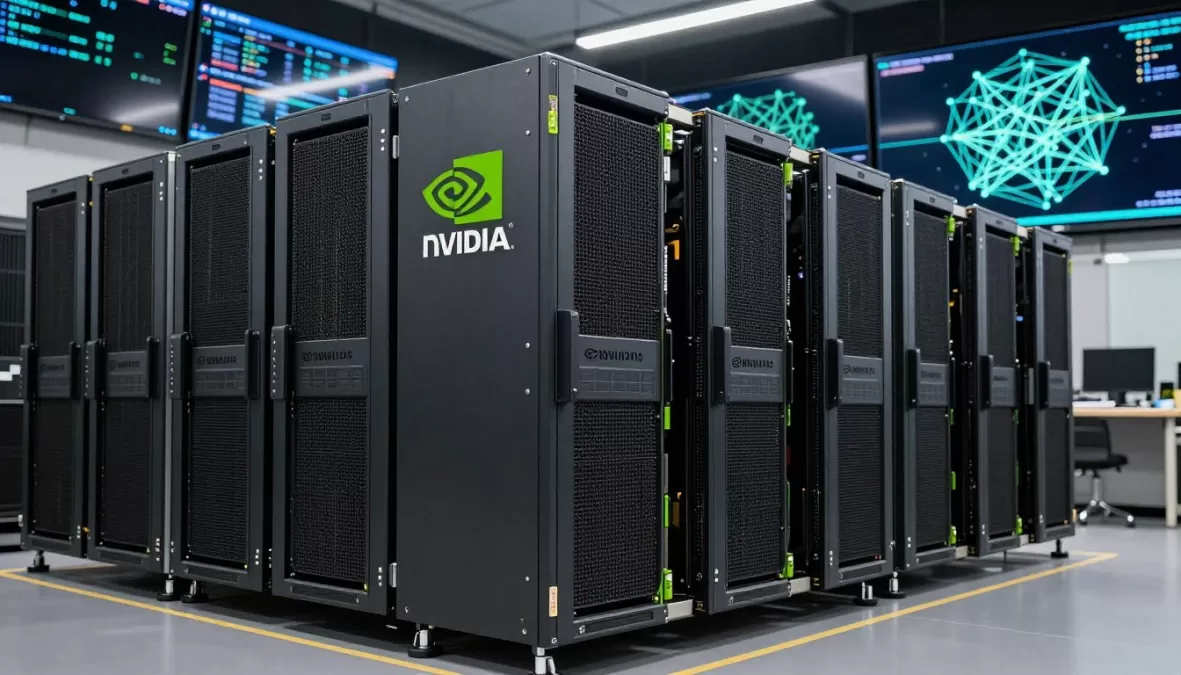
NVIDIA provides the computational foundation for modern AI. The company’s GPUs power training and inference for virtually all major AI systems.
No other company rivals NVIDIA’s dominance in AI hardware. Their technology enables the rapid advancement we’ve seen across the industry.
Hardware Innovation
The Blackwell architecture redefined AI computing performance. These chips deliver unprecedented speed for training massive neural networks.
NVIDIA’s Hopper generation GPUs remain widely deployed across data centers. Cloud providers and enterprises rely on this hardware for production AI workloads.
The company developed complete systems, not just chips. DGX servers provide turnkey solutions for organizations building AI infrastructure.
Software Ecosystem
NVIDIA’s CUDA platform became the standard for AI development. Software tools and libraries accelerate model training and optimization.
The company’s AI Enterprise software suite helps businesses deploy solutions. These tools simplify the complexity of production AI systems.
- TensorRT optimizes model inference performance
- Triton Inference Server manages model deployment at scale
- NeMo framework accelerates conversational AI development
- Omniverse enables AI-powered 3D simulation and design
- RAPIDS libraries speed up data science workflows
Market Position
NVIDIA’s valuation soared alongside AI adoption. The company became one of the most valuable technology firms globally.
Demand for their products consistently exceeded supply. Data center operators competed to secure allocations of the latest GPU systems.
Competition emerged from custom AI chips, but NVIDIA maintained dominance. Their software ecosystem and performance advantages proved difficult to replicate.
8. Databricks: Unifying Data and AI for Enterprises
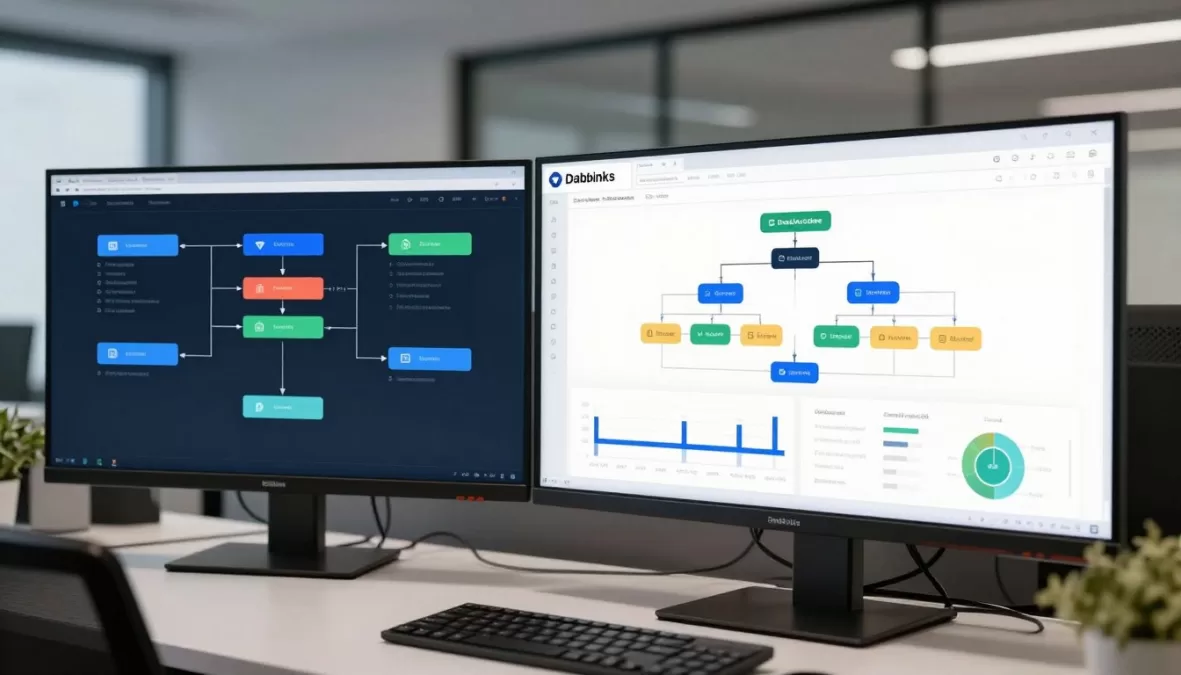
Databricks created a unified platform for data engineering and AI development. The company bridges the gap between data infrastructure and machine learning systems.
Organizations struggle with fragmented data and AI tools. Databricks solves this problem with an integrated approach.
Platform Capabilities
The Data Intelligence Platform combines data warehousing with AI capabilities. Teams can process massive datasets and build models in one environment.
Databricks achieved a remarkable valuation exceeding $43 billion in 2026. This reflects the platform’s critical role in enterprise AI strategies.
Delta Lake technology ensures data quality and reliability. Clean training data proves essential for building accurate AI models.
AI Innovation
The company developed DBRX, a powerful open-source language model. This demonstrates Databricks’ commitment to both infrastructure and AI advancement.
MLflow became the industry standard for managing machine learning lifecycles. Data scientists use these tools to track experiments and deploy models.
The platform simplifies the entire AI development process. From data preparation through model deployment, Databricks provides integrated tools.
Enterprise Adoption
Thousands of companies run production AI on Databricks. The platform handles everything from recommendation systems to predictive maintenance.
Annual recurring revenue growth exceeded expectations in 2026. Businesses increased spending as they scaled AI initiatives.
The company’s focus on governance and security appeals to regulated industries. Financial services, healthcare, and government agencies rely on the platform.
9. Scale AI: Providing Essential Training Data Infrastructure

Scale AI emerged as a critical infrastructure provider for the AI industry. Every major AI company relies on high-quality training data.
The company specializes in data labeling, annotation, and curation at massive scale. This expertise proves invaluable as models grow larger and more complex.
Core Services
Scale provides human-in-the-loop data processing services. Expert annotators label images, text, video, and other data types with high accuracy.
The platform supports autonomous vehicle development through specialized labeling. Self-driving car companies depend on Scale’s precision for safety-critical applications.
Natural language processing models require carefully annotated text data. Scale’s services ensure AI systems learn from accurate, unbiased training examples.
Technology Platform
Scale developed sophisticated tools for managing data workflows. The platform orchestrates human expertise with AI assistance for optimal efficiency.
Quality control systems ensure annotation accuracy. Multiple validation steps catch errors before data enters model training pipelines.
The company handles sensitive data with enterprise-grade security. Government and defense contractors trust Scale with classified information.
Market Growth
Scale’s valuation reached $13.8 billion, reflecting the training data market’s importance. As AI models scale, demand for quality data grows exponentially.
The company raised $1 billion to expand operations globally. New data centers support increased capacity for labeling services.
Partnerships with leading AI companies provide steady revenue. Long-term contracts ensure consistent business as customers scale their AI efforts.
Ready to Implement AI in Your Business?
Schedule a complimentary strategy consultation with our AI experts. We’ll help you evaluate which AI solutions align with your business objectives and develop a practical implementation roadmap. Limited slots available for Q2 2026.
10. Cohere: Enterprise-Focused Language AI Solutions

Cohere focuses exclusively on enterprise natural language processing. The company provides AI solutions designed specifically for business needs.
Unlike consumer-focused competitors, Cohere prioritizes privacy and customization. This approach resonates with organizations handling sensitive information.
Enterprise AI Platform
Cohere’s Command models power business applications worldwide. These systems excel at understanding and generating professional content.
The platform enables semantic search across company knowledge bases. Employees find information faster using natural language queries.
Retrieval-augmented generation connects AI models with proprietary data. Businesses get accurate answers grounded in their own documents and systems.
Product Offerings
Cohere developed specialized models for different industries. Financial services, healthcare, and legal sectors each have optimized versions.
The company’s multilingual capabilities support global operations. Models understand and generate text in dozens of languages accurately.
- Command R+ for complex reasoning and analysis tasks
- Embed for high-quality semantic search and similarity
- Classify for accurate text categorization
- Generate for content creation and summarization
- Custom fine-tuning for specialized applications
Market Strategy
Cohere’s business model focuses on long-term enterprise contracts. This provides predictable revenue and deep customer relationships.
The company raised over $435 million to scale operations. Investor confidence reflects the growing enterprise AI market opportunity.
Privacy-first architecture differentiates Cohere from competitors. Data never trains public models, addressing key customer concerns.
Annual recurring revenue grew significantly as enterprises expanded AI usage. Existing customers increased spending while new deployments added revenue.
AI Industry Trends Shaping 2026
The artificial intelligence sector evolved rapidly throughout recent years. Several key trends define the current landscape and future trajectory.
Multimodal AI Systems
New models process multiple data types simultaneously. Text, images, audio, and video combine in unified systems.
This capability enables more natural human-computer interaction. Users communicate through whatever medium suits their needs.

AI Agents and Automation
Autonomous agents handle complex tasks with minimal supervision. These systems plan, execute, and adapt their approaches dynamically.
Businesses deploy agents for customer service, research, and analysis. The technology reduces repetitive work and improves efficiency.
Competition intensified around agent capabilities in 2026. Companies race to develop systems that reliably complete multi-step tasks.
Infrastructure Investment
Data center construction accelerated worldwide. The computational demands of AI training require massive infrastructure.
Energy consumption became a critical consideration. Companies invest in renewable power sources to sustainably operate AI systems.
Custom chip development increased as alternatives to traditional GPUs emerged. Cost and performance optimization drive hardware innovation.
Regulatory Development
Governments worldwide implemented AI regulations. Safety, privacy, and transparency requirements shape product development.
Companies must navigate complex compliance landscapes. Different regions impose varying requirements on AI systems.
Industry standards emerged for testing and validation. Responsible AI practices became competitive differentiators.
Choosing the Right AI Company for Your Needs
Selecting an AI provider requires careful consideration of multiple factors. Different companies excel in specific areas and use cases.
Evaluation Criteria
Technical Capabilities
Assess the sophistication of AI models and their performance on relevant tasks.
- Model accuracy and reliability
- Supported data types and formats
- Customization and fine-tuning options
- Integration with existing systems
Business Considerations
Evaluate cost structure, scalability, and long-term viability of the platform.
- Pricing models and total cost
- Scalability for growth
- Support and documentation quality
- Company stability and roadmap
Security and Compliance
Ensure the solution meets your industry’s regulatory requirements.
- Data privacy protections
- Compliance certifications
- Security infrastructure
- Data residency options
Ecosystem and Support
Consider the broader platform ecosystem and available resources.
- Developer community size
- Third-party integrations
- Training and resources
- Partner network
Use Case Matching
Different AI companies specialize in particular applications. Match your requirements to provider strengths.
| Use Case | Recommended Companies | Key Capabilities |
| Customer Service Automation | OpenAI, Anthropic, Cohere | Conversational AI, context retention, safety controls |
| Code Generation & Development | OpenAI, Microsoft, Google DeepMind | Programming language support, code understanding, debugging |
| Data Analytics & Business Intelligence | Databricks, Google DeepMind, AWS | Data processing, visualization, predictive analytics |
| Content Creation & Marketing | OpenAI, Meta, Microsoft | Text generation, image creation, brand consistency |
| Enterprise Search & Knowledge Management | Cohere, Google DeepMind, Microsoft | Semantic search, document understanding, information retrieval |
| Research & Development | Google DeepMind, Meta, Anthropic | Scientific reasoning, literature analysis, hypothesis generation |
Implementation Best Practices
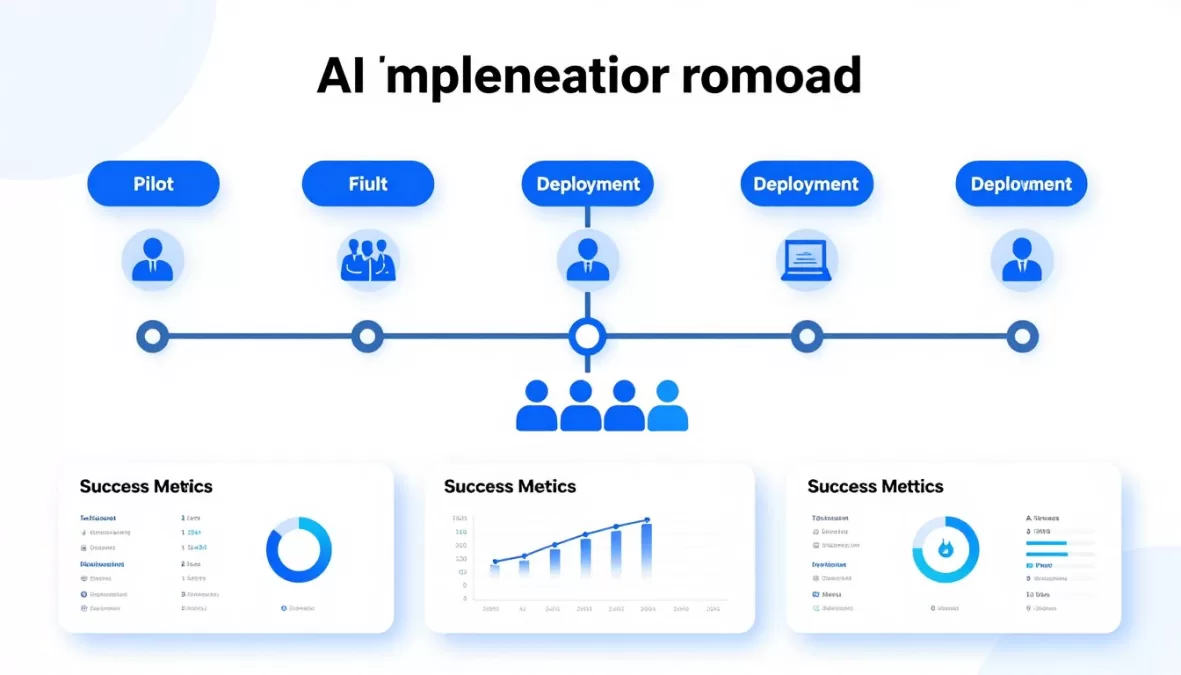
Successful AI deployment requires thoughtful planning and execution. Follow these guidelines to maximize results.
- Start with a clear use case and success metrics
- Conduct pilot projects before full-scale deployment
- Invest in team training and change management
- Establish governance and monitoring processes
- Plan for iterative improvement and optimization
- Build internal expertise alongside vendor partnerships
The Future of AI: What’s Next Beyond 2026
Artificial intelligence continues advancing at an extraordinary pace. The coming years will bring capabilities that seem impossible today.
Emerging Capabilities
AI systems will handle increasingly complex reasoning tasks. Multi-step problem solving with minimal human guidance becomes routine.
Personalization reaches new levels of sophistication. AI adapts to individual preferences while respecting privacy boundaries.
Scientific discovery accelerates through AI-powered research tools. Drug development, materials science, and fundamental physics benefit enormously.
Industry Transformation
Every sector faces disruption from AI technology. Healthcare, education, manufacturing, and services all undergo fundamental changes.
New business models emerge around AI capabilities. Companies create value in ways impossible before these technologies existed.
The competition among AI companies will intensify further. Market consolidation may occur as leaders pull ahead.
Investment Outlook
Analysts project the global AI market will exceed $500 billion by 2028. Enterprise AI adoption drives this growth as companies recognize competitive necessity. The top 10 AI companies in the world 2026 are positioned to capture the majority of this expanding market opportunity.
Challenges Ahead
Ethical considerations become more pressing as AI grows more powerful. Society must address bias, fairness, and accountability systematically.
Computing resource requirements continue escalating. Sustainable AI development requires solving energy and environmental challenges.
Workforce adaptation presents ongoing challenges. Education systems must prepare people for an AI-augmented future of work.

Frequently Asked Questions About Top AI Companies
Which AI company has the most advanced technology in 2026?
Google DeepMind leads in fundamental AI research and breakthrough innovations. Their Gemini family models demonstrate cutting-edge capabilities across multiple domains.
However, “most advanced” depends on specific criteria. OpenAI excels in user-friendly applications, Microsoft in enterprise integration, and NVIDIA in hardware infrastructure.
How do these AI companies make money?
Revenue models vary significantly. OpenAI and Anthropic charge subscription fees for AI access. Microsoft and Google integrate AI into existing products and cloud services.
AWS and Databricks provide infrastructure platforms where customers pay for usage. NVIDIA sells hardware to power AI systems. Scale AI charges for data processing services.
What differentiates open-source AI from proprietary models?
Open-source models like Meta’s Llama allow anyone to download, modify, and deploy the technology. This democratizes access but may raise safety concerns.
Proprietary models from OpenAI and Anthropic remain under company control. Users access them through APIs but cannot see internal workings. This enables better safety controls but limits transparency.
Which AI company is best for small businesses?
OpenAI’s ChatGPT offers the lowest barrier to entry with user-friendly interfaces and affordable pricing. Small businesses can start using AI immediately without technical expertise.
Microsoft 365 Copilot works well for businesses already using Office products. Google Cloud and AWS provide scalable options as needs grow.
How much does enterprise AI cost?
Costs vary dramatically based on use case and scale. Basic API access starts around
Frequently Asked Questions About Top AI Companies
Which AI company has the most advanced technology in 2026?
Google DeepMind leads in fundamental AI research and breakthrough innovations. Their Gemini family models demonstrate cutting-edge capabilities across multiple domains.
However, “most advanced” depends on specific criteria. OpenAI excels in user-friendly applications, Microsoft in enterprise integration, and NVIDIA in hardware infrastructure.
How do these AI companies make money?
Revenue models vary significantly. OpenAI and Anthropic charge subscription fees for AI access. Microsoft and Google integrate AI into existing products and cloud services.
AWS and Databricks provide infrastructure platforms where customers pay for usage. NVIDIA sells hardware to power AI systems. Scale AI charges for data processing services.
What differentiates open-source AI from proprietary models?
Open-source models like Meta’s Llama allow anyone to download, modify, and deploy the technology. This democratizes access but may raise safety concerns.
Proprietary models from OpenAI and Anthropic remain under company control. Users access them through APIs but cannot see internal workings. This enables better safety controls but limits transparency.
Which AI company is best for small businesses?
OpenAI’s ChatGPT offers the lowest barrier to entry with user-friendly interfaces and affordable pricing. Small businesses can start using AI immediately without technical expertise.
Microsoft 365 Copilot works well for businesses already using Office products. Google Cloud and AWS provide scalable options as needs grow.
How much does enterprise AI cost?
Costs vary dramatically based on use case and scale. Basic API access starts around $0.002 per 1,000 tokens for simple models.
Enterprise deployments with custom models, dedicated infrastructure, and support can cost hundreds of thousands to millions annually. Most companies start small and scale investment as they prove value.
Are AI models safe and reliable for business use?
Top AI companies invest heavily in safety and reliability. Systems undergo extensive testing before deployment, and companies like Anthropic prioritize alignment research.
However, no AI system is perfect. Businesses should implement human oversight, validate outputs, and start with lower-risk applications before expanding usage.
What training data do these companies use?
Companies train models on vast datasets from publicly available text, licensed content, and proprietary sources. The exact composition varies and is often not fully disclosed.
Scale AI and similar companies provide specialized labeled data. Quality training data has become a competitive advantage as models scale.
How often do AI models improve?
Major companies release new model versions every few months. These updates bring performance improvements, new capabilities, and bug fixes.
Incremental improvements happen continuously through fine-tuning and optimization. The pace of advancement has accelerated in recent years.
.002 per 1,000 tokens for simple models.
Enterprise deployments with custom models, dedicated infrastructure, and support can cost hundreds of thousands to millions annually. Most companies start small and scale investment as they prove value.
Are AI models safe and reliable for business use?
Top AI companies invest heavily in safety and reliability. Systems undergo extensive testing before deployment, and companies like Anthropic prioritize alignment research.
However, no AI system is perfect. Businesses should implement human oversight, validate outputs, and start with lower-risk applications before expanding usage.
What training data do these companies use?
Companies train models on vast datasets from publicly available text, licensed content, and proprietary sources. The exact composition varies and is often not fully disclosed.
Scale AI and similar companies provide specialized labeled data. Quality training data has become a competitive advantage as models scale.
How often do AI models improve?
Major companies release new model versions every few months. These updates bring performance improvements, new capabilities, and bug fixes.
Incremental improvements happen continuously through fine-tuning and optimization. The pace of advancement has accelerated in recent years.
Get Complete AI Market Intelligence
Access our full suite of resources including detailed company reports, trend analyses, comparison tools, expert consultations, and exclusive industry insights. Everything you need to make informed AI decisions for your business.
What’s Included:
- Comprehensive 50-page AI company analysis report
- Weekly AI industry newsletter with expert insights
- Interactive platform comparison tools
- Quarterly trend forecasts and predictions
- Access to exclusive webinars and events
- 30-minute strategy consultation
Prefer to speak with an expert? Call us directly:
Available Monday-Friday, 9 AM – 6 PM EST
Conclusion: Navigating the AI Revolution
The top 10 AI companies in the world 2026 represent the vanguard of technological innovation. Each organization contributes uniquely to advancing artificial intelligence capabilities.
Google DeepMind pushes the boundaries of fundamental research. OpenAI democratizes access through user-friendly products. Microsoft integrates AI throughout enterprise software.
Amazon provides essential infrastructure. Meta champions open-source development. NVIDIA supplies the computational hardware powering everything.
Specialized companies like Databricks, Scale AI, and Cohere address specific market needs. Their focused approaches create value in distinct segments.
The AI landscape continues evolving rapidly. New competitors emerge while established players expand their capabilities. Market dynamics shift as technology advances and regulations develop.
Organizations must stay informed about these developments. The right AI partnerships can provide significant competitive advantages. Wrong choices waste resources and create strategic vulnerabilities.
Success requires matching AI capabilities to business objectives. Technical sophistication matters less than solving real problems effectively. Start with clear goals and pilot projects before major commitments.
The future belongs to companies that successfully integrate AI into their operations. These top 10 AI companies in the world 2026 will continue shaping that future through innovation, infrastructure, and practical applications.

The AI revolution has only just begun. The companies profiled here lead today, but tomorrow’s landscape may look different. Continuous learning and adaptation remain essential.
Whether you’re a business leader, investor, or technology professional, understanding these organizations provides crucial context. The decisions they make ripple throughout the entire economy.
Stay informed, experiment thoughtfully, and position yourself to benefit from artificial intelligence advancement. The opportunities are immense for those who approach AI strategically and responsibly.

Priyanka Pandey
Senior Research Editor · Top10Sense
Priyanka specializes in tech, consumer products, and digital trends. She combines hands-on testing, vendor interviews, and database research to create trustworthy “Top 10” rankings. Her work has been referenced by industry blogs and brand report pages.