Compact floor machines provide daily walking exercise indoors without occupying permanent floor area. The most practical models combine dual-fold or ultra-low profiles, responsive remote controls, and quiet drive units that minimize vibration transfer into shared building structures. Selecting the proper model requires evaluating actual storage clearance, belt length, and independent sound output rather than manufacturer promotional figures.
Living in multi-family dwellings introduces specific spatial and acoustic constraints. Ceiling heights, under-bed clearances, floor joist stability, and neighbor proximity dictate which balance of belt cushioning and motor housing functions best in a restricted living footprint.
Compact Walking Pad Specifications and Noise Ratings
Evaluating apartment equipment requires contrasting physical dimensions against real operational footprints. The table below outlines folded dimensions, top speeds, stated weight capacities, and distinct noise disclosures across ten compact models.
| Model Name | Folded Dimensions | Speed Range | Weight Limit | Noise Comparison |
| WalkingPad P1 | 32.5×21.5×5.4 in | 0.5-3.7 mph | 220 lbs | Claims under 50 dB; independent sound tests measure 53 to 58 dB during active foot strikes. |
| WalkingPad C2 | 32.5×20.4×5.4 in | 0.5-3.7 mph | 220 lbs | Promoted as whisper quiet at 45 dB; real room operation registers between 52 and 57 dB. |
| WalkingPad A1 Pro | 32.5×21.5×5.0 in | 0.5-3.7 mph | 230 lbs | Marketed below 50 dB; acoustic checks indicate 51 dB motor idle and 56 dB under running strides. |
| WalkingPad R2 | 39.4×28.3×6.3 in | 0.5-7.5 mph | 240 lbs | Brand specifies 60 dB at maximum speed; dynamic foot impact reaches 62 to 67 dB at higher speeds. |
| UREVO Strol 2E | Non-folding flat | 0.6-4.0 mph | 265 lbs | Manufacturer claims under 45 dB; sound meters record 54 to 59 dB during regular walking. |
| UREVO Strol 3S | Non-folding flat | 0.6-4.0 mph | 265 lbs | Retail listings cite under 45 dB; incline drive adjustments and footsteps test between 55 and 60 dB. |
| Sperax Walking Pad | Non-folding flat | 0.6-3.8 mph | 320 lbs | Advertised below 50 dB; practical testing captures 56 to 61 dB across laminate flooring. |
| Goyouth Electric | Non-folding flat | 0.5-6.0 mph | 220 lbs | Marketing notes quiet motor; sound meters register 55 dB at 2 mph and up to 64 dB at brisk speeds. |
| DeerRun Smart Pad | Non-folding flat | 0.6-3.8 mph | 265 lbs | Brand materials cite under 50 dB; ambient tests document 53 to 58 dB during standard office use. |
| Egofit Walker Pro | Non-folding flat | 0.6-3.1 mph | 242 lbs | Promoted under 50 dB; motor emits roughly 50 dB while walking impact reaches 55 to 58 dB. |
Each machine approaches spatial economy from a different mechanical perspective. Foldable designs reduce length by half, whereas solid-deck models trade the folding hinge for structural rigidity and lower vertical deck height.
Kingsmith WalkingPad P1 Foldable Walking Device
The Kingsmith WalkingPad P1 utilizes a patented center-hinge fold that cuts the machine storage length down to 32.5 inches. Its minimalist chassis lacks an integrated console screen, routing display telemetry directly to a handheld remote control or a paired mobile device.
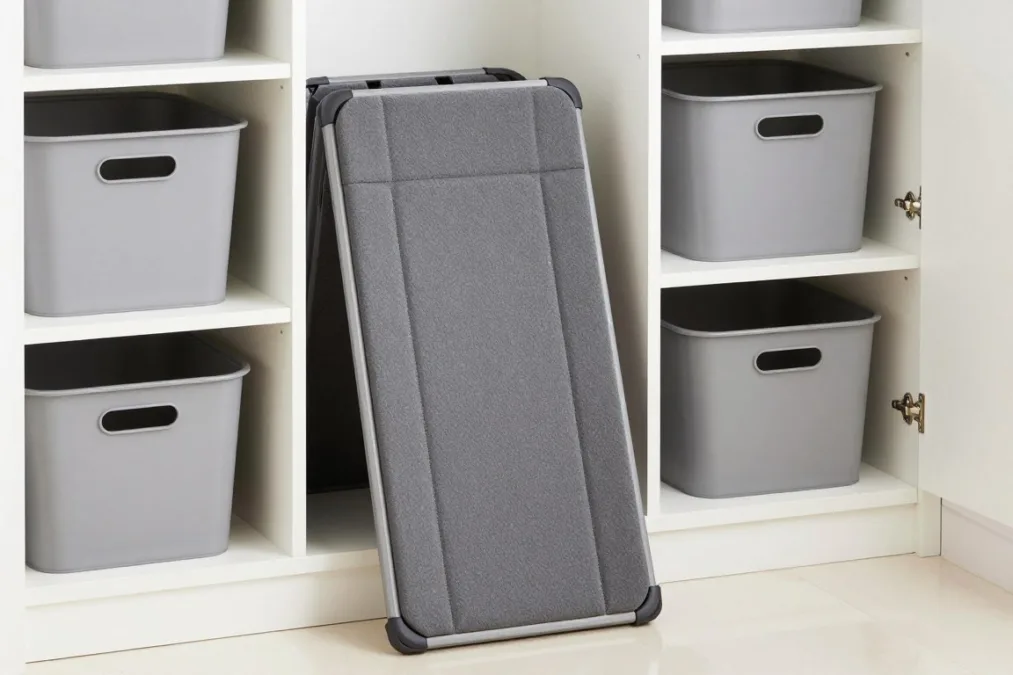
With folded dimensions of 32.5 by 21.5 by 5.4 inches, the unit fits into narrow wardrobe gaps or under elevated sofa frames. The operating speed range spans 0.5 to 3.7 mph, providing steady pacing for light to brisk desk walking, while the structural frame supports a manufacturer weight limit of 220 pounds.
Marketing documentation highlights noise production below 50 decibels. Independent acoustic measurements show the brushless motor runs around 48 decibels unloaded, but active heel strikes raise ambient room noise to between 53 and 58 decibels on hard subfloors.
Advantages
- Patented center fold shortens storage profile dramatically.
- Brushless drive motor maintains smooth operation at low walking speeds.
- Lightweight composite construction aids manual relocation via front wheels.
Limitations
- Absence of on-deck digital display requires looking at remote or mobile screen.
- The 220-pound weight ceiling excludes heavier household members.
- Hinge joint can feel slightly noticeable under thin-soled athletic shoes.
Kingsmith WalkingPad C2 Mini Walk
The WalkingPad C2 introduces a vibrant outer housing over the familiar double-fold architecture, appealing to modern living rooms and open desk layouts. The integrated foot-sensing technology automatically shifts belt acceleration according to whether foot placement lands near the front, middle, or rear of the walking belt.
Storage dimensions measure 32.5 by 20.4 by 5.4 inches when folded, matching a slender profile that slots beneath standard platform bed frames. The machine delivers speeds between 0.5 and 3.7 mph under a 220-pound manufacturer weight limit, maintaining consistency with its compact hardware bracket.
Manufacturer promotional copy labels the C2 as whisper-quiet at roughly 45 decibels. External audio evaluations show motor mechanical humming remains around 49 decibels, while cadence thumping elevates actual output to 52 through 57 decibels depending on user weight and footwear.
The primary compromise sits in the belt running width, which measures only 15.7 inches. Walking on narrow decks requires continuous spatial awareness to avoid clipping side rails, which can distract during intense typing or computer work.
Kingsmith WalkingPad A1 Pro Foldable Treadmill
Designed with a low-key matte black exterior, the Kingsmith WalkingPad A1 Pro incorporates an LED dashboard built directly into the front engine hood. This screen illuminates walking time, walking distance, step count, and current speed without requiring phone connectivity.
When folded shut, the A1 Pro measures 32.5 by 21.5 by 5.0 inches, achieving an exceptionally slim five-inch vertical height that slides under low-slung credenzas. It maintains a top walking speed of 3.7 mph from a baseline of 0.5 mph, paired with a slightly upgraded 230-pound manufacturer weight capacity.
Promotional literature asserts that operating sound remains under 50 decibels during typical use. Independent evaluations verify quiet motor operation at 51 decibels without load, though typical walking cadence pushes sound levels between 54 and 58 decibels across common apartment subfloors.
Advantages
- Integrated LED hood display provides immediate metric feedback.
- Ultra-thin 5.0-inch folded profile slides under tight horizontal furniture clearances.
- Quiet brushless motor reduces high-pitched electrical whine in shared rooms.
Limitations
- Belt tension requires frequent realignment after repeated folding cycles.
- Maximum 3.7 mph limit prevents brisk jogging or interval training.
- Moderate 230-pound load capacity limits broad multi-user applications.
Kingsmith WalkingPad R2 2-in-1 Folding Pad
The Kingsmith WalkingPad R2 bridges the gap between dedicated desk walking pads and traditional running platforms by adding an integrated, fold-down aluminum handrail. Users can walk with the bar folded down flat or raise the bar to engage higher belt velocity settings.
The folding mechanism collapses the unit to 39.4 by 28.3 by 6.3 inches, allowing it to stand vertically against a wall on its built-in stabilization foot. Operational velocities span from 0.5 mph up to 7.5 mph, supported by a 240-pound manufacturer weight threshold.
Retail listings cite operation below 60 decibels. Third-party testing records 54 decibels at low walking speeds, but foot impacts at speeds between 5.0 and 7.5 mph create resonance spikes reaching 62 to 67 decibels, which requires dense floor underlayment in upper-floor apartments.
Because the unit incorporates a structural upright handrail, it weighs noticeably more than desk-only pads. Moving its 80-pound mass between rooms requires maneuvering via front transport casters, which can mark softer wood or vinyl plank flooring.
UREVO Strol 2E Under Desk Treadmill
The UREVO Strol 2E trades folding hinges for a unibody steel frame that eliminates deck seams underfoot. The continuous running surface delivers greater structural stability across varying foot strikes without joint flex.
Because the main deck does not fold, its overall footprint stays constant at 49.6 by 20.9 by 4.9 inches, requiring unobstructed horizontal clearance under a bed or behind a living room sofa. The motor supports a speed range of 0.6 to 4.0 mph and accommodates a higher manufacturer weight rating of 265 pounds.
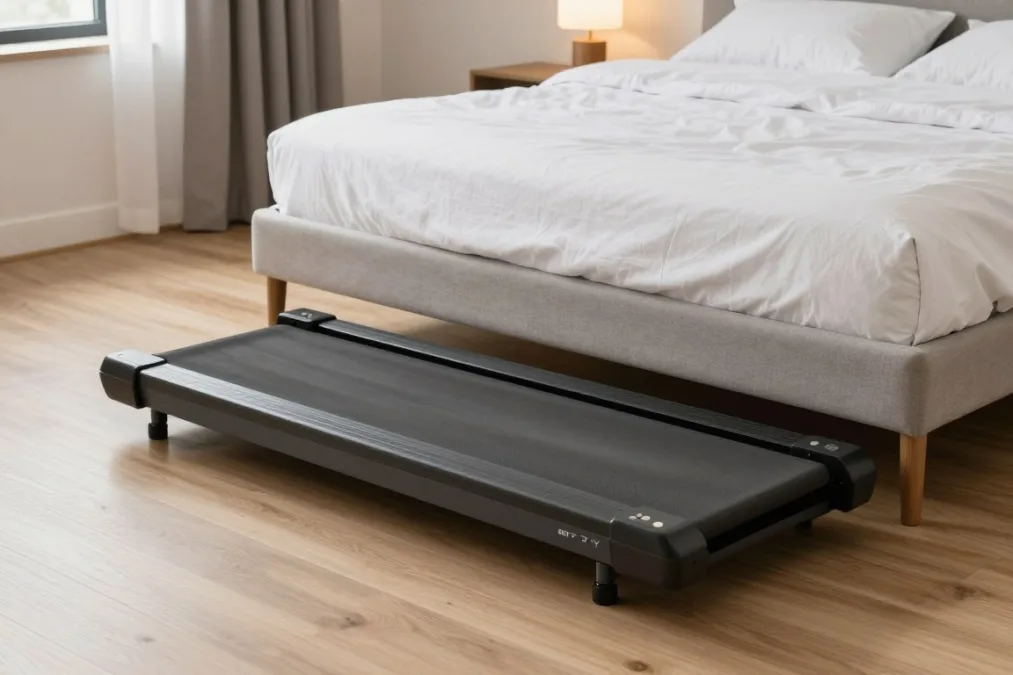
Advertising materials emphasize ultra-quiet performance under 45 decibels. Measured sound output shows the unit running between 54 and 59 decibels during active 3.0 mph walking routines, primarily driven by belt friction and repetitive shoe contact rather than motor humming.
Advantages
- Solid-deck construction prevents hinge sagging and center-seam unevenness.
- Higher 265-pound weight ceiling accommodates broader household requirements.
- Low 4.9-inch profile rolls easily under standard bed risers.
Limitations
- Full 49.6-inch length cannot collapse for compact closet corners.
- Lacks vertical standing kickstands, requiring flat floor storage.
- Speed adjustment increments produce noticeable audible beeps.
UREVO Strol 3S Incline Walking Pad
The UREVO Strol 3S differentiates itself in the compact fitness space by integrating automated electric incline into a low-profile platform. Adding slope variation increases cardiovascular workload and muscle engagement without demanding elevated speed settings.
This model features a non-folding frame measuring 50.8 by 21.3 by 5.5 inches, demanding dedicated horizontal floor space when stored away. The machine delivers walking velocities from 0.6 to 4.0 mph alongside an incline adjustment up to 9 levels, backed by a 265-pound manufacturer load rating.
While retailer descriptions claim quiet operation under 45 decibels, motorized incline gear activation combined with vigorous uphill stepping registers between 55 and 60 decibels during independent evaluation. Elevating the front deck also magnifies heel pressure through the floor.
The internal incline motors add chassis bulk, bringing overall equipment weight near 60 pounds. Lifting the rear end to engage the front transport wheels demands moderate physical effort inside tight apartment quarters.
Sperax Walking Pad Under Desk Treadmill
The Sperax Walking Pad is engineered around a reinforced suspension system and a multi-layer elastomeric belt intended to disperse heel shock. Its robust undercarriage makes it a common selection for apartments prioritizing higher payload allowances.
Its rigid frame measures 48.0 by 20.0 by 4.5 inches, presenting a very slim vertical profile that slides effortlessly beneath couches or desks. The running mechanism accommodates a speed range of 0.6 to 3.8 mph while providing an impressive manufacturer weight limit of 320 pounds.
Advantages
- Category-leading 320-pound weight rating provides substantial structural margins.
- Slim 4.5-inch vertical deck fits into exceptionally low clearance spaces.
- Textured running belt offers dependable grip for various shoe outsoles.
Limitations
- Non-folding design requires four feet of straight linear storage space.
- Front display resets workout metrics immediately when paused.
- Basic remote sensor requires direct line-of-sight toward the front bumper.
Sales promotions routinely state operational noise levels under 50 decibels. Independent sound captures demonstrate the drive belt and motor create 56 to 61 decibels under standard user load, largely governed by floor acoustics and room furnishings.
Goyouth Electric Under Desk Walking Pad
The Goyouth Electric Walking Pad incorporates an integrated digital console and Bluetooth audio capability into a durable, unibody transport frame. It serves dual functions as a slow workstation companion or an active cardio tool for brisk indoor walking sessions.
The non-folding chassis spans 50.0 by 21.0 by 5.5 inches, demanding an open storage track under furniture or upright propping against secure walls. The drive system spans a broad speed range of 0.5 to 6.0 mph, supported by a 220-pound manufacturer weight limit.
Marketing statements highlight whisper-level motor dynamics. Independent sound tests establish that while the motor hums softly around 52 decibels at 1.0 mph, belt rotation and energetic strides at 5.0 to 6.0 mph produce sound ranges of 61 to 65 decibels, creating significant downstairs vibration without an isolation mat.
The machine includes multi-color LED dashboard readouts that clearly display speed, workout duration, distance, and estimated calorie burn. However, the relatively narrow belt width of 15.75 inches requires steady focus at velocities exceeding 4.0 mph.
DeerRun Smart Walking Pad
The DeerRun Smart Walking Pad targets technology-integrated home offices with direct mobile synchronization via fitness tracking applications. The companion software logs movement telemetry, adjusts motor parameters, and schedules walking targets without requiring external hardware modules.
Constructed as a solid, flat-profile board, its exterior measures 47.6 by 19.8 by 4.7 inches, allowing straightforward storage along empty hallway baseboards or under bed skirts. The speed range spans 0.6 to 3.8 mph under a manufacturer-rated weight threshold of 265 pounds.
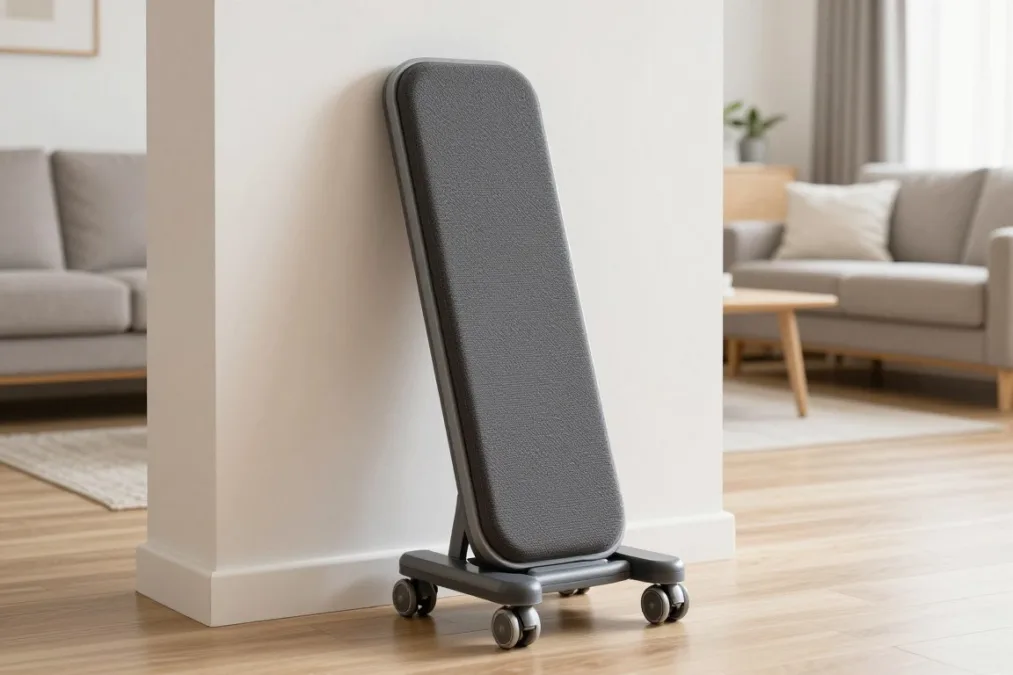
Brand documentation asserts quiet performance below 50 decibels. Independent assessments observe acoustic emissions reaching 53 to 58 decibels during steady office walking, which remains unobtrusive during standard virtual conference calls when using directional microphones.
Advantages
- Integrated mobile application syncs workout statistics automatically.
- Compact 47.6-inch overall footprint simplifies tight hallway handling.
- Dependable 265-pound weight support covers diverse household users.
Limitations
- Non-folding deck cannot be condensed into smaller closet cubbies.
- Remote control receiver exhibits occasional latency during rapid speed shifts.
- Plastic front bumper scratches easily on abrasive baseboard paint.
Egofit Walker Pro Under Desk Treadmill
The Egofit Walker Pro represents the shortest functional walking platform currently manufactured, designed explicitly for tight cubicles and micro-apartments. By condensing the overall frame length down to under 38 inches, it eliminates excess deck overhang.
With fixed dimensions of 37.8 by 21.2 by 6.9 inches, the unit fits into small spaces where full-length boards cannot clear room furniture. The integrated motor offers a speed range of 0.6 to 3.1 mph with an engineered fixed 5 percent incline, supporting user weights up to 242 pounds.
Manufacturer claims designate the sound output below 50 decibels. Verified sound metering records motor output near 50 decibels, while total walking output hovers between 55 and 58 decibels due to rhythmic foot contact across the short deck structure.
The truncated deck length of roughly 34 inches requires a shorter walking stride. Tall walkers or individuals accustomed to long running gates may find their heels catching the rear roller curve if stride cadence drifts backward.
Motor Noise Versus Footfall Transmission in Small Apartments
Apartment sound concerns split into airborne acoustic decibels and structural vibration transmission. Marketing claims routinely measure airborne motor sound in an empty testing booth without an active walker aboard, omitting the primary source of neighbor complaints.
When a human walks on a motorized belt, repetitive heel strikes send low-frequency acoustic vibrations directly through the floorboards. In wood-frame apartment buildings, this mechanical energy resonates through subfloors and ceiling drywall below, creating a thumping noise even when motor decibel outputs remain low.
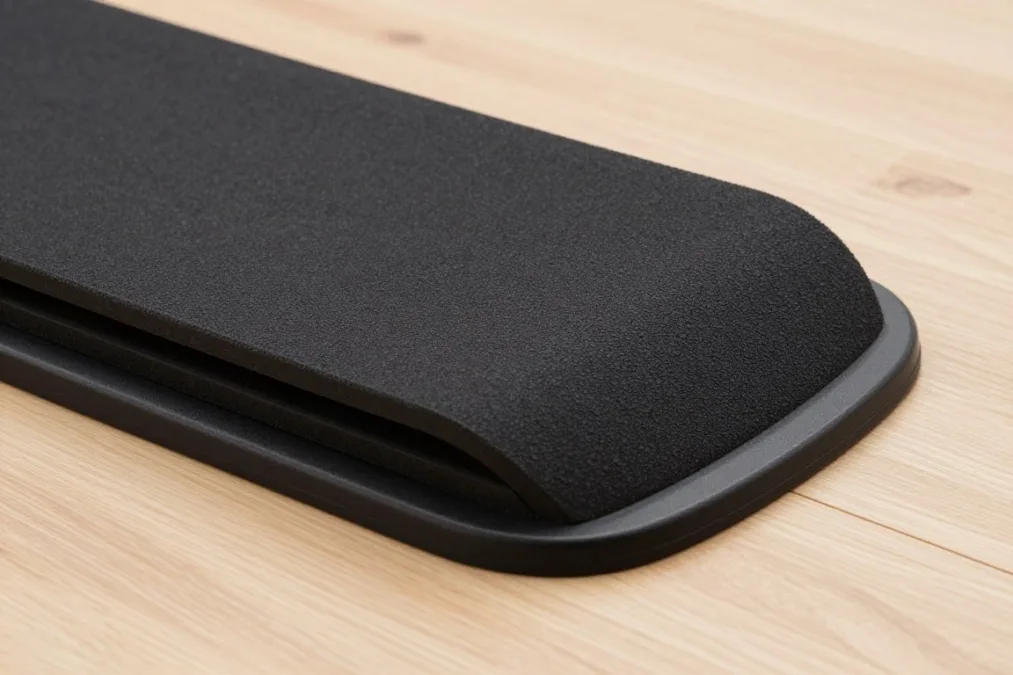
- Airborne noise stems from high-speed electric motor rotation, internal drive belts, and deck friction.
- Impact vibration originates from user bodyweight and cadence strikes against the deck suspension plate.
- Hardwood, vinyl, and tile flooring amplify impact noise by reflecting vibrational waves downward.
- High-density rubber equipment mats isolate mechanical shock and reduce lower-level ceiling resonance.
- Walking in cushioned athletic shoes dampens heel impact compared to hard-soled training footwear or bare feet.
Folding Decks Versus Flat Slide-Under Storage
Space-saving engineering divides into two mechanical categories: hinged folding decks and rigid low-clearance planks. Determining which configuration functions best in an apartment relies on whether horizontal floor cavities or vertical vertical closet corners represent the available storage space.
Hinged double-fold designs condense machine footprint length by roughly fifty percent, allowing storage inside compact closets or beside modular bookcases. Solid flat planks eliminate the structural joint in exchange for greater chassis stiffness and lower overall deck height, enabling smooth horizontal placement beneath furniture.
- Halves overall longitudinal length for upright closet placement.
- Requires secondary unfolding and latching sequence before each walk.
- Increases total vertical thickness to five or six inches when folded.
- Hinge seam requires periodic belt centering and tension checks.
Hinged Folding Systems
- Eliminates deck joints for consistent underfoot walking feel.
- Maintains exceptionally low vertical clearance around four inches.
- Demands four or more feet of unobstructed horizontal storage space.
- Heavier straight pull required when sliding out from under deep beds.
Solid Unibody Planks
Frequently Asked Questions
Will downstairs neighbors hear a walking pad through the floor?
Downstairs neighbors frequently hear the rhythmic structural thumping caused by heel impacts rather than electric motor humming. Placing a dense, high-density rubber equipment mat underneath the walking pad absorbs mechanical vibrations before they transfer into floor joists. Walking in cushioned footwear further dampens cadence shocks.
Can a walking pad be stored vertically against a wall?
Vertical storage depends strictly on whether the specific model includes manufacturer-approved kickstands or fold-out stabilizing feet. Models like the WalkingPad R2 stand vertically on designed supports, whereas rounded flat planks must lay horizontally to prevent tipping hazards and internal oil migration.
How do manufacturer noise ratings differ from real-world sound levels?
Manufacturers record decibel ratings using an unloaded machine operating in an acoustic laboratory chamber, capturing only faint motor hums. Real-world sound levels introduce shoe impact, belt friction, and floor resonance, which consistently registers five to ten decibels higher than promotional literature claims.
What is the minimum clearance needed under a bed or couch?
Most flat under-desk walking pads require between five and six inches of vertical clearance to pass beneath bed skirts and sofa frames smoothly. Measuring the lowest horizontal rail of the furniture frame confirms whether the motor casing and deck wheels can slide in without scratching finishes.
How often does an apartment walking pad require lubrication?
Lubrication frequency depends on weekly walking mileage, ambient apartment dust levels, and manufacturer specifications stated on the product label. Inspecting belt dryness periodically and applying pure silicone oil prevents excess friction that overheats compact drive motors.
Are walking pads suitable for running or high-speed workouts?
Most basic walking pads feature maximum speeds between 3.7 and 4.0 mph, making them suitable strictly for brisk walking workouts. Hybrid units equipped with sturdy fold-up safety handrails reach higher speeds, though elevated velocities generate significant noise and floor vibration in apartment buildings.
Summary of Apartment Walking Pad Selection
Selecting the ideal walking pad for apartment living requires balancing available storage geometry against structural noise mitigation. Verifying real-world decibel measurements, folded physical dimensions, and true manufacturer weight capacities prevents spatial clutter and neighbor disruptions. Pair the chosen machine with a dense shock-absorbing mat to maintain peace and daily fitness within compact residential quarters.

Priyanka Pandey
Senior Research Editor · Top10Sense
Priyanka specializes in tech, consumer products, and digital trends. She combines hands-on testing, vendor interviews, and database research to create trustworthy “Top 10” rankings. Her work has been referenced by industry blogs and brand report pages.