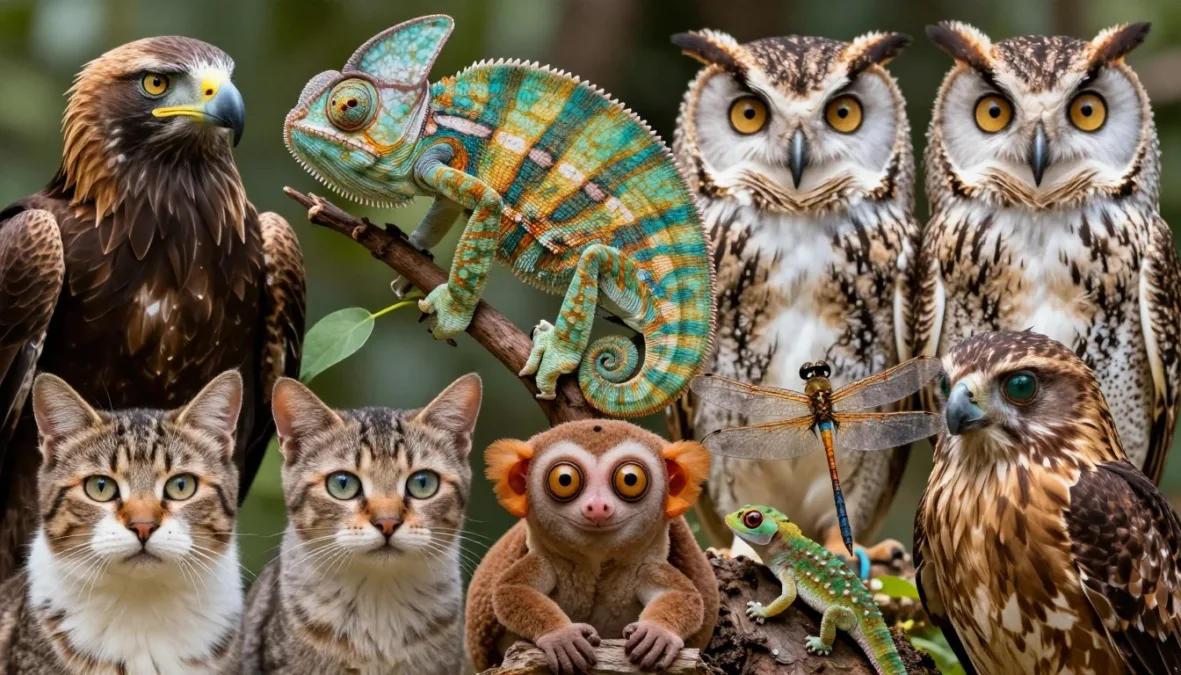
The animal kingdom contains creatures with visual abilities that make human eyesight look primitive. While humans pride themselves on sophisticated vision, many animals possess eyes that detect ultraviolet light, see clearly miles away, or perceive millions more colors than we ever could.
Evolution has shaped vision in remarkable ways across different species. Some animals developed eyes to hunt prey in complete darkness. Others evolved to spot predators from incredible distances.
This comprehensive guide ranks the top ten animals whose eyesight surpasses nearly everything else in nature. You’ll discover how these creatures use their extraordinary vision to survive and thrive in diverse environments.
Understanding Vision in the Animal Kingdom
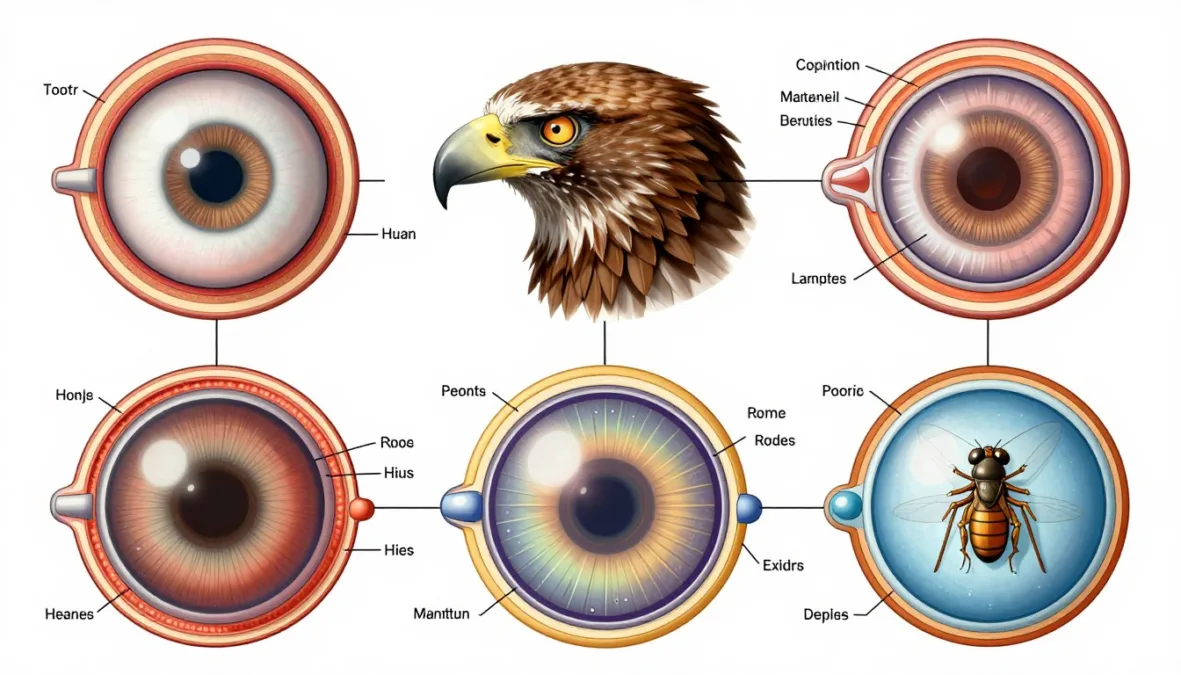
Vision varies dramatically across species based on evolutionary needs. The eyes of different animals evolved to solve specific survival challenges in their environments.
Most animals rely on photoreceptors to detect light. These specialized cells convert light into electrical signals that the brain interprets as images.
How Photoreceptors Work
Photoreceptors come in two main types. Rods detect light intensity and work well in dim conditions. Cones perceive color and function best in bright light.
Humans have three types of cones that detect red, green, and blue light. Many animals possess additional photoreceptor types that expand their visual spectrum beyond what humans can see.
The mantis shrimp, for example, has sixteen types of photoreceptors. This gives them access to colors humans cannot even imagine.
Field of Vision Matters
Field vision determines how much of the surroundings an animal can see without moving its eyes or head. Prey animals typically have wide fields of vision to detect predators approaching from any direction.
Predators often sacrifice field width for better depth perception. Forward-facing eyes create overlapping visual fields that help judge distances accurately when hunting.
Some animals achieve nearly complete surroundings awareness. Others focus their visual power in a narrow field to spot tiny details at great distances.
Visual Adaptations for Survival
Animals developed various eye adaptations based on their ecological niche. Nocturnal creatures evolved large pupils and a reflective layer called the tapetum lucidum that bounces light back through the retina.
Aquatic animals face different challenges. Water absorbs light differently than air, requiring special adaptations for underwater vision.
1. Mantis Shrimp: The Ultimate Color Vision Champion
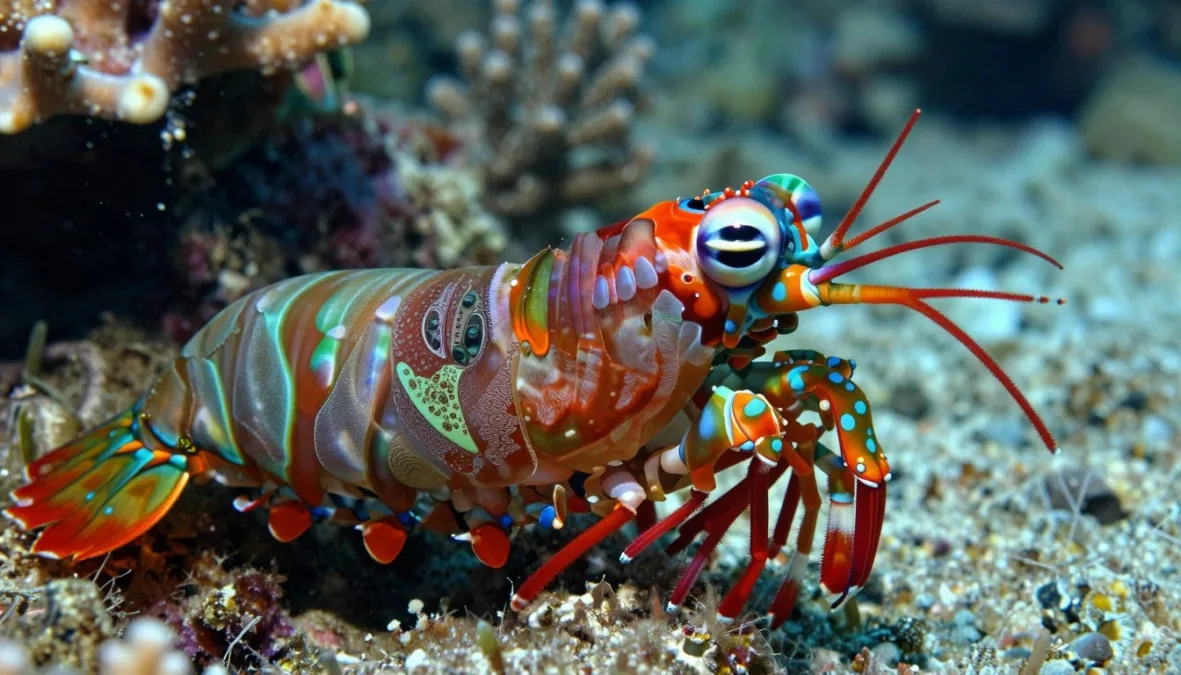
The mantis shrimp possesses the most complex vision system known in the animal kingdom. These marine creatures have sixteen types of photoreceptors compared to just three in humans.
This extraordinary creature can see ultraviolet light, visible light, and polarized light simultaneously. Each eye moves independently, processing visual information separately before combining it in the brain.
Unmatched Color Detection
Mantis shrimp eyes detect colors across a spectrum humans cannot comprehend. They perceive wavelengths from deep ultraviolet through the visible spectrum into infrared.
These shrimp see at least twelve different color channels. Humans see only three primary colors that mix to create all other shades we perceive.
Scientists believe mantis shrimp use their incredible color vision to identify prey, recognize other mantis shrimp, and navigate complex coral reef environments. The sheer number of colors they distinguish gives them advantages in their underwater world.
Trinocular Vision in Each Eye
Each mantis shrimp eye has three separate regions that process images independently. This creates trinocular vision within a single eye, allowing depth perception without needing to use both eyes together.
The middle band of the eye contains most of the specialized photoreceptors. This region scans objects by moving the eye rather than moving the head.
Fascinating Fact: Mantis shrimp can move each eye independently in different directions while maintaining perfect depth perception with each individual eye. No other animal on Earth has this capability.
Polarized Light Detection
Mantis shrimp detect both linear and circular polarized light. This ability helps them see through the camouflage of prey animals and spot transparent creatures in water.
Polarized vision also helps these creatures communicate. Their bodies reflect polarized light patterns that other mantis shrimp can see but predators cannot.
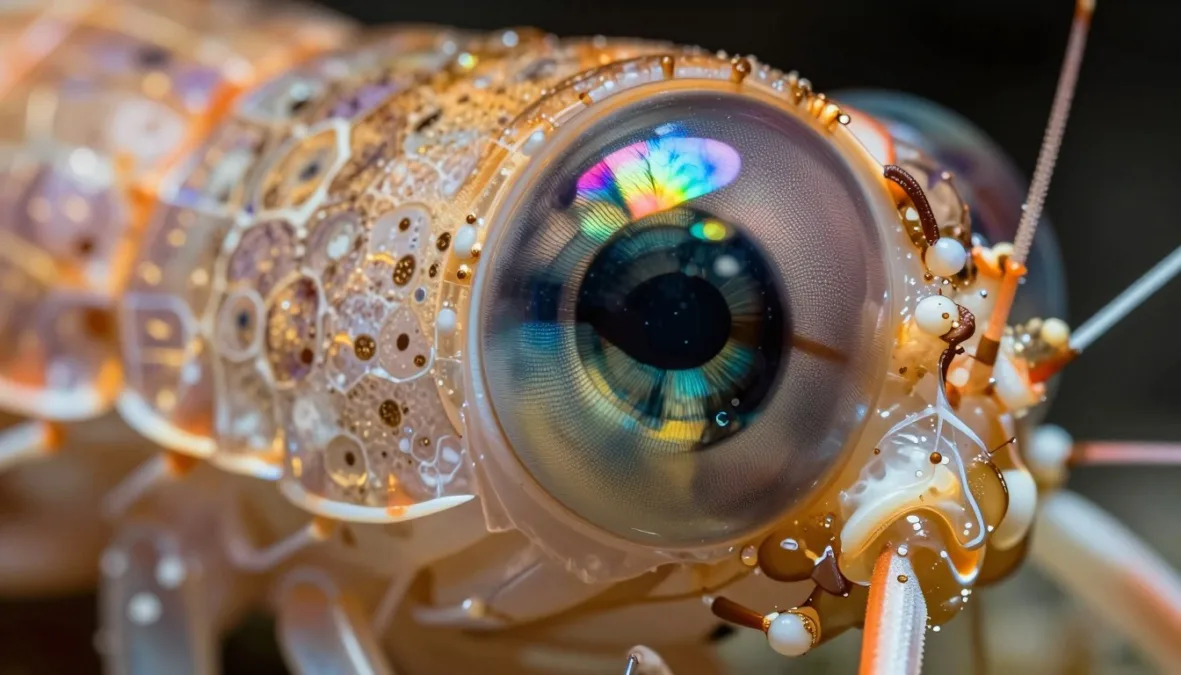
2. Eagles: Masters of Long-Distance Vision
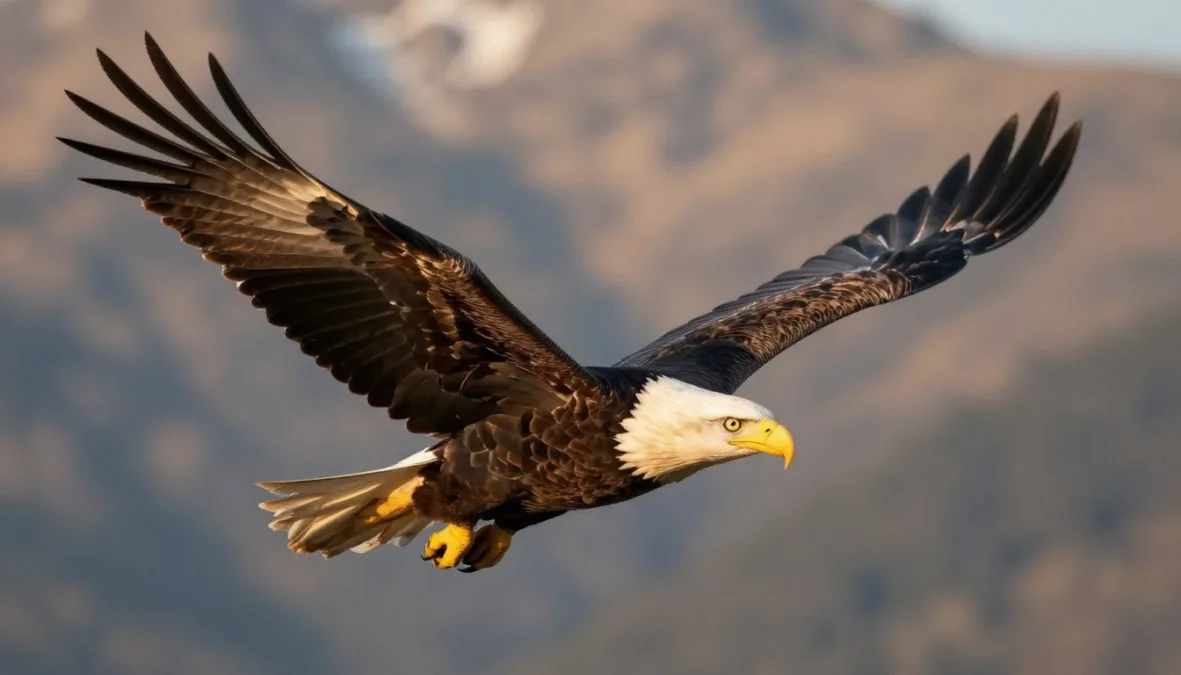
Eagles possess visual acuity that reaches four to eight times sharper than human eyesight. These magnificent birds of prey can spot a rabbit from more than two miles away.
An eagle eye contains approximately five times more light-detecting cells than human eyes. This density of photoreceptors creates remarkably sharp images even at extreme distances.
Specialized Fovea Structure
Eagles have two foveas in each eye compared to the single fovea humans possess. The fovea is the area of sharpest vision on the retina.
One fovea points forward for binocular vision while hunting. The other faces sideways, allowing eagles to scan for prey while soaring.
This dual-fovea system gives eagles both precision depth perception when diving and wide awareness when searching. They switch focus between foveas depending on what they’re doing at that moment.
How Eagles See From Miles Away
The secret to eagle long-distance vision lies in photoreceptor density. An eagle’s central fovea packs in about one million photoreceptors per square millimeter.
Humans have only about 200,000 photoreceptors in the same area. This five-fold difference means eagles resolve details that would appear as blurry shapes to human observers.
Additional Visual Advantages
- See ultraviolet light that reveals urine trails left by small mammals
- Process visual information faster than humans, seeing more frames per second
- Wider field vision covering nearly 340 degrees
- Special eyelid membrane protects eyes during high-speed dives
Hunting Precision
- Track multiple prey animals simultaneously
- Adjust focus instantly while diving at speeds over 100 mph
- Maintain visual clarity despite wind and movement
- Judge distances perfectly for talon strikes

Eagles also see a broader spectrum of colors compared to humans. They detect ultraviolet wavelengths that help them track prey trails and identify potential mates.
3. Chameleons: Independent Eye Movement Specialists
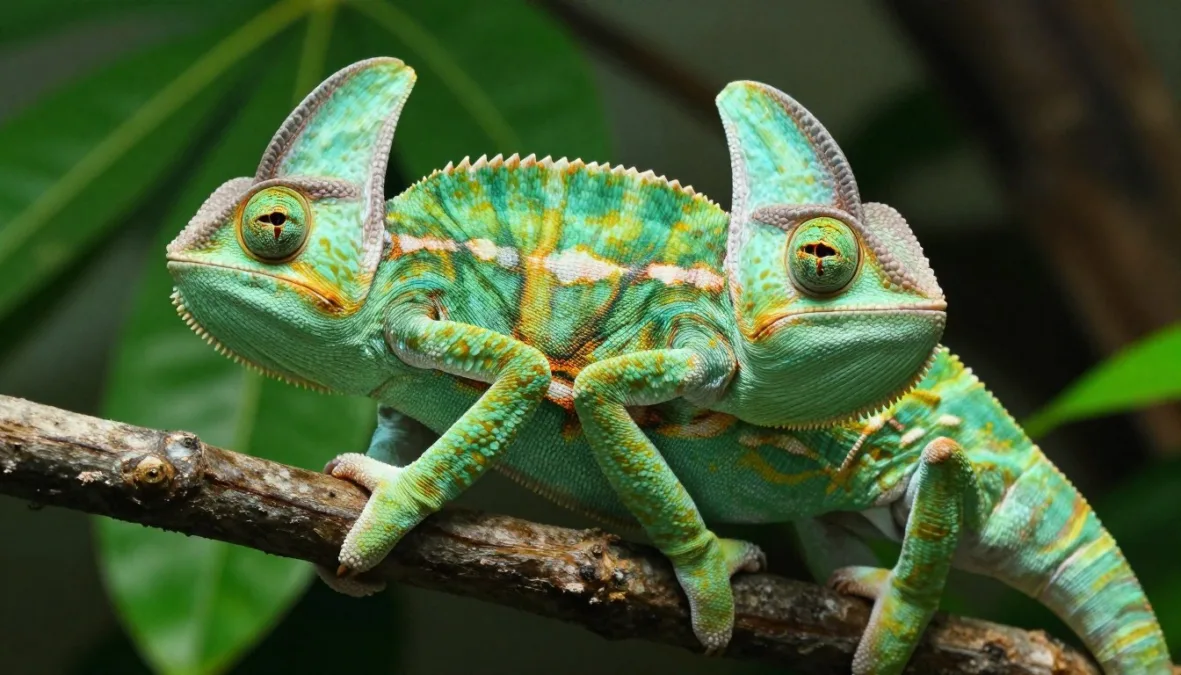
Chameleons possess perhaps the most unusual vision system among vertebrates. Each eye operates completely independently, moving and focusing on different objects simultaneously.
These reptiles achieve a combined field vision of nearly 360 degrees. One eye can watch for predators behind while the other searches for insect prey ahead.
How Independent Eyes Work
Chameleon eyes can rotate roughly 180 degrees horizontally and 90 degrees vertically. This incredible range lets them scan their entire surroundings without moving their body.
Each eye sends separate signals to the brain. The chameleon processes two completely different images at the same time without confusion.
When a chameleon spots prey, both eyes lock onto the target. This creates binocular vision for precise depth perception needed to strike with their projectile tongue.
Exceptional Visual Acuity
Chameleons can see small insects clearly from five to ten meters away. Their eyes contain a high density of cone cells that provide sharp color vision.
The lens in a chameleon eye is actually negative, unlike most vertebrate eyes. This unique structure combined with a large cornea creates a telephoto effect that magnifies distant objects.
Vision Fact: Chameleons can see ultraviolet light which helps them regulate behavior and social interactions. UV vision also helps them spot insects that reflect ultraviolet wavelengths.
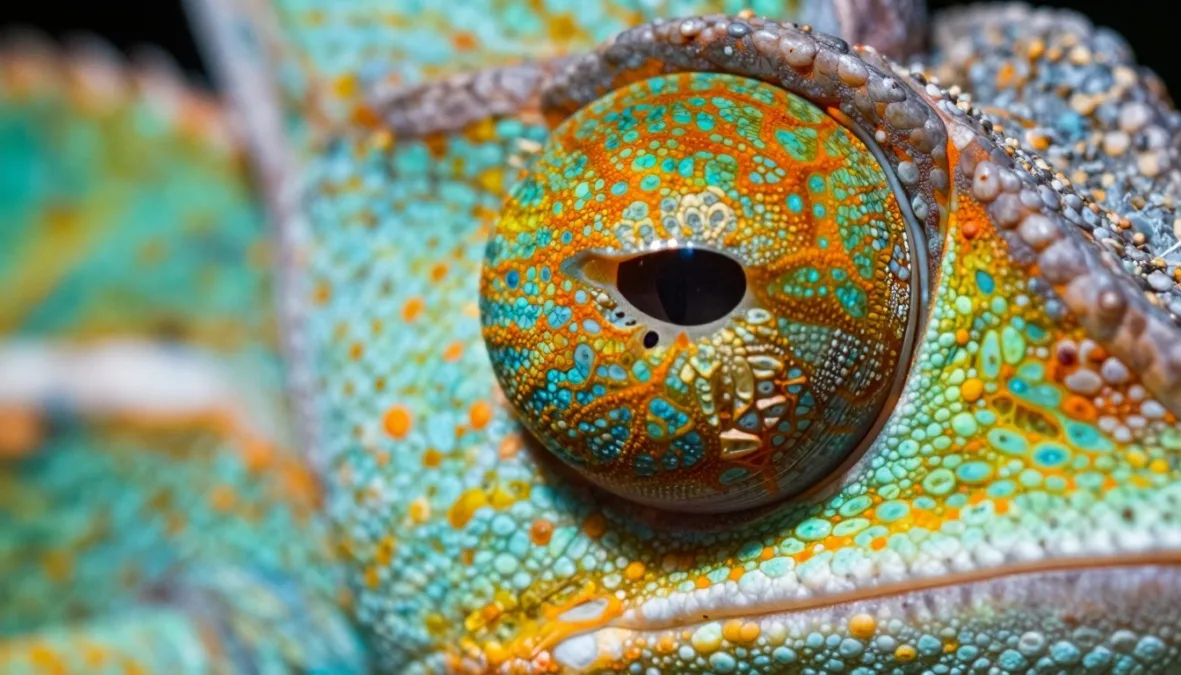
Color Perception and UV Detection
Chameleons see a rich world of colors that extends into the ultraviolet spectrum. This helps them identify ripe fruits, detect predators, and communicate with other chameleons.
Their skin patterns reflect UV light in ways invisible to most predators. Other chameleons can see these patterns clearly, using them for species recognition and social signaling.
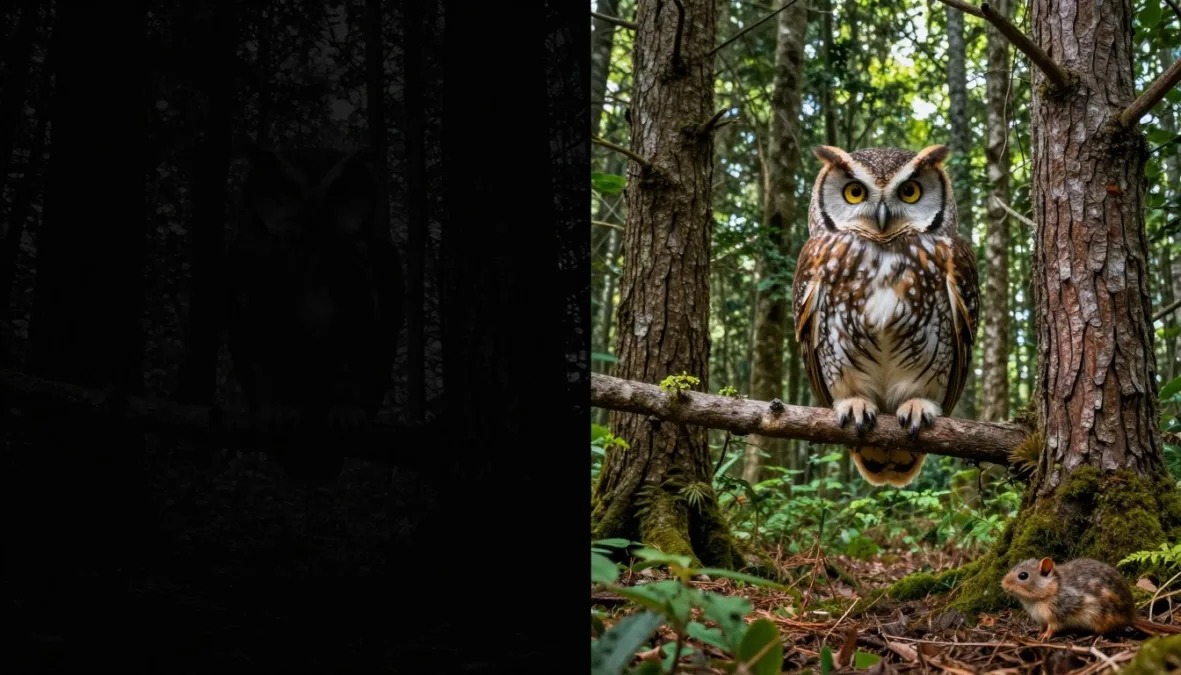
4. Owls: Night Vision Specialists
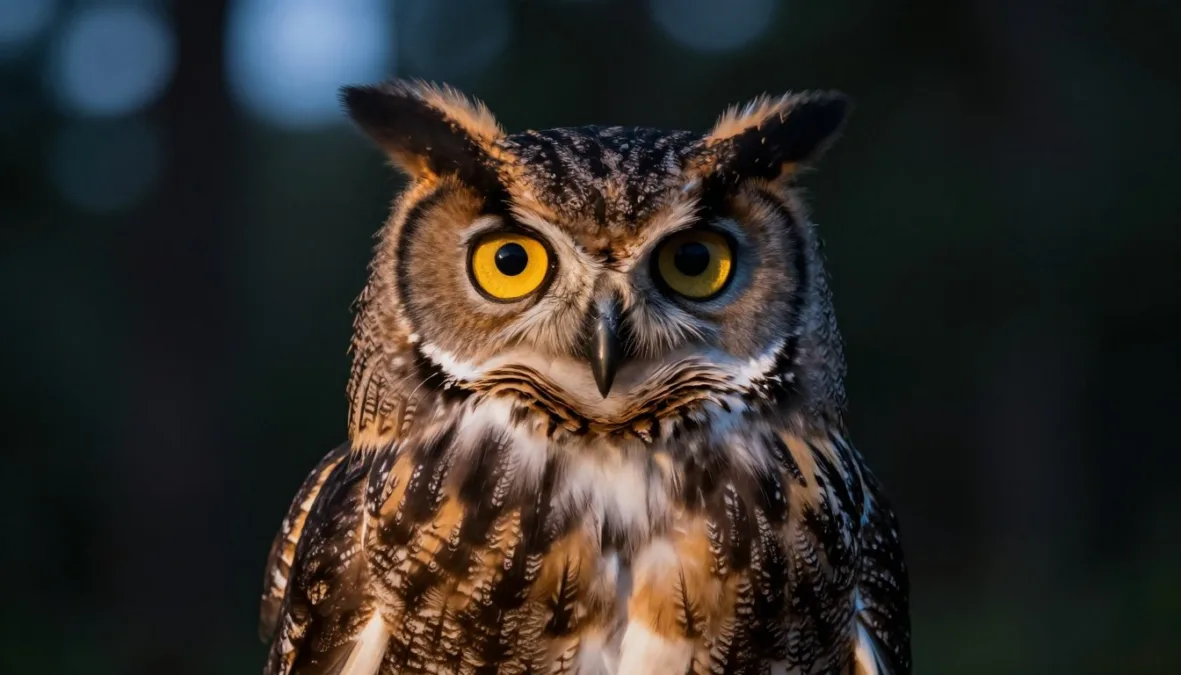
Owls dominate night vision among birds with eyes specially evolved for hunting in near darkness. Their enormous eyes collect maximum light to see clearly when other predators are blind.
An owl’s eyes are so large they cannot move within their sockets. To compensate, owls can rotate their heads up to 270 degrees to scan their surroundings.
Tubular Eye Structure
Unlike spherical eyeballs in most animals, owl eyes are elongated tubes. This shape creates a longer distance between the lens and retina, functioning like a telephoto camera lens.
The tubular structure captures more light and produces larger, sharper images. Owl eyes fill most of the skull cavity, leaving little room for anything else.
These massive eyes gather so much light that owls see clearly in conditions humans would consider pitch black. They need only a tiny fraction of the light humans require to see.
Rod-Dominated Retinas
Owl retinas contain primarily rod photoreceptors rather than cones. Rods are extremely sensitive to light but don’t detect color well.
This trade-off makes perfect sense for nocturnal hunters. Owls sacrifice color perception for the ability to detect movement and shapes in minimal light.
The density of rod cells in owl eyes exceeds that of most other animals. More rods mean more light-gathering capability in dark conditions.
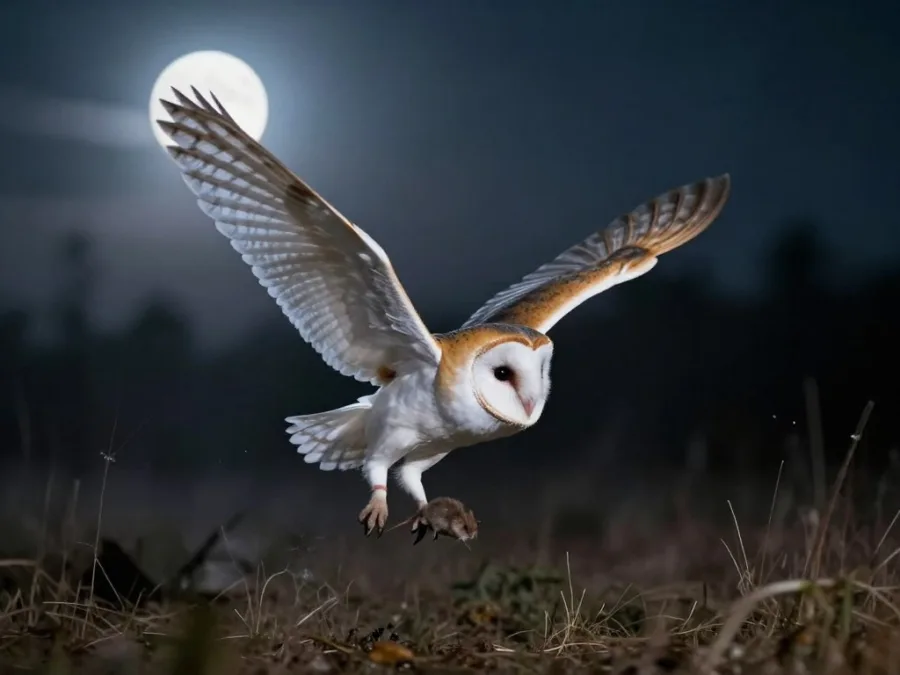
The Tapetum Lucidum Advantage
Many owls possess a reflective layer behind the retina called the tapetum lucidum. This structure reflects light back through photoreceptors, giving them a second chance to absorb photons.
The tapetum appears as eye shine when light hits owl eyes at night. Different owl species have tapetum colors ranging from yellow to red.
This reflective layer effectively doubles the light available to photoreceptors, dramatically improving vision in low-light environments.
Binocular Vision for Hunting
Forward-facing eyes give owls extensive binocular overlap in their field vision. This creates exceptional depth perception crucial for judging strike distances in darkness.
Owls can see in three dimensions better than most birds. This allows them to navigate through dense forest branches at night and strike prey with pinpoint accuracy.
5. Goats: Panoramic Vision Experts
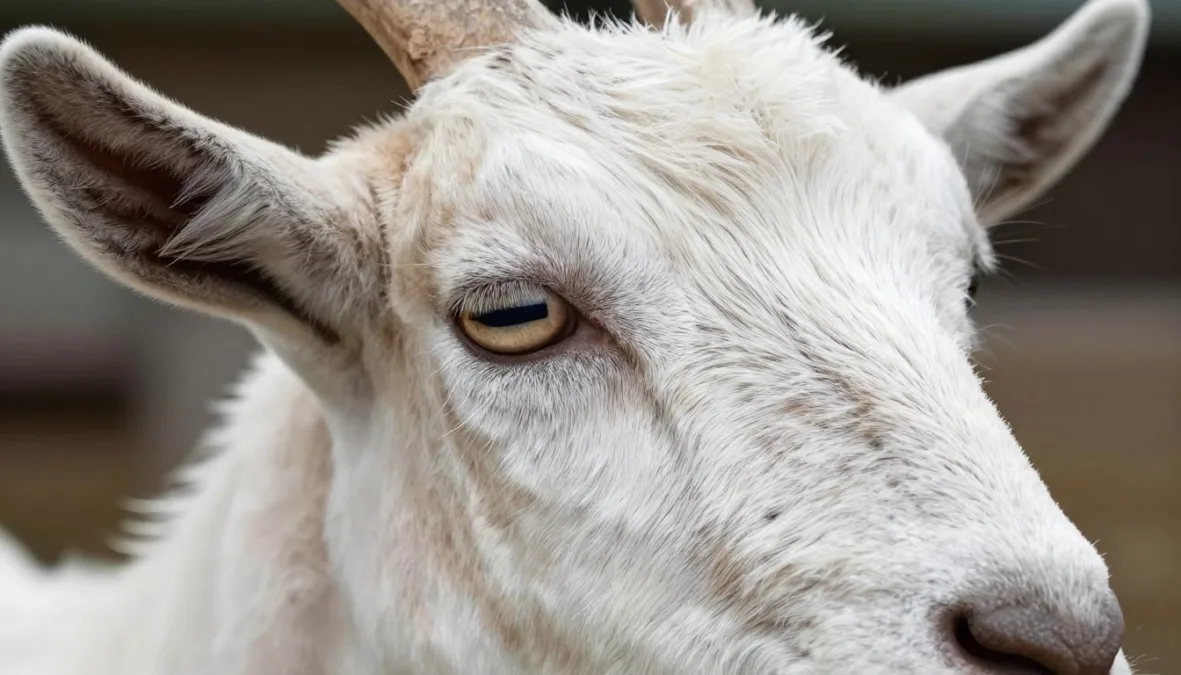
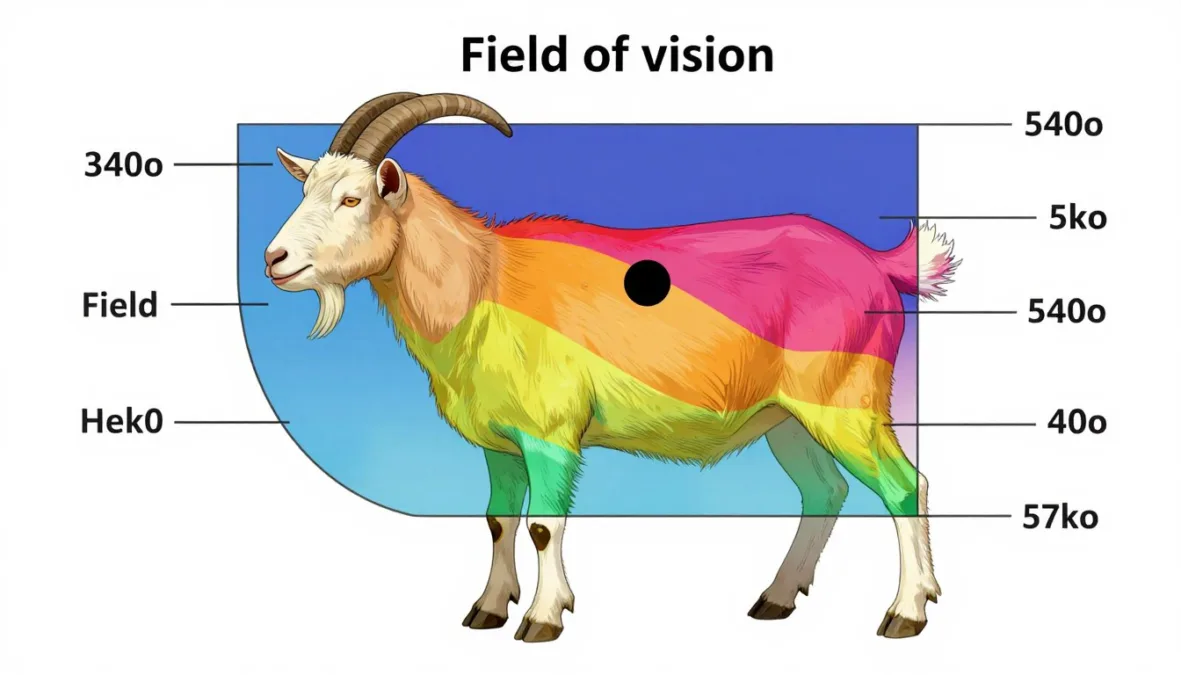
Goats possess some of the most distinctive eyes in the animal kingdom with rectangular horizontal pupils. This unusual pupil shape creates a visual field spanning 320 to 340 degrees.
Prey animals like goats evolved wide-angle vision to detect predators approaching from nearly any direction. They can see almost everything around them without turning their heads.
The Rectangular Pupil Advantage
Rectangular pupils in goats remain parallel to the ground even when they lower their head to graze. This orientation maintains a constant horizon line in their vision.
The horizontal pupil shape also controls light entry differently across the visual field. This allows goats to see clearly both in bright sunlight overhead and shadowy areas on the ground simultaneously.
When pupils dilate in dim light, the rectangular shape opens wider than circular pupils could. This gives goats better night vision than you might expect from a grazing animal.
Panoramic Awareness
Goats sacrifice depth perception for panoramic coverage. Their eyes sit on the sides of their head, creating maximum peripheral vision with minimal binocular overlap.
This wide field vision means goats have just a small blind spot directly behind them. They can monitor almost their entire surroundings for approaching predators while feeding.
Motion Detection Capability
Goats excel at detecting movement across their wide visual field. Their eyes quickly notice anything that moves, even at the edges of their peripheral vision.
This sensitivity to motion triggers an immediate alert response. Goats can react to potential threats before predators get close enough to strike.
Survival Adaptation: Goat eyes can maintain visual contact with the horizon while their head is down eating. This allows continuous predator surveillance during vulnerable feeding times.
6. Dragonflies: Compound Eye Masters
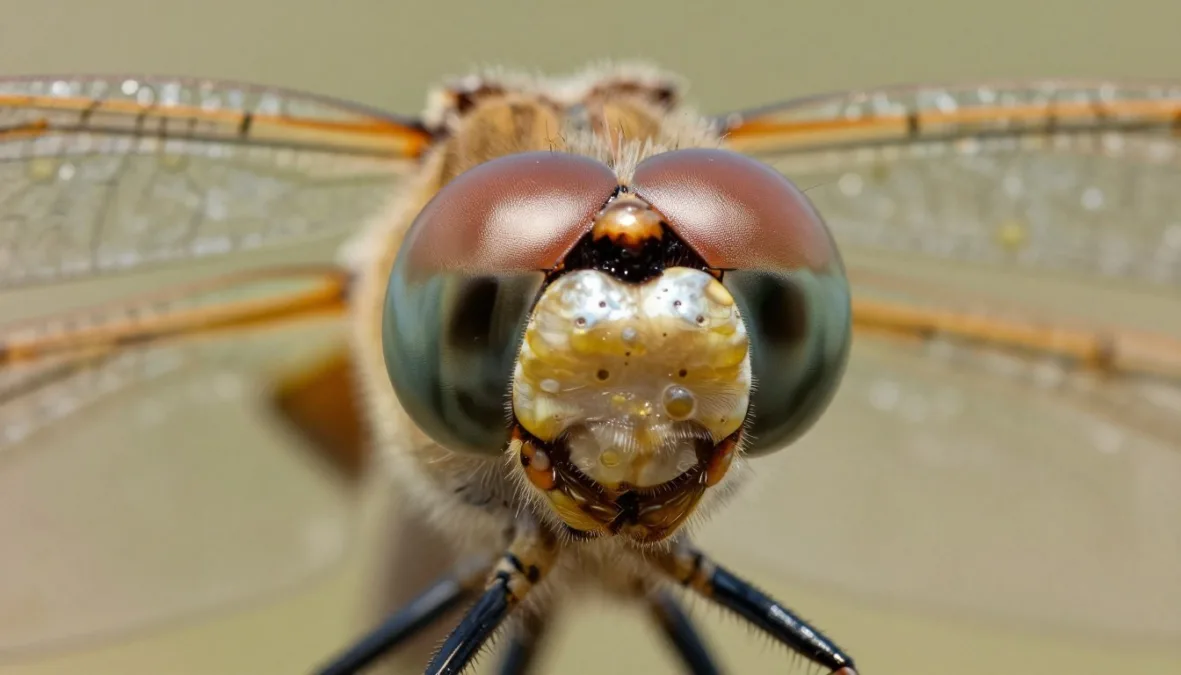
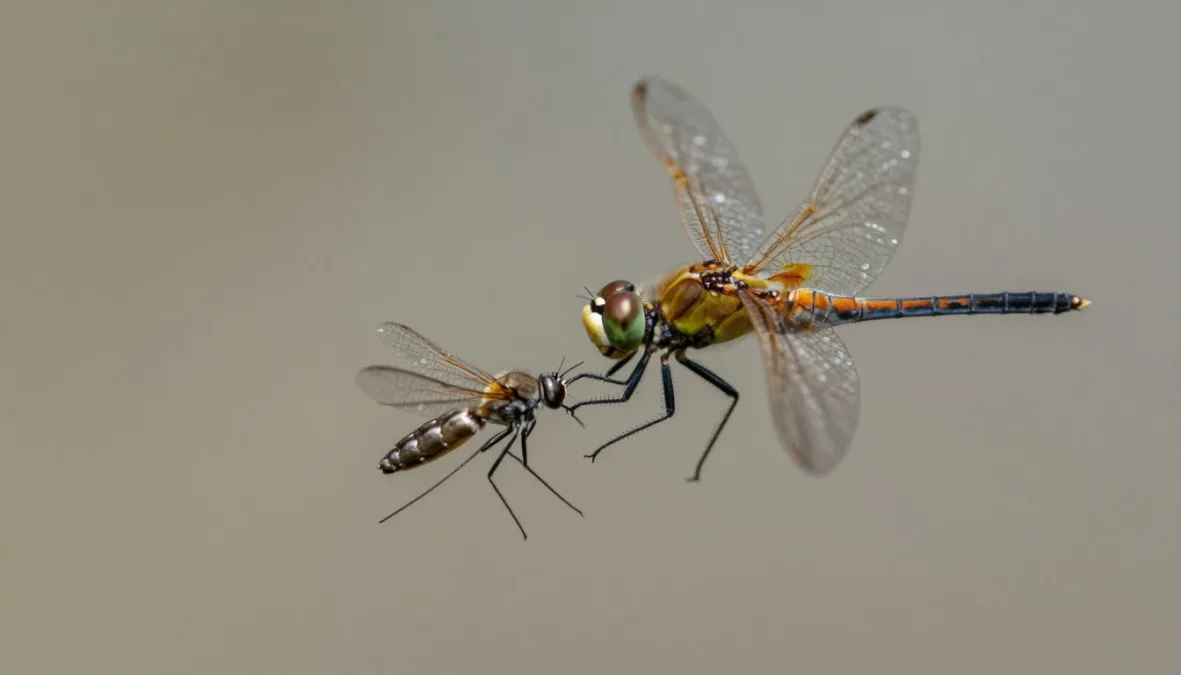
Dragonflies possess the largest compound eyes relative to body size in the insect world. These eyes contain up to 30,000 individual visual units called ommatidia.
Each ommatidium acts as a separate eye, creating a mosaic image. The dragonfly brain combines all these individual inputs into a seamless view of its surroundings.
Nearly 360-Degree Vision
Dragonfly compound eyes wrap around their head, providing almost complete spherical vision. They see forward, backward, up, and down simultaneously.
This wraparound coverage gives dragonflies awareness of everything in their environment. Prey cannot approach from any direction without being detected.
The eyes are so large they meet at the top of the head. This maximizes visual coverage and minimizes blind spots to nearly zero.
Motion Detection Excellence
Dragonflies process visual information faster than almost any other animal. They detect motion and react to it with incredible speed.
Their eyes can perceive changes in light up to 300 times per second. Humans only process about 60 changes per second, making dragonfly vision five times faster.
This rapid processing lets dragonflies track fast-moving prey, avoid obstacles during flight, and perform aerial maneuvers that seem impossible.
Hunting Advantages
- Track multiple flying insects simultaneously
- Calculate interception angles in milliseconds
- Success rate over 95 percent when hunting
- Adjust flight path mid-pursuit instantly
Visual Specialization
- Different regions of eye detect different colors
- See ultraviolet light invisible to humans
- Top eye portion optimized for detecting prey against sky
- Bottom portion specialized for seeing against ground
Color Vision and Polarization
Dragonflies see colors across a wider spectrum than humans. They detect ultraviolet wavelengths and can distinguish subtle color differences we cannot perceive.
These insects also see polarized light. This ability helps them navigate, find water sources, and detect prey that might otherwise blend into backgrounds.
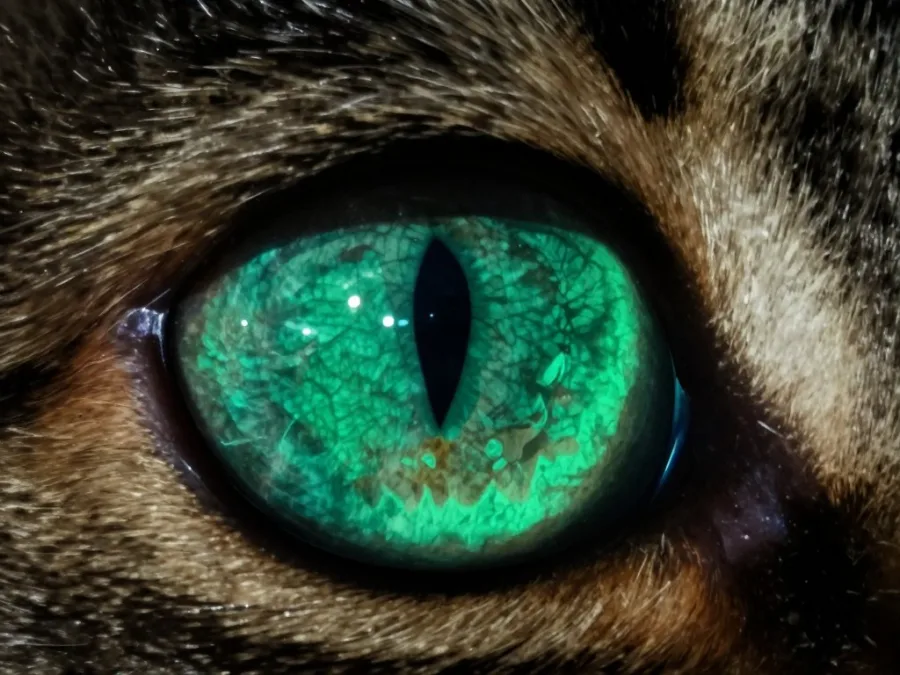
7. Cats: Supreme Low-Light Hunters
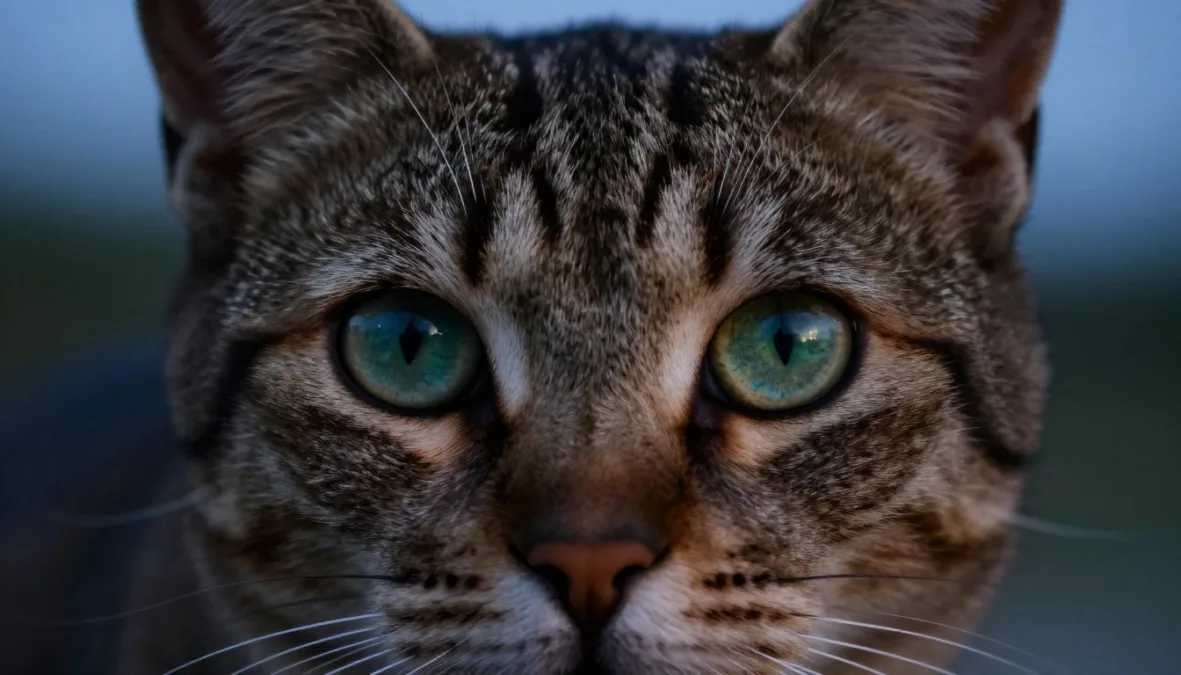
Cats possess vision perfectly adapted for hunting in dim light conditions. Their eyes gather light so efficiently that cats see clearly in just one-sixth the light humans require.
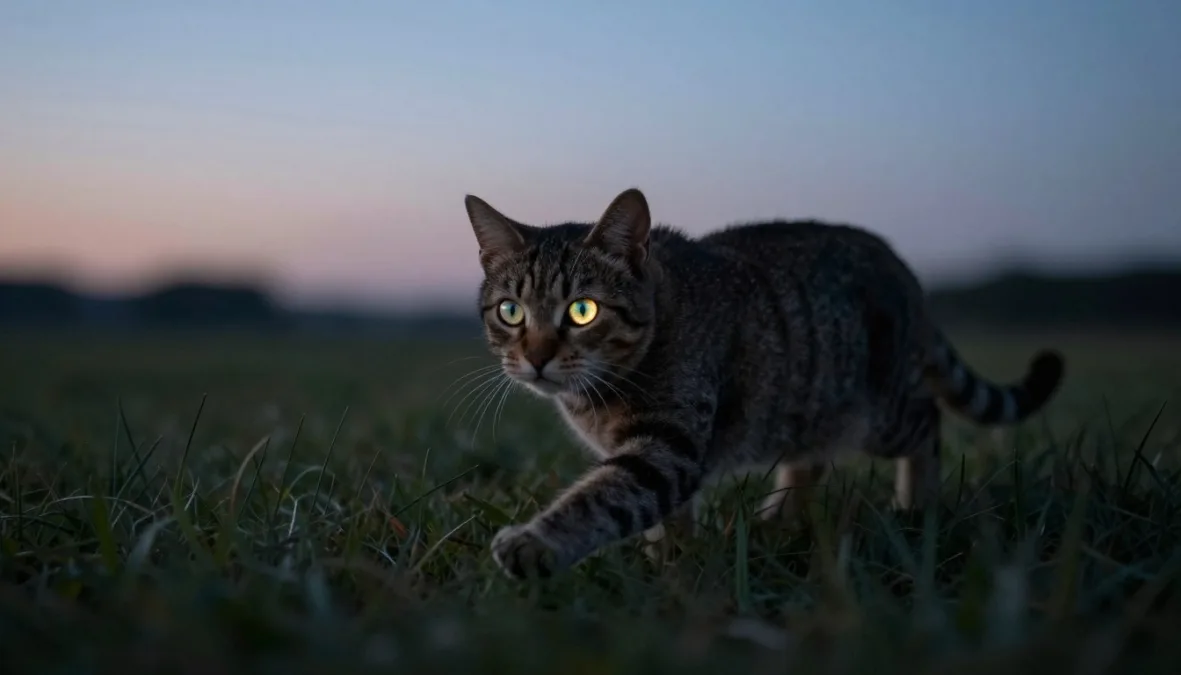
Domestic cats and their wild relatives evolved as crepuscular hunters. They’re most active during dawn and dusk when light levels are low.
The Tapetum Lucidum Effect
A specialized reflective layer called the tapetum lucidum sits behind cat retinas. This structure reflects light back through the photoreceptors for a second pass.
The tapetum essentially recycles light that would otherwise pass through the eye unused. This doubles the light available to photoreceptors, dramatically improving sensitivity.
When light hits cat eyes at night, the tapetum creates the characteristic eye shine. The reflection color varies from green to gold depending on the cat and lighting angle.
Vertical Slit Pupils
Cats have vertical slit pupils that can expand dramatically in darkness or contract to tiny slits in bright light. This gives them exceptional control over light entering the eye.
The vertical orientation provides better depth perception for ambush predators. It helps cats judge the exact distance to prey before pouncing.
Slit pupils can close more completely than round pupils. This protects sensitive photoreceptors from bright sunlight while maintaining some vision.
Rod-Rich Retinas
Cat retinas contain a much higher ratio of rods to cones compared to humans. Rods excel at detecting light and motion but don’t perceive color as well.
This rod dominance makes cats highly sensitive to movement in their peripheral vision. They instantly notice even subtle motion from potential prey.
Trade-Off: Cats sacrifice some color vision and daytime detail perception for superior night vision and motion detection. They see fewer colors than humans but detect movement much better in low light.
Field Vision and Hunting
Cats have a visual field spanning about 200 degrees with significant binocular overlap. This provides both good peripheral awareness and excellent depth perception for hunting.
The wide field helps cats monitor their surroundings for threats while focusing on prey. Forward-facing eyes create the 3D vision needed to judge pouncing distances accurately.
8. Hawks: Precision Daytime Predators
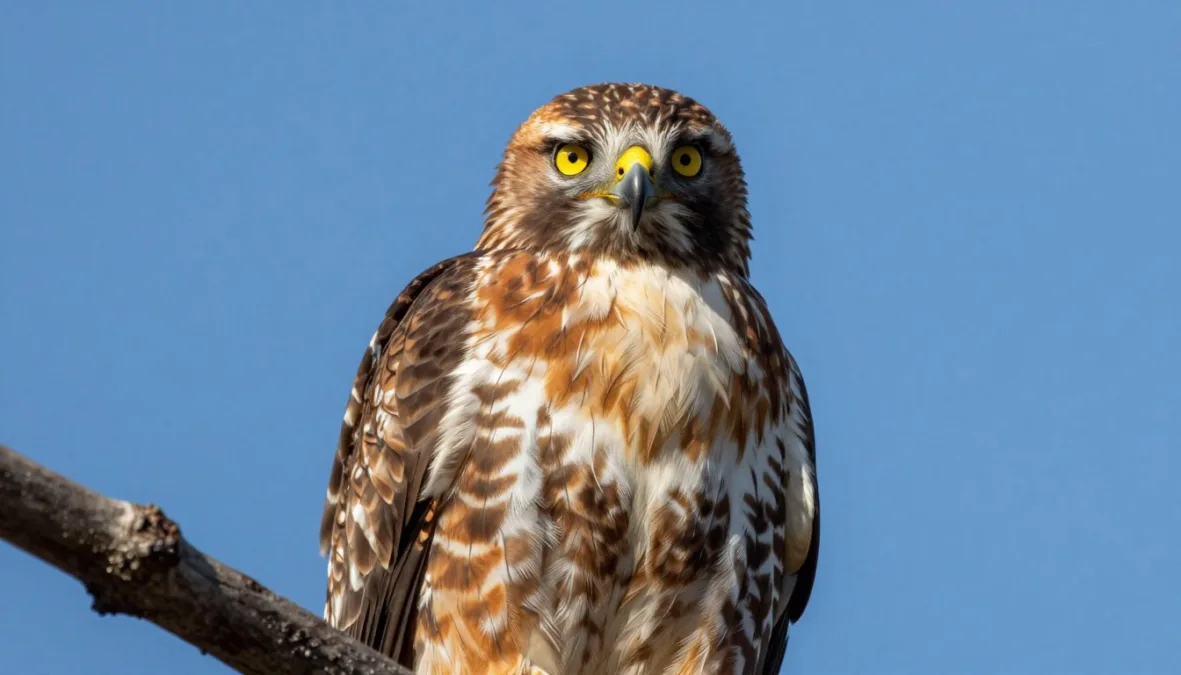
Hawks rival eagles in visual acuity with eyesight approximately eight times sharper than humans. These skilled hunters spot prey from hundreds of feet in the air.
Unlike owls that hunt at night, hawks are diurnal predators. Their eyes evolved for maximum performance in bright daylight conditions.
High-Resolution Vision
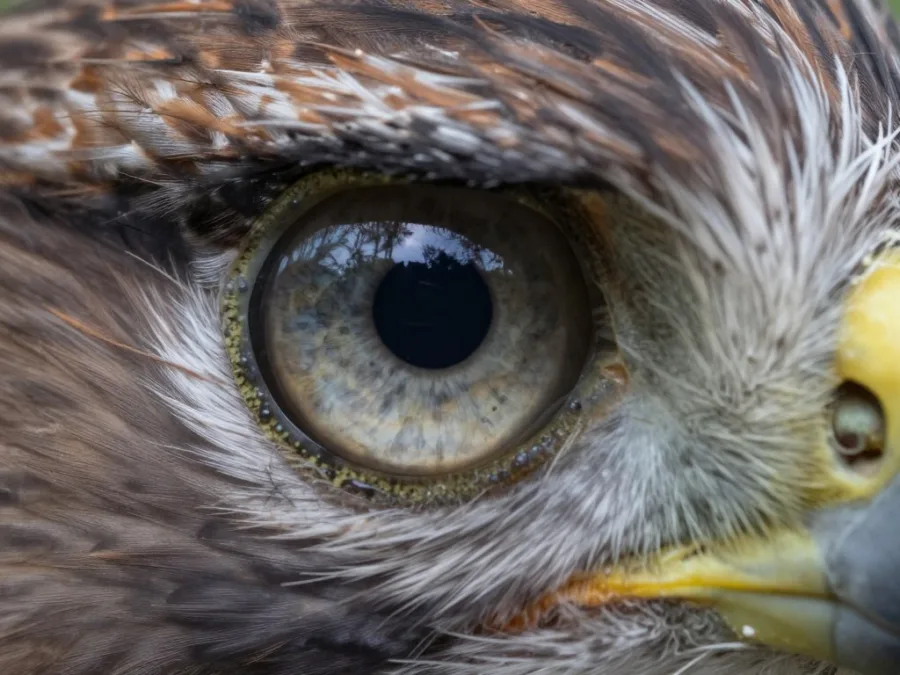
Hawks pack an extraordinary number of photoreceptors into their retinas. The central fovea area contains over one million cones per square millimeter.
This high photoreceptor density creates images with incredible resolution. Hawks distinguish fine details that appear as indistinct blurs to human observers.
The combination of large eyes and dense photoreceptors gives hawks vision equivalent to using powerful binoculars. They see clearly at distances where humans would need optical aids.
Color Vision Superiority
Hawks see a broader range of colors compared to humans. They possess four types of color receptors while humans have only three.
The fourth photoreceptor type detects ultraviolet wavelengths. This UV vision helps hawks track small mammals by spotting urine trails that reflect ultraviolet light.
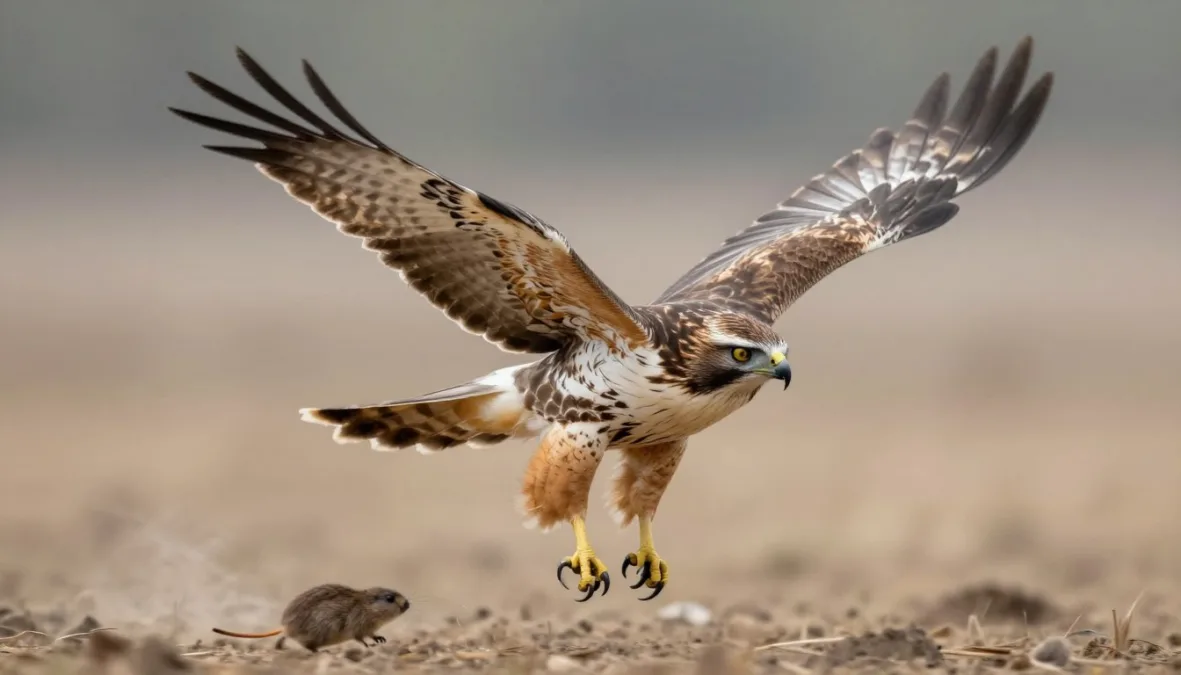
UV detection also helps hawks identify healthy versus sick prey. Feather and fur condition shows differently in ultraviolet, revealing animal health status from a distance.
Rapid Visual Processing
Hawks process visual information much faster than humans. They see the world at a higher frame rate, making everything appear to move in slow motion from their perspective.
This faster processing allows hawks to track prey during high-speed dives. They adjust their flight path in real-time to compensate for prey movements.
Hunting Vision Features
- Detect prey movement from over 100 feet altitude
- Maintain focus during rapid descent
- Process visual data at twice human speed
- See ultraviolet light for tracking trails
- Distinguish colors humans cannot perceive
9. Tarsiers: Enormous Eyes for Nocturnal Life
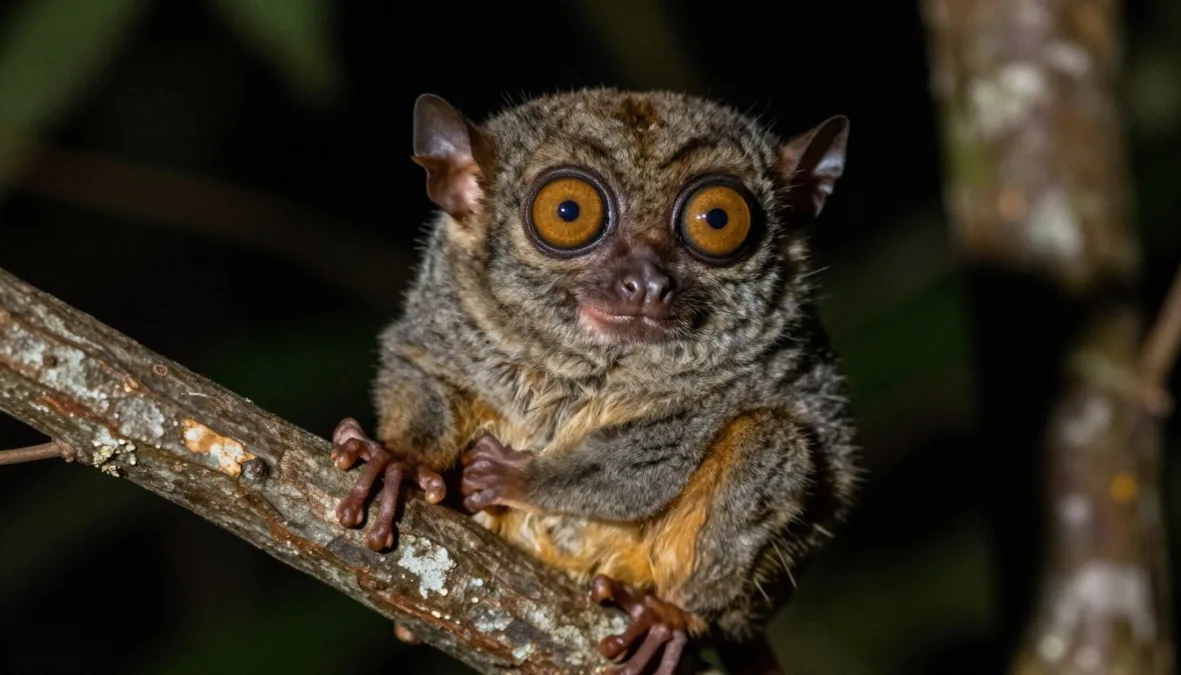
Tarsiers possess the largest eyes relative to body size of any mammal. Each eye is actually larger than its brain, demonstrating how critical vision is for these tiny primates.
These nocturnal creatures cannot move their eyes in their sockets. To compensate, tarsiers can rotate their heads nearly 180 degrees in each direction like owls.
Extreme Eye Size Adaptation
Tarsier eyes are fixed in place due to their enormous size. The eyeballs fill so much space in the skull that no room remains for muscles to move them.
Each eye weighs more than the tarsier’s brain. This extreme eye size allows maximum light gathering for hunting insects at night in dark forests.
The cornea and lens in tarsier eyes are exceptionally large. These oversized optical components collect and focus whatever minimal light exists in their nocturnal environment.
Rod-Dominated Vision
Tarsier retinas contain almost exclusively rod photoreceptors. This adaptation maximizes sensitivity to light at the cost of color vision.
The density of rods in tarsier eyes exceeds most other nocturnal mammals. More rods mean better detection of faint light and movement in darkness.
Tarsiers see the world mostly in shades of gray. They trade color perception for the ability to hunt effectively in near-total darkness.
Binocular Vision Benefits
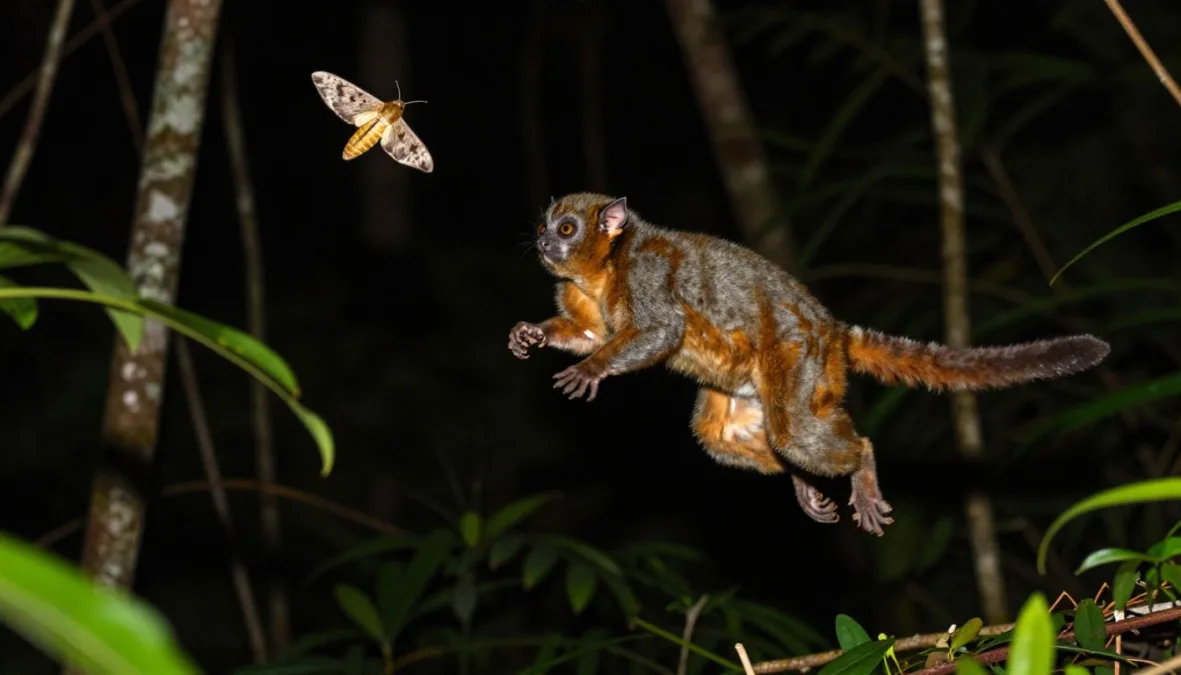
Forward-facing eyes give tarsiers excellent binocular overlap and depth perception. This helps them judge distances accurately when leaping between branches at night.
The large eye size also creates a wider field vision compared to other primates of similar size. Tarsiers maintain good peripheral awareness despite their forward-focused eyes.
Unique Adaptation: Tarsiers are the only entirely carnivorous primate. Their exceptional night vision allows them to hunt insects, lizards, and small birds in complete darkness where other primates cannot see.
10. Geckos: Ultimate Darkness Vision
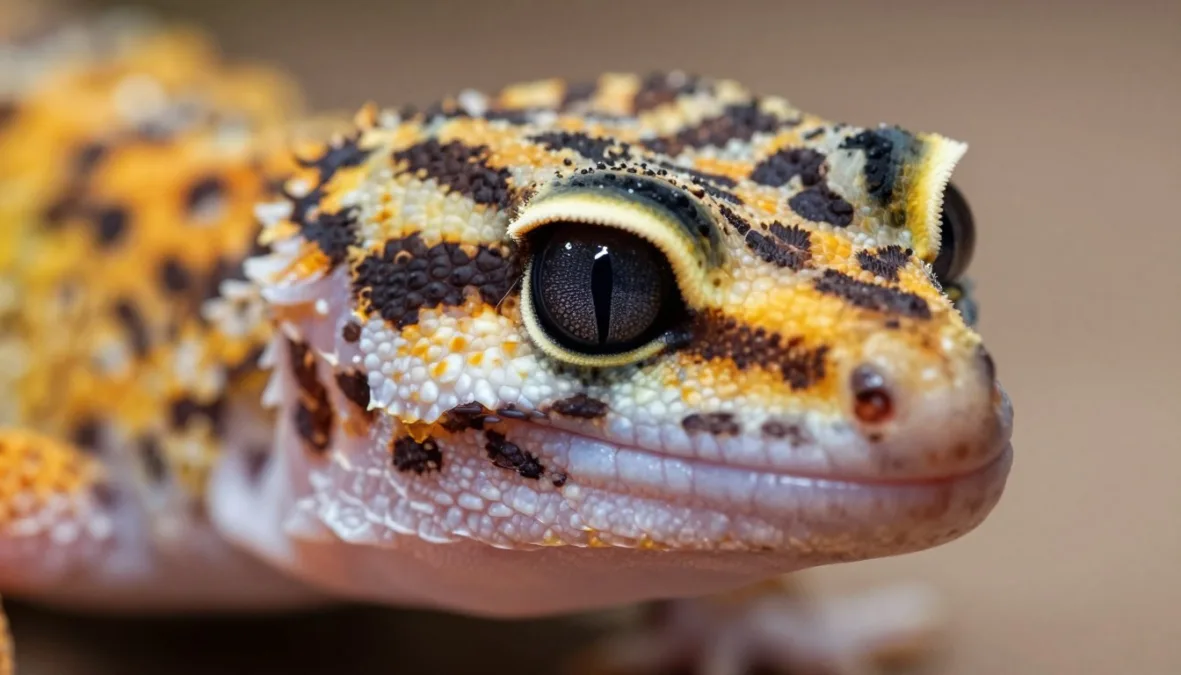
Geckos possess vision capabilities that surpass even cats in low-light conditions. These remarkable reptiles see color in darkness where humans are completely blind.
Most animals lose color vision in dim light as their cone photoreceptors stop functioning. Geckos evolved modified cones that work efficiently even when almost no light is available.
Color Vision in Darkness
Gecko eyes contain highly sensitive cone photoreceptors that function in light levels 350 times dimmer than human cones require. This allows them to see colors at night.
The cones in gecko eyes are much larger and more light-sensitive than those in other animals. They detect and differentiate colors when the world appears monochrome to humans and most other creatures.
This exceptional ability helps nocturnal geckos identify food, recognize other geckos, and navigate their environment in darkness while retaining color information.
Vertical Pupils and Light Control
Many gecko species have vertical slit pupils that open extremely wide in darkness. This pupil shape allows maximum light entry for night vision.
During daytime, the pupils contract to tiny pinholes. This protects the sensitive retina from bright light while maintaining visual function.
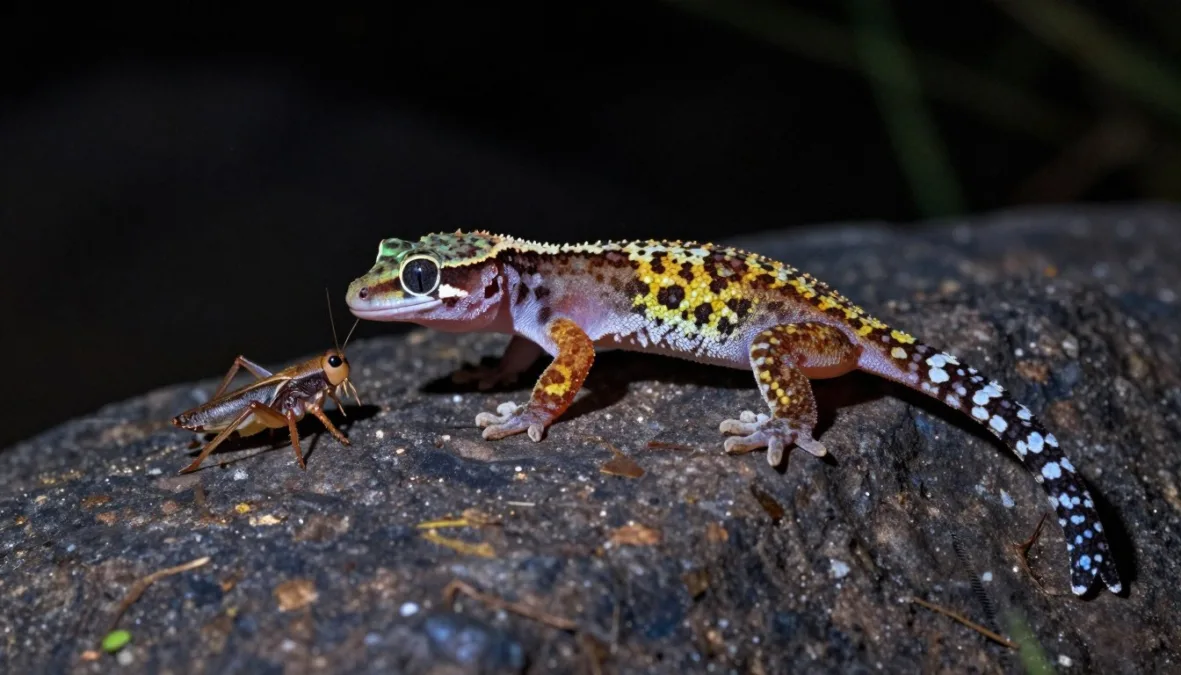
The vertical orientation also improves depth perception. Geckos can judge distances accurately when jumping to catch prey or leap between surfaces.
Multifocal Optical System
Gecko eyes use a multifocal optical system unique among vertebrates. Different wavelengths of light focus at different depths within the eye simultaneously.
This creates multiple sharp images at various distances without needing to adjust focus. Geckos see clearly at both near and far ranges at the same time.
Vision Advantages
- See colors in near-complete darkness
- Cone sensitivity 350 times greater than humans
- Multifocal system for simultaneous near and far focus
- Excellent motion detection in low light
Hunting Capabilities
- Track insects in starlight conditions
- Distinguish prey from background in darkness
- Judge jumping distances accurately at night
- Maintain color vision when other animals see only gray
Scientific Discovery: Researchers discovered gecko night color vision by testing their ability to discriminate colored objects in extremely dim light. Geckos succeeded where all other tested vertebrates failed, revealing their extraordinary visual system.
Comparing Vision Across Species
The diversity of vision in the animal kingdom demonstrates how evolution shapes sensory systems. Each species developed eyes optimized for its specific ecological niche and survival needs.
Comparing these visual systems reveals fascinating trade-offs. Animals that excel in one aspect of vision often sacrifice performance in other areas.
Visual Acuity Rankings
Eagles and hawks lead in sharpness of vision with resolution eight times better than humans. They can identify details from miles away that we could never see unaided.
Mantis shrimp sacrifice some acuity for incredible color detection. Their vision is less sharp than birds of prey but perceives wavelengths across a vastly wider spectrum.
Dragonflies trade static image quality for motion detection speed. Their mosaic compound eye vision processes movement faster than almost any other creature.
Color Perception Differences
Mantis shrimp dominate color vision with sixteen photoreceptor types detecting wavelengths from ultraviolet through infrared. They perceive colors beyond human comprehension.
Birds including eagles and hawks see four primary colors versus three in humans. Their additional ultraviolet sensitivity reveals patterns invisible to mammals.
Nocturnal specialists like owls, cats, and tarsiers sacrifice color vision for light sensitivity. They see primarily in shades of gray but function perfectly in darkness.
| Animal | Visual Strength | Light Sensitivity | Color Range | Field of Vision |
| Mantis Shrimp | Maximum color detection | Moderate | 16 photoreceptor types | Variable per eye |
| Eagles | Extreme distance clarity | High | 4 color receptors plus UV | 340 degrees |
| Chameleons | Independent eye control | Moderate | UV to visible spectrum | 360 degrees |
| Owls | Superior night vision | Extreme | Limited color perception | 110 degrees binocular |
| Goats | Panoramic awareness | Moderate | Dichromatic | 320-340 degrees |
| Dragonflies | Motion detection speed | High | UV to visible spectrum | Nearly 360 degrees |
| Cats | Low-light hunting | Very high | Limited compared to humans | 200 degrees |
| Hawks | Daytime precision hunting | High | 4 receptors plus UV | Similar to eagles |
| Tarsiers | Largest eye-to-body ratio | Extreme | Minimal color vision | Good binocular overlap |
| Geckos | Color vision in darkness | Extreme for color vision | Functional in near darkness | Wide for a small predator |
Night Vision Specialists
Owls, cats, tarsiers, and geckos evolved exceptional night vision through different adaptations. All maximize light gathering but use distinct strategies.
Owls and tarsiers develop enormous eyes that collect maximum light. Cats use a reflective tapetum layer to recycle light through photoreceptors.
Geckos achieved the remarkable feat of maintaining color vision in darkness through ultra-sensitive cone cells. This capability is unique among vertebrates.
Field Vision Trade-Offs
Prey animals like goats sacrifice depth perception for panoramic coverage. Their wide field vision detects approaching predators from almost any direction.
Predators including eagles, hawks, owls, and cats prioritize binocular overlap for depth perception. They need to judge distances accurately when striking prey.
Chameleons and dragonflies achieve both wide coverage and targeting capability through unique solutions. Independent eye movement and compound eye structure provide comprehensive awareness.
How Human Vision Compares
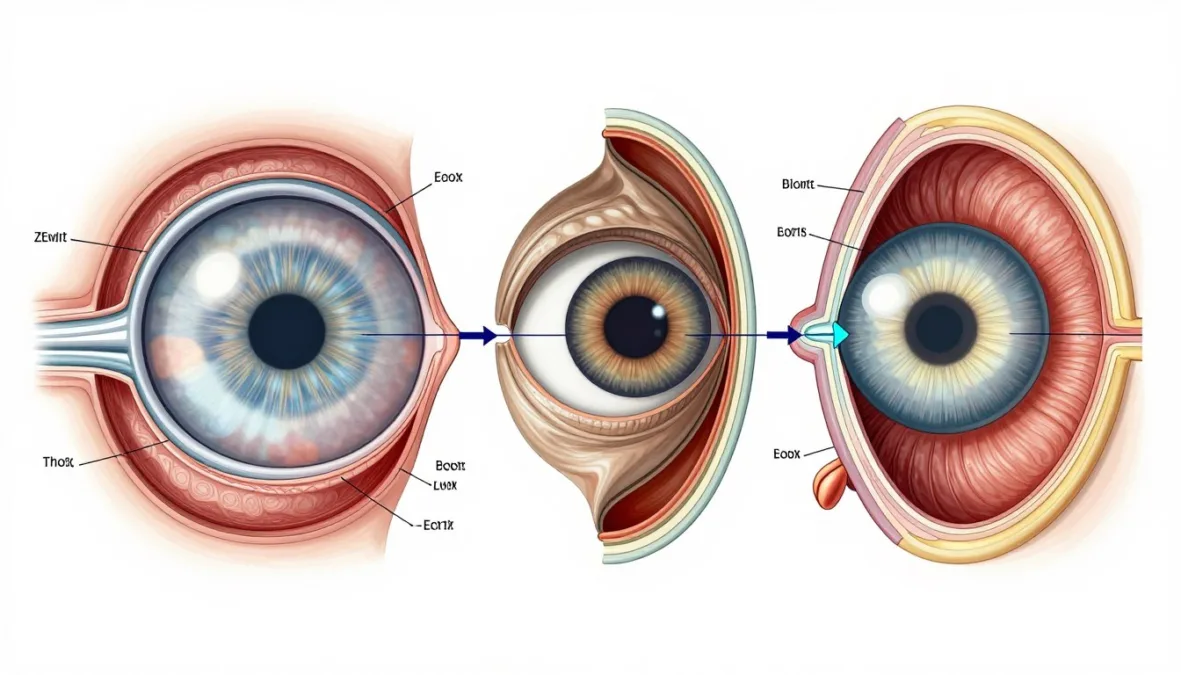
Human eyesight is good but unremarkable compared to many animals. We see fewer colors than birds, less detail than eagles, and require far more light than nocturnal mammals.
Humans evolved as diurnal primates relying on color vision and depth perception. Our eyes work well for manipulating objects and navigating complex environments but lack specialized features of other animals.
Color Vision Limitations
Humans have trichromatic color vision with three cone types detecting red, green, and blue light. This seems adequate until compared to animals with four or more photoreceptor types.
We cannot see ultraviolet light that birds use for navigation and mate selection. The infrared spectrum visible to some snakes remains invisible to human eyes.
Mantis shrimp perceive wavelengths and color distinctions completely outside human experience. We lack the neural architecture to even imagine what they see.
Where Humans Excel
- Excellent depth perception from binocular vision
- Good color differentiation in daylight
- Fine detail recognition up close
- Pattern recognition and visual memory
- Adaptive focus across various distances
Where Humans Fall Short
- Poor night vision compared to nocturnal animals
- Limited ultraviolet and infrared detection
- Much lower visual acuity than birds of prey
- Narrow field vision compared to prey animals
- Slower visual processing than many insects
Visual Acuity Differences
Human visual acuity measures around 20/20 at best. Eagles and hawks achieve what would test as 20/2 or better using human measurement standards.
This eight-fold difference means raptors distinguish details at 20 feet that humans need to approach within 2 feet to see clearly. Their photoreceptor density creates sharper images at all distances.
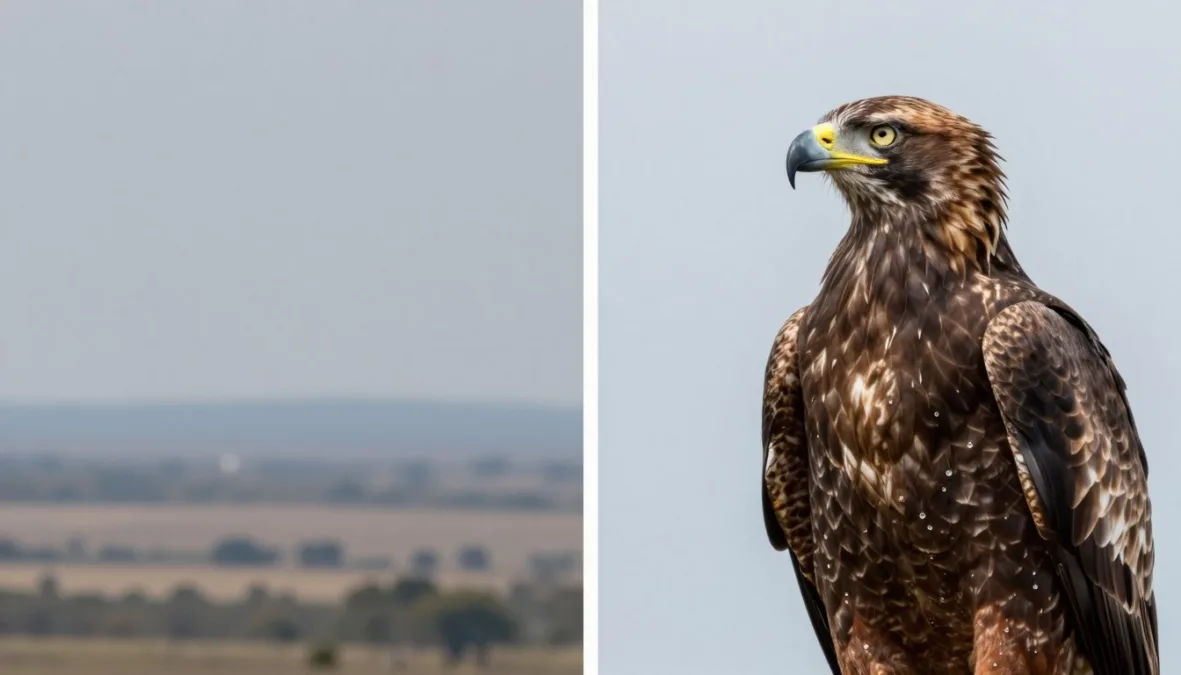
Humans cannot match the distance vision of predatory birds. We compensate with technology like binoculars and telescopes to artificially enhance our capabilities.
Light Sensitivity Gaps
Humans need relatively bright light to see well. Our eyes function poorly in the dim conditions where cats hunt comfortably and owls see perfectly.
The tapetum lucidum in cat eyes recycles light for a second pass through photoreceptors. Humans lack this structure, limiting our night vision capability.
Gecko eyes maintain color vision in light levels 350 times dimmer than human cones require. We cannot comprehend seeing colors in what appears to us as complete darkness.
Field Vision Restrictions
Human field vision spans roughly 180 degrees with significant binocular overlap in the center. This provides good depth perception but limited peripheral awareness.
Goats see 340 degrees simultaneously, monitoring nearly everything around them. Chameleons achieve 360-degree coverage through independent eye movement.
We have a substantial blind spot directly behind our heads. Many animals evolved vision systems that eliminate or minimize these gaps.
Why Animals Evolved Different Vision Types
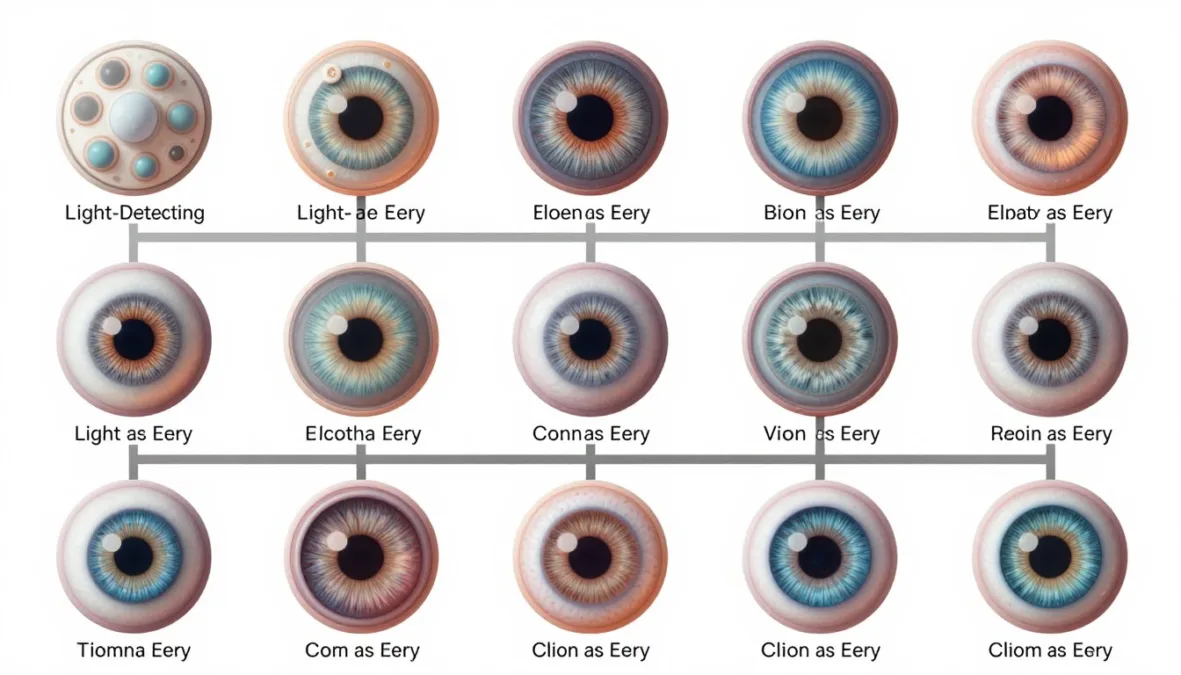
Vision evolved independently multiple times across the animal kingdom. Different environments and survival challenges drove the development of specialized eye structures.
Natural selection favored visual systems that improved survival and reproduction. Animals with better vision for their specific niche passed those traits to offspring.
Predator Versus Prey Vision
Predators typically evolved forward-facing eyes with substantial binocular overlap. This configuration provides excellent depth perception needed to judge strike distances accurately.
Eagles, hawks, owls, cats, and chameleons all have forward-facing eyes. They sacrifice peripheral awareness for precision targeting of prey.
Prey animals like goats evolved eyes on the sides of their heads. This placement maximizes field vision to detect approaching predators from any direction.
The trade-off between depth perception and peripheral coverage appears repeatedly across species. Ecology determines which visual strategy evolution favors.
Nocturnal Versus Diurnal Adaptations
Nocturnal animals faced different visual challenges than daytime creatures. Night hunters needed to maximize light gathering in dim conditions.
Owls, cats, tarsiers, and geckos all evolved large eyes, high rod density, and other adaptations for seeing in darkness. Some developed reflective tapetum layers to recycle light.
Diurnal predators like eagles and hawks optimized for bright-light performance. They packed more cones into their retinas for sharp daytime vision and color detection.
Environmental Pressure: Animals active at different times evolved distinctly different eye structures. The amount of available light shaped whether eyes prioritized color detection or light sensitivity.
Habitat-Specific Vision
Underwater vision presents unique challenges. Water absorbs light differently than air and requires different optical solutions.
Mantis shrimp evolved specialized eyes for the complex light environment of coral reefs. Their polarization detection and UV sensitivity help them navigate murky water.
Flying animals need to detect objects while moving at high speeds. Dragonflies developed fast visual processing and wide field coverage for aerial hunting.
Specialized Hunting Strategies
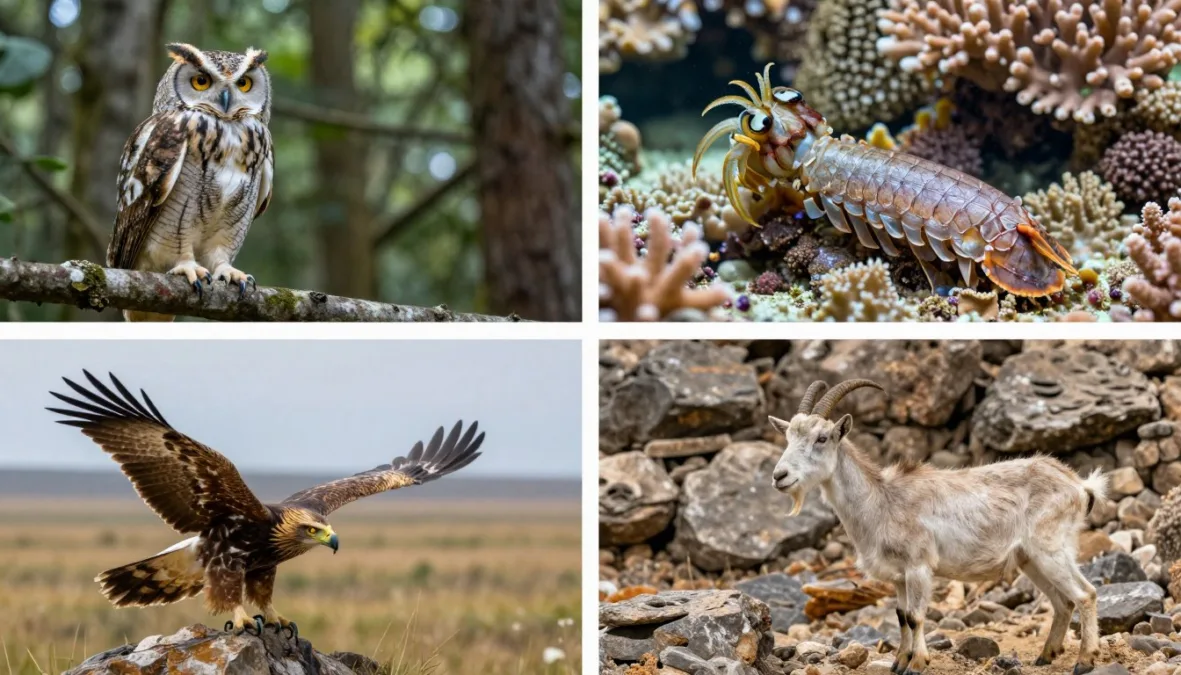
Ambush predators evolved different vision than pursuit hunters. Cats developed motion-sensitive eyes to spot prey movement and depth perception for pouncing.
Aerial hunters like hawks and eagles needed extreme distance vision. They spot small prey from hundreds of feet above ground and dive accurately.
The mantis shrimp uses its extraordinary color vision to identify prey types and assess their health or readiness. Visual information helps them select optimal targets.
Each hunting strategy drove specific visual adaptations. Eyes evolved to solve the particular challenges each predator faced when finding and catching food.
Common Myths About Animal Vision
Misconceptions about animal vision persist despite scientific evidence. Understanding the truth helps us appreciate how diverse visual systems actually work.
Myth: Dogs See Only Black and White
Many people believe dogs see the world in grayscale. This is false. Dogs have dichromatic color vision similar to humans with red-green color blindness.
Dogs possess two types of color-detecting cones rather than the three humans have. They see blues and yellows but cannot distinguish reds and greens well.
Their color vision is limited compared to humans but far from black and white. Dogs see a world of blue, yellow, and gray shades.
Myth: Eagles Can See a Mouse From Miles Away
While eagle vision is exceptional, claims of seeing mice from multiple miles are exaggerated. Eagles can spot prey from about two miles away under optimal conditions.
The size of the prey matters. Eagles detect larger animals like rabbits from greater distances than they spot tiny mice.
Atmospheric conditions affect vision at extreme ranges. Haze, heat shimmer, and distance reduce clarity even for eagles with their superior eyesight.
Myth: Cats See Perfectly in Total Darkness
Cats need some light to see. They cannot function in absolute darkness despite their excellent night vision capabilities.
Cat eyes require about one-sixth the light humans need. This gives them a huge advantage in dim conditions but they still need some photons to detect.
The tapetum lucidum reflects light through the retina but cannot create light. Without any light entering the eye, even cats are blind.
Scientific Fact: No animal can see in complete darkness. All vision requires some light entering the eye. Nocturnal animals simply need far less light than diurnal species.
Myth: Bulls Are Enraged by Red Color
Bulls are actually red-green colorblind like most mammals. They cannot distinguish red from other colors in the bullfighting cape.
Bulls respond to the movement of the cape, not its color. The red color is traditional for bullfighting but has no special effect on the animal.
Cattle see blues and yellows but struggle with reds and greens. A blue or yellow cape would produce the same reaction as a red one.
Myth: Owls Can Rotate Their Heads Completely Around
Owls can rotate their heads about 270 degrees in either direction. This is impressive but falls short of a complete 360-degree rotation.
The 270-degree range allows them to look directly behind while facing forward. Special blood vessel and bone adaptations prevent injury during extreme rotation.
Owls evolved this capability because their eyes cannot move in their sockets. Head rotation compensates for fixed eyeballs.
The Remarkable Diversity of Animal Vision
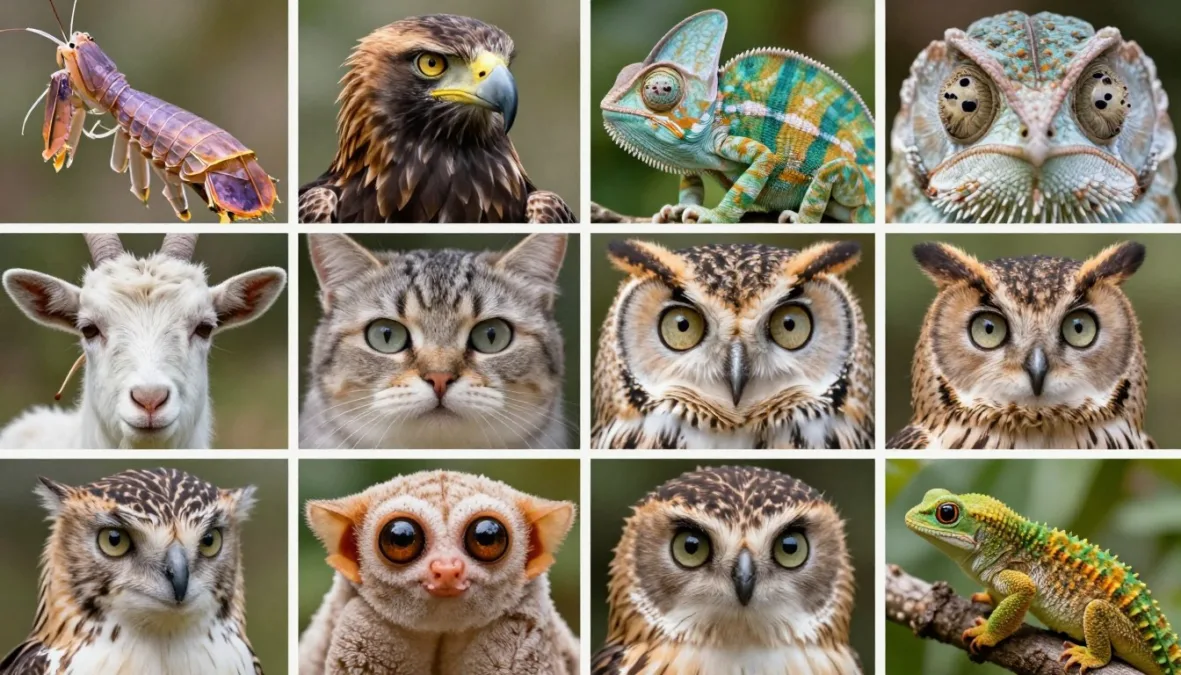
The animal kingdom showcases extraordinary diversity in visual capabilities. From mantis shrimp seeing impossible colors to geckos perceiving hues in darkness, evolution created solutions for every environment.
Each species on this list evolved eyes perfectly suited to its ecological niche. Predators developed precision targeting vision while prey animals gained panoramic awareness.
These ten animals represent the pinnacle of vision in nature. Their eyes demonstrate millions of years of evolutionary refinement solving specific survival challenges.
Understanding animal vision helps us appreciate the complexity of life. What seems like a simple sense involves intricate biological structures and sophisticated neural processing.
Humans may not match the visual capabilities of eagles, mantis shrimp, or cats. Yet we developed intelligence and technology that let us study and understand these remarkable adaptations.
The eyes looking back at us from the natural world see things we can barely imagine. That makes the animal kingdom even more fascinating to explore.
Never Miss Amazing Wildlife Discoveries
Join our community of over 50,000 nature enthusiasts and get exclusive access to fascinating articles about animal adaptations, behavior insights, and breaking discoveries from the natural world. Receive our weekly newsletter packed with stunning wildlife photography and expert knowledge delivered straight to your inbox.
Share This Article
Found this article fascinating? Share it with fellow nature lovers and help spread knowledge about these incredible animals.
Explore More Wildlife
Continue your journey through the animal kingdom with our extensive library of wildlife articles and stunning photography.

Priyanka Pandey
Senior Research Editor · Top10Sense
Priyanka specializes in tech, consumer products, and digital trends. She combines hands-on testing, vendor interviews, and database research to create trustworthy “Top 10” rankings. Her work has been referenced by industry blogs and brand report pages.