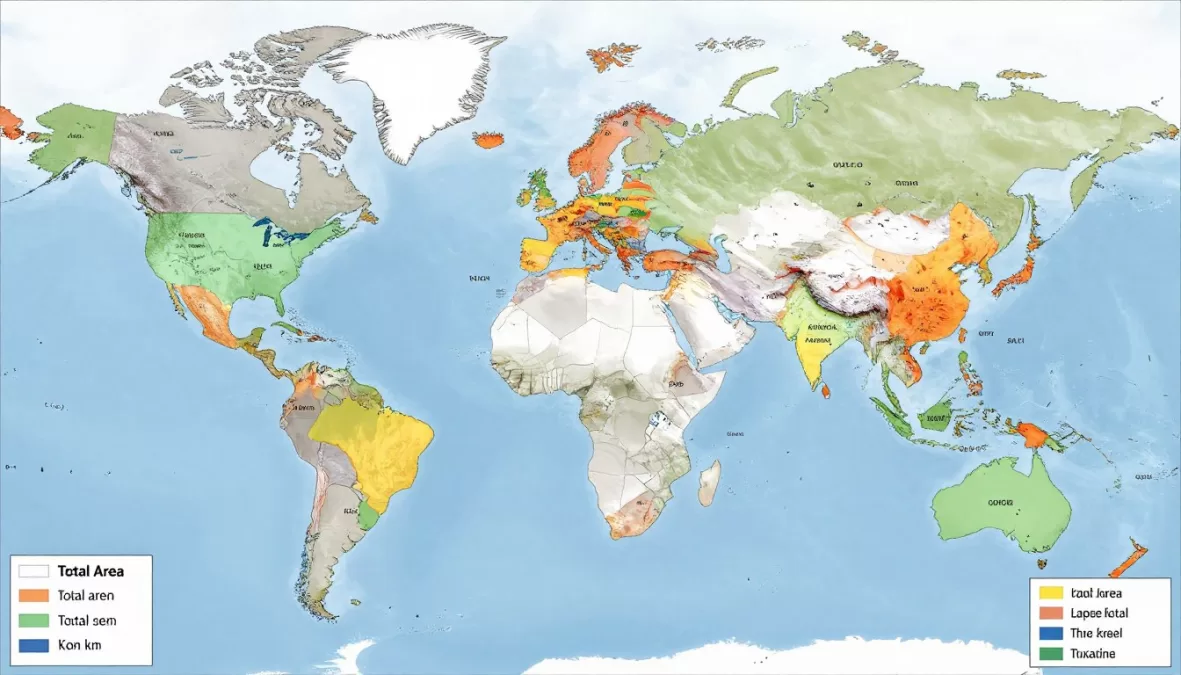

Our planet stretches across vast continents and diverse landscapes. Some countries claim territories so enormous they contain multiple climate zones, time zones, and ecosystems within their borders.
The largest country in the world spans over seventeen million square kilometers. That single nation covers more surface area than entire continents.
Understanding which countries dominate Earth’s landmass reveals fascinating insights. These geographic giants shape global politics, control critical resources, and house diverse populations across their extensive territories.
Understanding How We Measure Country Size and Territory
Measuring a country’s total area involves specific methodologies. Geographic organizations worldwide use standardized approaches to calculate territorial dimensions accurately.
Total Area Components
A country’s official size includes both land area and water area. This combined measurement provides the most accurate representation of territorial extent.
Land area represents solid ground including mountains, plains, forests, and deserts. Water area encompasses inland lakes, rivers, reservoirs, and coastal waters within territorial boundaries.
Measurement Standards
International organizations use square kilometers as the primary unit. This metric allows consistent comparisons across all nations regardless of their geographic location.
Territorial waters extend outward from coastlines according to international maritime law. Countries dependencies often include offshore islands and territories that contribute to overall area calculations.

Important Note: Some territories remain disputed between nations. This article uses internationally recognized figures from authoritative geographic databases and the United Nations statistics division.
Different organizations may report slightly varying numbers. These discrepancies often result from disputed territories, changing coastlines, or updated surveying techniques.
The list world largest countries remains relatively stable. However, political changes occasionally affect territorial boundaries and official area measurements.
1. Russia: The Undisputed Largest Country in the World

Russia dominates global geography as the largest country in the world by area. This transcontinental country spans an incredible 17,098,242 square kilometers.
No other nation comes remotely close to Russia’s territorial expanse. The country stretches across eleven time zones from Eastern Europe to the Pacific coast.
Geographic Scale
Russia’s total area exceeds the entire continent of Antarctica. The country covers more than one-eighth of Earth’s inhabited land surface.
This massive territory includes diverse landscapes. Visitors encounter frozen tundra, vast forests, expansive steppes, and towering mountain ranges within Russian borders.

Key Territorial Features
- Spans two continents with territory in both Europe and Asia
- Contains the world’s largest forest reserves in Siberia
- Houses Lake Baikal, the deepest freshwater lake globally
- Extends across 11 time zones from Kaliningrad to Kamchatka
- Borders 14 different countries along its extensive frontiers
- Controls vast Arctic territories in the northern regions

Russia’s land area alone measures approximately 16.4 million square kilometers. The remaining territory consists of water area including major rivers, lakes, and coastal waters.
The largest country world designation brings both advantages and challenges. Managing such enormous territory requires extensive infrastructure, resource allocation, and administrative complexity.
Fascinating Fact: Russia largest country status means you could fit the entire United States within its borders and still have territory remaining for additional nations.

The country’s vast natural resources include extensive oil and gas reserves. Russia controls significant portions of global energy supplies within its territorial boundaries.
Population distribution across this enormous surface area remains highly uneven. Western Russia near Europe contains dense urban centers while Siberian regions feature sparse settlement patterns.
2. Canada: North America’s Geographic Giant

Canada claims the position as the second largest country globally. This North American nation covers 9,984,670 square kilometers of territory.
The country world ranking places Canada far ahead of most other nations. Only Russia surpasses Canada in total territorial extent.
Territorial Composition
Canada’s total area includes substantial water area. The country contains more lakes than any other nation worldwide with over two million freshwater bodies.
The land area extends from the Atlantic to Pacific oceans. Canada also reaches northward to the Arctic Ocean across its vast northern territories.
Geographic Diversity
Canadian territory encompasses remarkable geographic variety. Landscapes range from coastal rainforests to prairie grasslands to Arctic tundra.
The country shares the world’s longest international border with the United States. This boundary stretches for nearly 9,000 kilometers across the continent.

Notable Canadian Features
- Contains approximately 20% of the world’s fresh water reserves
- Extends across six time zones from coast to coast
- Includes extensive Arctic archipelago in northern regions
- Features the longest coastline of any country at 202,080 kilometers
- Houses vast boreal forests covering millions of square kilometers
- Spans greater width than the distance from London to Baghdad

Despite enormous territorial extent, Canada maintains relatively low population density. Most citizens concentrate near the southern border with the United States.
The country’s natural resources include vast mineral deposits, extensive forests, and significant energy reserves. These resources contribute substantially to the national economy.

3. United States: A Continental Powerhouse

The United States ranks as the third largest country by total area. American territory encompasses 9,833,517 square kilometers across North America and beyond.
This measurement includes the continental United States plus Alaska and Hawaii. The total area calculation also incorporates territorial waters surrounding the coastlines.
Territorial Components
The United States land area covers diverse geographic regions. From Atlantic shores to Pacific coastlines, American territory spans the continent.
Alaska alone contributes significantly to the total area. This northern state adds over 1.7 million square kilometers to overall American territory.
Hawaii extends American presence into the Pacific Ocean. These volcanic islands add unique tropical territory to the national total.

Geographic Highlights
- Spans four time zones in the continental territory plus additional zones
- Contains diverse ecosystems from Arctic tundra to tropical rainforests
- Features extensive coastlines on Atlantic, Pacific, and Gulf waters
- Includes major river systems like the Mississippi and Colorado
- Houses varied terrain including mountains, plains, and deserts
- Controls additional territories in the Pacific and Caribbean

The United States benefits from remarkable geographic diversity. Climate zones range from arctic conditions in Alaska to tropical environments in Hawaii and Florida.
Natural resources within American territory remain abundant and varied. The country possesses significant agricultural land, mineral deposits, and energy resources.

Population distribution across the United States shows concentration in coastal regions and major cities. However, settlement patterns extend throughout the continental territory.
Comparison Note: The United States total area closely rivals China’s territorial extent. Rankings between these two nations sometimes vary depending on measurement methodologies.
4. China: Asia’s Territorial Leader

China ranks as the fourth largest country measured by total area. This Asian giant covers approximately 9,596,961 square kilometers.
The precise ranking between China and the United States sometimes shifts. Different measurement methodologies produce varying results for these similarly-sized nations.
Territorial Extent
Chinese territory stretches across East Asia from the Pacific coast westward to Central Asian borders. The country spans approximately 5,000 kilometers from east to west.
From northern borders with Russia and Mongolia to southern tropical regions, China extends roughly 5,500 kilometers north to south.
Geographic Features
China’s landscape includes the world’s highest mountains in Tibet. The Himalayan range forms natural borders along southwestern regions.
Major rivers including the Yangtze and Yellow River flow through Chinese territory. These waterways have shaped civilization and agriculture for millennia.

Key Territorial Characteristics
- Contains the world’s highest plateau in Tibet
- Spans five different time zones administratively unified
- Borders 14 different countries along land frontiers
- Features diverse climates from subarctic to tropical
- Includes extensive desert regions in the northwest
- Houses three of the world’s major river systems

China’s total land area supports the world’s largest population. Over 1.4 billion people inhabit Chinese territory across diverse geographic regions.
The country’s eastern coastal regions contain dense urban centers. Western territories feature more sparse populations across mountains and deserts.

Natural resources within Chinese borders remain substantial. The territory contains varied mineral deposits, agricultural lands, and growing renewable energy installations.
5. Brazil: South America’s Dominant Territory

Brazil claims the title of largest country in South America. This nation covers 8,515,767 square kilometers of South American territory.
The country South America dominates geographically and economically. Brazilian territory occupies nearly half of the entire continent’s land area.
Continental Dominance
Brazil’s territory extends across central and eastern South America. The country shares borders with every South American nation except Chile and Ecuador.
From the Amazon Basin in the north to southern grasslands, Brazilian territory encompasses remarkable diversity. Coastal regions stretch for over 7,000 kilometers along the Atlantic Ocean.

Geographic Treasures
- Contains approximately 60% of the Amazon rainforest
- Features the Amazon River, world’s largest by volume
- Spans four time zones across its extensive territory
- Includes diverse ecosystems from rainforest to wetlands
- Houses the Pantanal, world’s largest tropical wetland
- Contains significant portions of the Atlantic Forest biome

Brazil’s land area includes some of Earth’s most biodiverse regions. The Amazon rainforest alone contains an estimated 10% of all species on the planet.
The country’s natural resources extend beyond biological wealth. Brazil possesses significant mineral deposits, agricultural potential, and renewable energy capacity.

Compare Geographic Giants

Want to visualize how these massive countries compare? Our interactive comparison tool lets you overlay country shapes and see relative sizes instantly.
Population distribution in Brazil concentrates along coastal regions. The interior Amazon territories maintain lower population density despite enormous territorial extent.
6. Australia: The Island Continent

Australia holds the unique distinction of being both a country and a continent. This island nation covers 7,692,024 square kilometers.
As the world’s largest island and smallest continent, Australia occupies a special geographic position. The country world largest island designation recognizes this unique status.
Island Continent Features
Australian territory includes the mainland continent plus numerous islands. Tasmania represents the largest additional island territory to the south.
The country’s total area extends across diverse climate zones. From tropical northern regions to temperate southern areas, Australia displays remarkable variety.
Territorial Characteristics
Much of central Australia consists of arid outback territory. These interior regions feature low rainfall and sparse vegetation across vast distances.
Coastal regions support most population centers. Australian settlement patterns concentrate along eastern and southeastern shores near water resources.

Australian Geographic Highlights
- Surrounded entirely by ocean with no land borders
- Contains the Great Barrier Reef ecosystem offshore
- Features extensive desert and semi-arid interior regions
- Spans three time zones across the continent
- Includes unique wildlife found nowhere else globally
- Houses ancient geological formations over 3 billion years old

Australia’s land area includes diverse ecosystems despite arid interior regions. Coastal zones feature rainforests, woodlands, and unique Mediterranean-climate areas.
The country’s mineral wealth contributes significantly to the economy. Australian territory contains substantial deposits of iron ore, coal, gold, and other valuable resources.

Population density in Australia remains among the world’s lowest. Approximately 26 million people inhabit this vast territory, mainly concentrated in coastal cities.
Unique Status: Australia represents the only nation that governs an entire continent. No other countries share the Australian continental landmass.
7. India: The South Asian Subcontinent

India ranks as the seventh largest country globally by total area. This South Asian nation covers approximately 3,287,263 square kilometers.
The country occupies the majority of the Indian subcontinent. Indian territory extends from the Himalayas southward into the Indian Ocean.
Subcontinent Geography
India’s land area includes remarkable geographic diversity. The northern regions feature the world’s highest mountain range along borders with China and Nepal.
Central plains form the Indo-Gangetic agricultural heartland. These fertile regions support dense populations and intensive cultivation.
Southern peninsular territory extends into tropical waters. Coastal regions along the Arabian Sea and Bay of Bengal add thousands of kilometers of shoreline.

Key Geographic Features
- Borders seven different countries across land frontiers
- Contains portions of the Himalayan mountain system
- Features major river systems including Ganges and Brahmaputra
- Spans diverse climate zones from alpine to tropical
- Includes the Thar Desert in northwestern regions
- Extends across two time zones administratively unified

India’s total area supports over 1.4 billion people. This makes the country the most populous nation, with population recently surpassing China.
Despite being the seventh largest country by area, India ranks second globally by population. This creates significantly higher population density compared to larger nations.

Natural resources within Indian territory include agricultural land, mineral deposits, and renewable energy potential. The country continues developing these resources for economic growth.

8. Argentina: Southern South American Expanse

Argentina claims the position as the eighth largest country worldwide. This South American nation encompasses 2,780,400 square kilometers of territory.
The country stretches along the southern portion of South America. Argentine territory extends from tropical northern borders to the Antarctic-adjacent south.
North-South Extension
Argentina’s territory spans approximately 3,700 kilometers from north to south. This enormous latitudinal range creates exceptional climate and ecosystem diversity.
Northern regions border Bolivia and Paraguay in subtropical zones. Southern territories reach Tierra del Fuego near Antarctica across dramatically different environments.
Geographic Variety
The western border features the Andes mountain range. These peaks form natural boundaries with Chile along the entire length of the country.
Eastern regions include the Pampas grasslands. These fertile plains support extensive agricultural production across central Argentina.

Argentine Territorial Highlights
- Extends across four time zones including Atlantic territories
- Contains diverse ecosystems from jungle to glaciers
- Features extensive Atlantic coastline exceeding 4,700 kilometers
- Includes numerous Andean peaks over 6,000 meters elevation
- Houses portions of the Gran Chaco wilderness region
- Claims Antarctic territory under international treaty

Argentina’s land area includes some of South America’s most productive agricultural regions. The Pampas produce significant quantities of grain, beef, and other agricultural products.
The country’s southern Patagonian region remains sparsely populated. These territories feature dramatic landscapes including glaciers, mountains, and windswept plains.

Discover More Geographic Wonders
Join our community of geography enthusiasts! Receive weekly insights about world geography, fascinating country facts, and exclusive educational resources delivered to your inbox.
Natural resources in Argentina include mineral deposits, hydroelectric potential, and agricultural land. The country benefits from diverse resource availability across its extensive territory.
9. Kazakhstan: The Largest Landlocked Country

Kazakhstan ranks as the ninth largest country in the world. This Central Asian nation covers 2,724,900 square kilometers of territory.
The largest landlocked country designation belongs to Kazakhstan. No other nation without ocean access claims such extensive territorial area.
Landlocked Expanse
Kazakhstan’s territory extends across Central Asia between Russia and China. The country spans approximately 3,000 kilometers from west to east.
Despite lacking ocean coastline, Kazakhstan borders the Caspian Sea. This massive inland water body provides important maritime access and resources.

Geographic Characteristics
- Transcontinental country spanning Europe and Asia
- Contains diverse landscapes from deserts to mountains
- Features extensive steppe grasslands across central regions
- Includes the Caspian Sea shoreline in the west
- Houses portions of the Altai and Tian Shan mountains
- Borders five different countries across land frontiers

Kazakhstan’s total land area remains sparsely populated. Approximately 19 million people inhabit this vast territory, creating very low population density.
The country’s natural resources include substantial mineral wealth. Kazakhstan possesses significant oil, natural gas, uranium, and various metal deposits.

Central regions feature expansive steppe ecosystems. These grasslands have shaped Kazakh culture and supported nomadic traditions for centuries.

10. Algeria: Africa’s Largest Territory

Algeria completes the list as the tenth largest country globally. This North African nation encompasses 2,381,741 square kilometers of territory.
The largest country Africa designation belongs to Algeria. Since South Sudan’s independence, Algeria has held the position as the continent’s largest nation by area.
Desert Dominance
Approximately 80% of Algerian territory consists of Sahara Desert. This vast arid region extends across southern portions of the country.
The Sahara within Algeria includes diverse desert landscapes. Visitors encounter sand dunes, rocky plateaus, mountain ranges, and occasional oases.
Coastal Territory
Northern Algeria features Mediterranean coastline and coastal mountains. These regions support most population centers and agricultural activity.
The Tell Atlas mountain range runs parallel to the coast. These peaks create a geographic transition between coastal zones and interior desert.

Algerian Geographic Features
- Contains the largest portion of the Sahara Desert
- Features Mediterranean coastline exceeding 1,600 kilometers
- Includes multiple mountain ranges across the territory
- Borders seven different countries across land frontiers
- Spans two time zones across its extensive territory
- Houses significant oil and natural gas reserves

Algeria’s total area makes it the largest country in Africa and the Arab world. The nation surpassed Sudan as Africa’s largest after South Sudan gained independence in 2011.
Population distribution in Algeria concentrates heavily in northern coastal regions. The vast Saharan interior maintains very low population density despite enormous territorial extent.

Natural resources within Algerian territory include substantial hydrocarbon reserves. The country ranks among world leaders in natural gas production and exports.

Comparing the World’s Largest Countries by Area

Understanding the relative sizes of the world’s largest countries requires direct comparison. The differences between these territorial giants reveal fascinating geographic patterns.
| Rank | Country | Total Area (km²) | Land Area (km²) | Water Area (km²) | % of Earth’s Land |
| 1 | Russia | 17,098,242 | 16,376,870 | 721,372 | 11.5% |
| 2 | Canada | 9,984,670 | 9,093,510 | 891,163 | 6.7% |
| 3 | United States | 9,833,517 | 9,147,420 | 685,924 | 6.5% |
| 4 | China | 9,596,961 | 9,326,410 | 270,550 | 6.3% |
| 5 | Brazil | 8,515,767 | 8,358,140 | 157,630 | 5.7% |
| 6 | Australia | 7,692,024 | 7,682,300 | 58,920 | 5.2% |
| 7 | India | 3,287,263 | 2,973,190 | 314,073 | 2.2% |
| 8 | Argentina | 2,780,400 | 2,736,690 | 43,710 | 1.9% |
| 9 | Kazakhstan | 2,724,900 | 2,699,700 | 25,200 | 1.8% |
| 10 | Algeria | 2,381,741 | 2,381,741 | 0 | 1.6% |
Russia’s Overwhelming Size Advantage
Russia largest country status becomes clear through direct comparison. The nation’s territory exceeds Canada by over 7 million square kilometers.
To visualize this difference, Russia’s land area surpasses the combined territories of the next three largest countries. Canada, the United States, and China together still fall short of Russian territorial extent.

Water Area Significance
Canada possesses the largest water area among these nations. The country’s 891,163 square kilometers of water includes countless lakes and extensive territorial waters.
This substantial water area affects total area rankings. Some measurements focusing solely on land area would adjust positions among the largest countries world rankings.


Continental Distribution
These ten largest countries represent only four continents. Asia claims three positions, while Europe/Asia, North America, South America, Africa, and Oceania each contribute representatives.
Notably, Europe contributes no countries to this list independently. Russia, classified as transcontinental country, represents European presence through its partially European territory.
- Russia (transcontinental)
- China
- India
- Kazakhstan (transcontinental)
Asia
- Canada
- United States
- Brazil
- Argentina
Americas
- Australia (Oceania)
- Algeria (Africa)
Other Continents
Population Density and Territory Size Relationships

Large territorial area does not necessarily correlate with large population. The relationship between surface area and population reveals interesting patterns among the world’s largest countries.
High Population Despite Size
China and India demonstrate how massive populations inhabit relatively large territories. Both nations exceed 1.4 billion people despite ranking fourth and seventh in area.
These countries maintain significantly higher population density compared to larger nations. Limited territory per capita creates unique demographic and development challenges.
Sparse Populations Across Vast Areas
Russia, Canada, and Australia feature very low population density. Enormous territories support relatively small populations concentrated in specific regions.
Kazakhstan and Algeria similarly maintain sparse populations. Desert and remote regions within these nations remain largely uninhabited despite extensive total area.
| Country | Population (approx) | Population Density (per km²) | Habitable Area Percentage |
| Russia | 146 million | 8.5 | ~27% |
| Canada | 39 million | 4.2 | ~35% |
| United States | 335 million | 36 | ~75% |
| China | 1.41 billion | 153 | ~50% |
| Brazil | 215 million | 25 | ~60% |
| Australia | 26 million | 3.4 | ~20% |
| India | 1.43 billion | 464 | ~85% |
| Argentina | 46 million | 17 | ~55% |
| Kazakhstan | 19 million | 7 | ~30% |
| Algeria | 45 million | 19 | ~20% |
Climate and Habitability Factors
Extreme climates reduce habitable portions of many large countries. Arctic conditions limit settlement in northern Canada and Russia.
Desert environments restrict populations in Algeria, Kazakhstan, and Australia. Approximately 80% of Algeria consists of uninhabitable Sahara Desert.

Mountainous terrain affects settlement patterns in several nations. The Himalayas, Andes, and other major ranges create natural barriers to dense population.
Natural Resources and Territorial Wealth

Vast territories often contain abundant natural resources. The largest countries world control significant portions of global resource supplies.
Energy Resources

Russia possesses enormous oil and natural gas reserves. The country ranks among global leaders in hydrocarbon production and exports.
Canada holds substantial oil sands deposits. The United States maintains diverse energy resources including oil, gas, and coal.
Mineral Wealth

Australia contains significant iron ore, gold, and other mineral deposits. Brazil possesses extensive mineral resources including iron and rare earth elements.
Kazakhstan maintains substantial uranium reserves. China holds diverse mineral wealth supporting industrial production.
Agricultural Land

The United States features highly productive agricultural regions. Brazil and Argentina maintain extensive farmland supporting global food supplies.
India cultivates diverse crops across varied climate zones. Canada possesses significant grain-producing areas despite shorter growing seasons.
Forest Resources
Russia contains approximately 20% of the world’s forests. Vast Siberian forests represent critical global carbon storage.
Canada and Brazil house extensive forest coverage. These nations play vital roles in global climate regulation and biodiversity preservation.

Water Resources
Canada holds approximately 20% of global freshwater supplies. Countless lakes and rivers provide abundant water resources.
Brazil contains the Amazon River system with the world’s largest water volume. Russia features extensive river systems including the Volga, Ob, and Yenisei.

Perspective: Comparing With the World’s Smallest Country

The smallest country in the world creates dramatic contrast with territorial giants. Vatican City encompasses merely 0.44 square kilometers.
Comparing Russia to Vatican City reveals staggering scale differences. Russia’s territory exceeds Vatican City approximately 38.8 million times.
Size Perspective
You could fit Vatican City into Russia over 38 million times. This comparison illustrates the enormous range in country sizes globally.
Even Algeria, the tenth largest country, dwarfs Vatican City. The North African nation exceeds the smallest country by over 5.4 million times.

Other Notably Small Territories
- Monaco: 2.02 square kilometers (second smallest)
- San Marino: 61 square kilometers
- Liechtenstein: 160 square kilometers
- Malta: 316 square kilometers
- Maldives: 298 square kilometers

These microstates demonstrate that political sovereignty does not require extensive territory. Small nations maintain independence despite minimal land area.
Hong Kong and Singapore represent other small but economically significant territories. Though not among the smallest, their limited area contrasts sharply with continental giants.
Understanding Territories, Dependencies, and Disputed Areas

Many countries dependencies affect global territorial calculations. Some nations control extensive territories beyond their primary landmass.
Major Territorial Holdings
France maintains territories worldwide despite modest European mainland size. French territories include French Guiana in South America, New Caledonia in the Pacific, and others.
The United Kingdom controls various overseas territories. These include the Falkland Islands, Gibraltar, and numerous Caribbean possessions.
Autonomous Territories
Greenland represents the world’s largest island but remains part of Denmark. This massive territory significantly exceeds Denmark’s European landmass.
Hong Kong and the Faroe Islands maintain special administrative status. These territories function semi-autonomously while remaining under sovereign nations.
Disputed Regions
Western Sahara remains disputed between Morocco and independence movements. Different sources handle this territory inconsistently in area calculations.
Antarctica lacks internationally recognized sovereign control. Multiple nations claim Antarctic territories under the Antarctic Treaty system.

Territorial Waters Considerations
Territorial waters extend country boundaries beyond land. International law allows nations to claim waters within 12 nautical miles of coastlines.
Exclusive Economic Zones (EEZ) extend further offshore. These maritime areas grant countries resource rights up to 200 nautical miles from shores.

Countries with extensive coastlines gain substantial maritime territory. Canada, Russia, and the United States control vast ocean areas beyond their land borders.
Historical Changes in Country Sizes and Borders

National boundaries shift throughout history. Wars, treaties, independence movements, and political changes alter territorial extent.
Recent Territorial Changes
South Sudan gained independence in 2011. This separation reduced Sudan’s territory significantly, allowing Algeria to become the largest country Africa.
The Soviet Union’s collapse in 1991 created dramatic changes. Russia emerged as the largest successor state but lost substantial territory compared to USSR totals.
20th Century Changes
The British Empire’s dissolution reshaped global geography. Former colonies including Canada, Australia, and India gained full sovereignty.
World War outcomes redrew European and Asian boundaries. Germany, Poland, and other nations experienced significant territorial adjustments.
Ongoing Disputes
Some territorial disputes remain unresolved. Kashmir, for instance, affects total area calculations for India and Pakistan.
The Democratic Republic Congo emerged from colonial history. This nation ranks among Africa’s largest but has experienced border conflicts.

Future Territorial Considerations
Climate change may affect territorial calculations. Rising sea levels could reduce land area for coastal and island nations.
Arctic ice melt opens new territorial questions. Nations bordering the Arctic Ocean increasingly assert claims to previously inaccessible regions.

Geographic Records and Fascinating Facts About Large Countries

The world’s largest countries contain numerous geographic superlatives. These nations house record-breaking natural features within their boundaries.
Extreme Geographic Features
Highest Mountain

Mount Everest straddles the China-Nepal border at 8,849 meters elevation. China shares this highest point on Earth.
Longest River

The Amazon River in Brazil carries more water than any other river globally. Its basin covers much of northern South America.
Largest Desert

The Sahara Desert extends across Algeria and neighboring nations. This massive arid region covers over 9 million square kilometers.
Deepest Lake

Lake Baikal in Russia reaches depths of 1,642 meters. This ancient lake contains approximately 20% of Earth’s unfrozen freshwater.
Largest Rainforest

The Amazon rainforest spans multiple countries with the majority in Brazil. This ecosystem represents unparalleled biodiversity.
Coldest Inhabited Place

Oymyakon in Russia holds records for coldest inhabited location. Temperatures have plunged below -70°C in this Siberian village.
Remarkable Statistics
- Russia contains over 100,000 rivers longer than 10 kilometers
- Canada has more lakes than all other countries combined
- Australia is the only country that is also a continent
- Brazil’s Amazon rainforest produces 20% of Earth’s oxygen
- China has the world’s longest man-made structure (Great Wall)
- India contains 8 of the world’s 10 highest mountain peaks
- Argentina extends closer to Antarctica than any other nation
- Kazakhstan is the world’s largest landlocked country by significant margin
- Algeria controls the largest portion of Sahara Desert territory
- The United States spans more time zones than any country except Russia

Frequently Asked Questions About the Largest Countries
What is the largest country in the world by area?
Russia is the largest country in the world by area, covering approximately 17,098,242 square kilometers. This transcontinental nation spans from Eastern Europe across northern Asia to the Pacific Ocean. Russia’s territory exceeds the next largest country, Canada, by over 7 million square kilometers. The country encompasses 11 time zones and represents more than one-eighth of Earth’s inhabited land surface.
How do countries measure their total area?
Countries calculate total area by combining land area and water area within their borders. Land area includes all solid ground such as mountains, plains, forests, and deserts. Water area encompasses inland lakes, rivers, reservoirs, and territorial waters along coastlines. International organizations use square kilometers as the standard measurement unit. Some variations in reported sizes occur due to disputed territories, measurement methodologies, and whether calculations include or exclude certain water bodies.
Which continent has the most large countries by area?
Asia contains the most countries among the world’s 10 largest by area, with four representatives: Russia (which is transcontinental), China, India, and Kazakhstan (also transcontinental). The Americas follow with four countries: Canada, United States, Brazil, and Argentina. Africa contributes one country (Algeria), and Oceania contributes one (Australia). Europe has no countries on the list independently, though Russia extends into European territory.
What is the largest landlocked country in the world?
Kazakhstan holds the title as the largest landlocked country, covering 2,724,900 square kilometers without any ocean coastline. The country does border the Caspian Sea, which is technically a landlocked water body rather than an ocean. Kazakhstan exceeds other landlocked nations like Mongolia and Chad by substantial margins. This Central Asian nation spans diverse landscapes from steppes to deserts to mountains across its extensive interior territory.
How much larger is Russia than the United States?
Russia’s total area of 17,098,242 square kilometers exceeds the United States’ 9,833,517 square kilometers by approximately 7.26 million square kilometers. This means Russia is roughly 1.74 times larger than the United States. Despite this size difference, the United States has a significantly larger population (approximately 335 million compared to Russia’s 146 million) and higher population density.
What percentage of Earth’s land do the 10 largest countries occupy?
The 10 largest countries collectively occupy approximately 49.5% of Earth’s total land area. Russia alone accounts for about 11.5% of global land surface. These nations control nearly half of all land on the planet despite representing only 10 of the world’s roughly 195 countries. This concentration demonstrates how unevenly Earth’s landmass distributes among nations.
Which is larger: Canada or China?
Canada is slightly larger than China by total area. Canada covers 9,984,670 square kilometers compared to China’s 9,596,961 square kilometers, making Canada about 388,000 square kilometers larger. However, China has significantly more land area because Canada includes substantial water area from its countless lakes. The ranking between these nations can vary depending on whether measurements use total area or land area only.
What is the largest country in Africa by area?
Algeria is the largest country in Africa, covering 2,381,741 square kilometers. Algeria gained this status in 2011 when South Sudan separated from Sudan, reducing Sudan’s total area. Algeria’s territory consists primarily of Sahara Desert, with approximately 80% of the country being arid or semi-arid land. The country also holds the distinction of being the largest nation in the Arab world.
Do large countries have larger populations?
Large territorial area does not necessarily correlate with large population. While China and India have both large areas and large populations (over 1.4 billion each), many huge countries have small populations. Australia, Kazakhstan, and Canada all rank among the 10 largest by area but have relatively small populations and very low population density. Russia, despite being the world’s largest country, has only about 146 million people.
How does climate affect habitable area in large countries?
Climate significantly reduces habitable portions of many large countries. Arctic conditions in northern Canada and Russia make vast regions unsuitable for permanent settlement. Desert environments limit habitability in Algeria (80% Sahara Desert), Kazakhstan, and Australia (70% arid or semi-arid). Only about 27% of Russia’s territory is considered readily habitable, while Algeria’s habitable area is approximately 20%. These climate constraints concentrate populations in more hospitable regions.
Understanding Global Geography Through Territorial Giants

The largest countries in the world by area shape global geography, politics, and resource distribution. These ten nations collectively control nearly half of Earth’s land surface.
Russia’s overwhelming size dominance establishes it as the undisputed territorial leader. No other nation approaches Russian territorial extent, which exceeds even continental Australia.
Geographic diversity characterizes these massive nations. From Arctic tundra to tropical rainforests, from towering mountains to vast deserts, the largest countries encompass Earth’s most extreme environments.
Population distribution across these territories remains remarkably uneven. Some giant nations maintain sparse populations while others support over one billion inhabitants within their borders.
Natural resource wealth concentrates in these large countries. Their territories contain substantial portions of global energy reserves, minerals, freshwater, forests, and agricultural land.
Understanding country sizes provides essential geographic context. These territorial measurements reflect historical processes, geographic constraints, and ongoing political realities shaping our world.
Continue Exploring World Geography
Deepen your geographic knowledge with our comprehensive resources, interactive tools, and expert-curated content about countries, territories, and Earth’s remarkable diversity.

Priyanka Pandey
Senior Research Editor · Top10Sense
Priyanka specializes in tech, consumer products, and digital trends. She combines hands-on testing, vendor interviews, and database research to create trustworthy “Top 10” rankings. Her work has been referenced by industry blogs and brand report pages.