

The artificial intelligence industry has transformed business operations across every sector in 2026. Companies investing in AI technology now drive unprecedented innovation.
Market analysts project AI investments will exceed $500 billion this year. This represents a fundamental shift in how businesses approach technology adoption.
The following companies lead this transformation. Their innovations define the future of artificial intelligence and shape how organizations worldwide implement these systems.
Stay Ahead of the AI Revolution
Join 50,000+ business leaders and investors receiving monthly insights on emerging AI companies, market trends, and implementation strategies.
- Exclusive AI market analysis and company profiles
- Implementation strategies from industry experts
- Early access to emerging technology reports
- No spam, unsubscribe anytime
Understanding the AI Leadership Landscape in 2026
The AI companies 2026 list reflects dramatic changes from previous years. Traditional technology giants now compete with specialized artificial intelligence startups for market dominance.
Three factors determine leadership positions this year. Technical innovation drives product development, while market adoption validates business models. Investment capital fuels rapid scaling operations.

Revenue growth patterns reveal which companies capture real value. The top performers generate $10 billion or more annually from AI products and services. This separates market leaders from promising contenders.
Market Dynamics
Competition intensifies as companies race to develop superior models. The winners combine technical excellence with practical business applications that solve real problems.
Investment Trends
Venture capital firms deployed $85 billion into AI startups last year. These investors seek companies with proven technology and clear paths to profitability in expanding markets.
1. OpenAI: Pioneering Advanced AI Systems
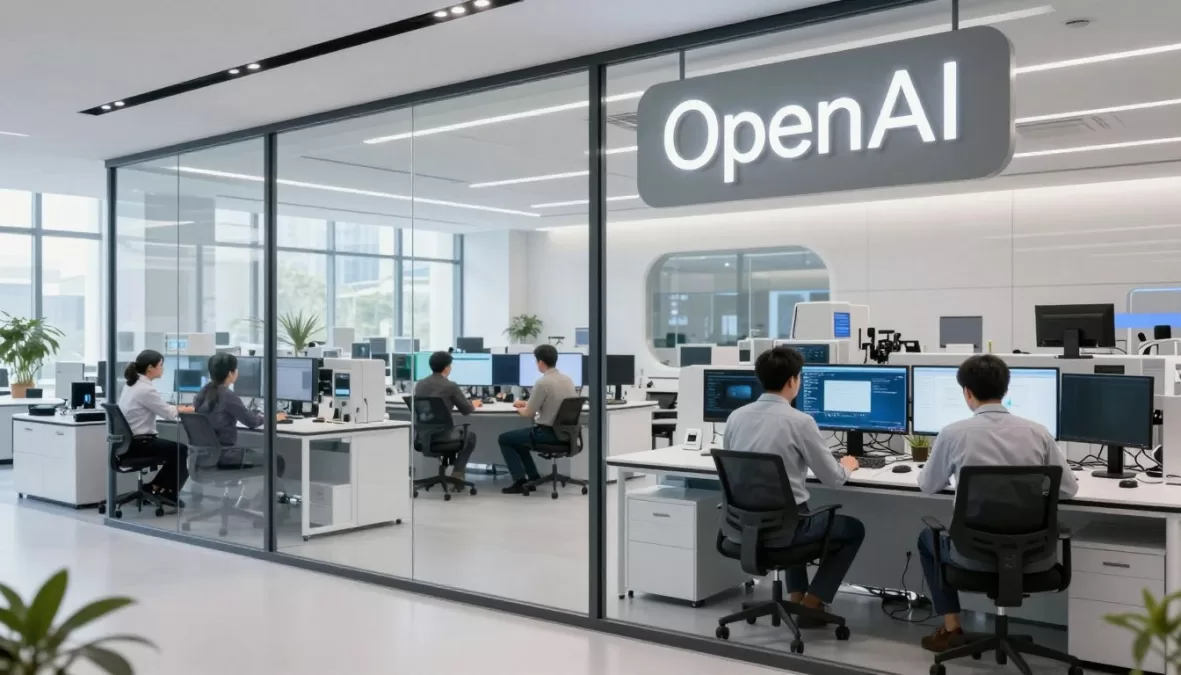
OpenAI maintains its position as the most influential AI company in 2026. Their GPT series models revolutionized how businesses and individuals interact with artificial intelligence.
The company generates over $15 billion in annual revenue through ChatGPT subscriptions and enterprise API services. More than 500 million people use their products monthly.
Revolutionary Product Development
OpenAI released GPT-5 in early 2026 with unprecedented capabilities. The model demonstrates human-level reasoning across complex tasks while consuming 40% less computational resources than its predecessor.
Their enterprise platform now serves 85% of Fortune 500 companies. These organizations use OpenAI’s tools for customer service, content creation, data analysis, and software development.
Strategic Partnerships and Growth
Microsoft’s continued investment strengthens OpenAI’s infrastructure capabilities. The partnership provides access to massive data center resources necessary for training next-generation models.
OpenAI recently expanded into autonomous agents that complete multi-step business processes. Early testing shows these AI systems reduce operational costs by 35% for participating companies.
2. Google DeepMind: Advancing AI Research and Applications

Google DeepMind represents the merged strength of Google’s AI initiatives and DeepMind’s research excellence. This combination created the world’s most comprehensive artificial intelligence research organization.
The company’s Gemini model family competes directly with OpenAI’s offerings. DeepMind’s systems demonstrate superior performance in mathematical reasoning and scientific research applications.
Breakthrough Scientific Achievements
DeepMind’s AlphaFold system solved protein structure prediction completely this year. This achievement accelerates drug discovery and biological research across the pharmaceutical industry.
Their AI models now assist researchers at over 2,000 universities and research institutions worldwide. These tools reduce research time from years to months for complex scientific problems.
Commercial Applications and Market Presence
Google integrates DeepMind technology across all products. Search, advertising, cloud services, and consumer applications all leverage these advanced AI systems for improved performance.
Research Innovation
DeepMind publishes more peer-reviewed AI research papers than any competitor. Their open approach accelerates industry-wide progress and establishes technical leadership.
Business Integration
Google Cloud Platform offers DeepMind models through simple APIs. Developers worldwide build applications using this infrastructure without managing complex AI systems.
The company operates 15 data center facilities optimized for AI training. These resources support continuous model improvement and rapid deployment of new capabilities.
3. Anthropic: Safety-Focused AI Development

Anthropic emerged as a major AI player through its focus on safe and reliable systems. The company’s Claude model family prioritizes helpful, harmless, and honest AI interactions.
Investors recognize this approach as essential for enterprise adoption. Anthropic raised $7 billion in funding last year at a $30 billion valuation.
Claude AI Model Leadership
Claude 3.5 Opus leads benchmark performance across reasoning tasks while maintaining strong safety characteristics. The model refuses harmful requests more effectively than competing systems.
Enterprise customers prefer Claude for sensitive applications. Financial services, healthcare, and legal industries choose Anthropic’s platform for its reliability and security features.
Constitutional AI Methodology
Anthropic developed Constitutional AI training techniques that embed ethical principles directly into model behavior. This innovation reduces harmful outputs without sacrificing capability.
Key Strengths
- Industry-leading safety protocols and ethical AI practices
- Superior performance on reasoning and analysis tasks
- Strong enterprise trust and adoption rates
- Transparent research and development approach
Growth Challenges
- Smaller market presence than OpenAI and Google
- Limited consumer brand recognition outside tech circles
- Higher pricing than some competitors for API access
The company partners with Amazon Web Services for infrastructure. This relationship provides computational resources and distribution channels to enterprise customers.
4. Microsoft: Enterprise AI Integration Leader

Microsoft leveraged its OpenAI partnership to dominate enterprise AI adoption. The company integrated artificial intelligence across its entire product portfolio during the past two years.
Copilot services now generate $12 billion annually. This makes Microsoft the largest enterprise AI software provider measured by revenue.
Comprehensive AI Product Suite
Microsoft 365 Copilot transforms how people work. The AI assistant helps users with emails, documents, presentations, and data analysis within familiar applications.
Over 300 million workers use Copilot features daily. Organizations report 30% productivity improvements for knowledge workers using these tools regularly.
Azure AI Infrastructure Leadership
Azure offers the most comprehensive cloud AI platform. Developers access hundreds of pre-trained models, custom training tools, and deployment services through unified interfaces.
| Product Category | Market Position | Annual Revenue | User Base |
| Microsoft 365 Copilot | Leader | $8.5B | 300M users |
| Azure AI Services | Leader | $6.2B | 500K businesses |
| GitHub Copilot | Leader | $2.8B | 5M developers |
| Dynamics 365 AI | Strong | $1.5B | 150K businesses |
GitHub Copilot revolutionized software development. Programmers write code 55% faster using AI suggestions and automated completion features.
The company operates 300+ data center locations worldwide. This infrastructure supports AI model training and inference at unprecedented scale.
5. NVIDIA: Powering AI Infrastructure

NVIDIA controls 95% of the AI chip market in 2026. Their GPUs remain essential for training and running large artificial intelligence models.
The company’s market value exceeds $3 trillion as AI demand drives unprecedented semiconductor sales. Revenue reached $120 billion last year.
Hardware Innovation Leadership
The Blackwell architecture launched this year delivers 4x performance improvements over previous generations. These chips enable training models with trillions of parameters efficiently.
Every major AI company depends on NVIDIA hardware. OpenAI, Google, Microsoft, and Meta operate data center facilities filled with hundreds of thousands of NVIDIA GPUs.
Software and Platform Development
NVIDIA CUDA software maintains dominance as the AI development platform. Millions of developers build applications using these tools and libraries.
The company expanded beyond hardware into AI software services. NVIDIA AI Enterprise provides complete solutions for businesses deploying artificial intelligence systems.
Data Center Chips
H100 and Blackwell GPUs power AI training worldwide. Supply constraints continue as demand exceeds production capacity despite massive manufacturing expansion.
Automotive AI
NVIDIA DRIVE platform leads autonomous vehicle development. Major automakers use this technology for self-driving systems and advanced driver assistance.
Edge AI Solutions
Jetson platform brings AI capabilities to robots, drones, and IoT devices. These systems enable real-time artificial intelligence processing at deployment locations.
Industry analysts project NVIDIA’s AI revenue will triple by 2028. The company invests $10 billion annually in research and development.
6. Amazon Web Services: Cloud AI Services

Amazon Web Services dominates cloud infrastructure for artificial intelligence workloads. AWS provides the foundation for thousands of AI companies and enterprise deployments.
The platform generated $25 billion from AI-related services last year. This positions AWS as the largest cloud AI provider measured by revenue and customer count.
Comprehensive AI Service Portfolio
AWS SageMaker simplifies machine learning model development. Data scientists build, train, and deploy models without managing complex infrastructure.
Bedrock service provides access to foundation models from Anthropic, Meta, and others through simple APIs. Customers choose the best model for each application.
Custom Silicon Innovation
Amazon developed Trainium and Inferentia chips specifically for AI workloads. These custom processors deliver 40% better price-performance than alternative solutions.
- SageMaker Studio for model development
- Distributed training on thousands of GPUs
- Automated hyperparameter optimization
- Cost optimization recommendations
AI Training Services
- Real-time prediction endpoints
- Batch transformation processing
- Serverless deployment options
- Multi-model hosting capabilities
AI Inference Services
- Healthcare AI compliance tools
- Financial services fraud detection
- Retail personalization engines
- Manufacturing quality control systems
Industry Solutions
AWS operates in 33 geographic regions with 105 availability zones. This global infrastructure enables low-latency AI applications worldwide.
7. Meta: AI for Consumer Applications

Meta deploys artificial intelligence to 3.8 billion users across Facebook, Instagram, and WhatsApp. This represents the largest AI deployment measured by daily active users.
The company invested $35 billion in AI development and infrastructure last year. These resources support content moderation, recommendation systems, and new product development.
Llama Open Source Leadership
Meta released Llama 3.1 as an open-source model rivaling proprietary alternatives. Over 2 million developers downloaded and deployed these models in custom applications.
This open approach disrupts traditional AI business models. Researchers and startups access state-of-the-art technology without massive infrastructure investments.
Reality Labs AI Innovation
Meta integrates artificial intelligence throughout its virtual reality products. AI-powered avatars, spatial understanding, and natural interaction systems enhance user experiences.
The company demonstrated AI assistants that understand context within VR environments. These agents help users with tasks, answer questions, and facilitate social interactions.
Meta AI assistant launched across all platforms with 500 million monthly users. The service answers questions, generates images, and helps with planning activities.
Need Help Selecting an AI Partner?
Our team has evaluated 200+ AI companies across every industry vertical. Let us help you find the perfect technology partner for your specific business requirements.
Free 30-minute strategy session • No obligation consultation
8. Apple Intelligence: Consumer Device AI

Apple launched Apple Intelligence in 2025 as a comprehensive AI system integrated across all devices. The company prioritizes privacy and on-device processing over cloud-based solutions.
Over 1.5 billion devices now run Apple Intelligence features. This installed base creates the world’s largest edge AI deployment.
Privacy-First AI Architecture
Apple’s AI processes most requests directly on user devices. This approach protects personal data while delivering fast responses without internet connectivity.
The company developed custom Neural Engine chips that enable powerful AI without compromising battery life. These processors run complex models efficiently on phones and tablets.
Practical Consumer Applications
Siri evolved into a truly intelligent assistant through Apple Intelligence. The system understands context, maintains conversation history, and controls device functions naturally.
Device Integration
Apple Intelligence works seamlessly across iPhone, iPad, Mac, and Vision Pro. Users start tasks on one device and continue on another without interruption.
The system learns individual preferences and usage patterns. Suggestions improve over time as AI models adapt to each person’s specific needs.
Key Features
- Writing assistance in all applications with style adaptation
- Photo organization and search using natural language
- Smart email summaries and priority inbox management
- Real-time translation across 20 languages
- Health insights from wearable sensor data analysis
- Proactive suggestions based on daily routines
Apple partners with OpenAI for complex queries requiring cloud processing. Users choose when to engage cloud services for enhanced capabilities.
9. Tesla: Autonomous Systems and Robotics

Tesla applies artificial intelligence to autonomous vehicles and humanoid robotics. The company collected more real-world driving data than all competitors combined.
Full Self-Driving systems now operate on 6 million vehicles. This fleet generates data that continuously improves AI model performance.
Autonomous Driving AI
Tesla’s neural networks process camera feeds to understand road environments completely. The system recognizes objects, predicts behavior, and plans safe paths in real-time.
Version 12 achieved significant milestones this year. The AI handles complex urban driving situations that previously required human intervention.
Optimus Humanoid Robot Development
Tesla adapted its vehicle AI technology to humanoid robots. Optimus bots demonstrate remarkable dexterity and task learning capabilities.
Competitive Advantages
- Largest real-world autonomous driving dataset
- Custom AI training infrastructure with Dojo supercomputer
- Vertical integration from chips to finished products
- Rapid iteration cycles and continuous improvement
Market Challenges
- Regulatory approval process for full autonomy remains slow
- Safety concerns persist around supervised self-driving
- Competition intensifies from traditional automakers
The company plans to deploy thousands of Optimus robots in its factories this year. These machines handle repetitive tasks and work alongside human employees.
Tesla’s Dojo supercomputer ranks among the world’s most powerful AI training systems. This infrastructure processes petabytes of driving data monthly.
10. Midjourney: Creative AI Pioneer

Midjourney revolutionized AI-generated imagery and established creative artificial intelligence as a legitimate industry. Over 20 million users create images through the platform monthly.
The company operates profitably with just 40 employees. This efficiency demonstrates how AI companies can scale without traditional organizational structures.
Image Generation Excellence
Midjourney Version 6 produces photorealistic images indistinguishable from professional photography. Artists, designers, and marketers use these tools daily for creative projects.
The platform understands complex artistic styles and composition principles. Users describe desired images in natural language and receive multiple variations instantly.
Creative Industry Transformation
Advertising agencies now produce campaign concepts in hours instead of weeks. Midjourney enables rapid visual exploration of creative directions before committing production resources.
Professional Design
Graphic designers use Midjourney for concept development and client presentations. The AI accelerates creative workflows while maintaining artistic control.
Content Creation
Publishers generate custom illustrations and featured images instantly. Social media managers create engaging visual content at unprecedented scale.
Product Visualization
E-commerce businesses visualize products in various settings. Furniture companies show items in different room styles without physical staging.
Film studios experiment with Midjourney for storyboarding and concept art. Directors visualize scenes before expensive production begins.
The platform recently added video generation capabilities. Users create short clips from text descriptions, expanding creative possibilities beyond static images.
Key Market Trends Shaping AI in 2026
Several powerful trends define the artificial intelligence landscape this year. These patterns reveal where the industry moves and which strategies succeed.
Enterprise Adoption Acceleration
Businesses of all sizes now implement AI systems. What began as experimental projects evolved into core operational infrastructure.
Companies invest an average of $12 million annually in AI initiatives. This spending covers software, infrastructure, training, and specialized personnel.
Platform Consolidation
Organizations prefer comprehensive platforms over point solutions. Single vendors that provide multiple AI capabilities win against specialized competitors.
Integration complexity drives this trend. Companies want tools that work together seamlessly rather than managing dozens of separate AI systems.
Specialized Models Growth
Industry-specific AI models outperform general-purpose alternatives for specialized tasks. Healthcare, legal, and financial services deploy custom-trained systems.
These vertical solutions understand domain terminology and comply with industry regulations. Accuracy improvements justify development costs for large organizations.
Autonomous Agents Emergence
AI agents that complete multi-step tasks independently represent the next evolution. These systems plan approaches, use tools, and achieve goals with minimal human guidance.
Customer service agents handle 70% of inquiries without human intervention. Research agents analyze data, identify patterns, and generate insights automatically.
Open Source Momentum
Open source AI models challenge proprietary platforms. Meta’s Llama, Mistral’s models, and others provide capabilities comparable to commercial alternatives.
Developers customize these foundation models for specific applications. This flexibility creates competitive advantages impossible with closed systems.
- Multimodal models processing text, images, audio, video simultaneously
- Extended context windows remembering entire conversations and documents
- Improved reasoning capabilities for complex problem-solving
- Reduced computational requirements through efficiency improvements
- Enhanced factual accuracy and reduced hallucinations
Technical Innovations
- 40% average productivity increase for knowledge workers using AI tools
- $2.8 trillion projected annual economic value from AI by 2028
- 65% of companies report competitive advantages from AI adoption
- New job categories created around AI system management and optimization
- Shift toward outcome-based AI pricing models instead of usage-based
Business Impacts
- EU AI Act implementation requiring compliance across member states
- US state-level AI regulations creating compliance complexity
- Copyright and intellectual property frameworks adapting to AI
- Data privacy requirements strengthening for AI training data
- Safety testing requirements for high-risk AI applications
Regulatory Developments
Investment Landscape for AI Companies
Venture capital firms invested $127 billion in AI companies last year. This represents 45% of all technology investment dollars.
Public markets value leading AI companies at unprecedented multiples. Investors believe artificial intelligence will transform every industry over the next decade.

Funding Patterns and Valuations
Late-stage AI startups raise rounds exceeding $500 million regularly. OpenAI, Anthropic, and others command multi-billion dollar valuations before achieving profitability.
Infrastructure companies supplying picks and shovels to AI builders attract substantial investment. Data center operators, chip designers, and cloud platforms benefit from sustained demand.
| Investment Category | 2025 Funding | 2026 Projection | Growth Rate |
| Foundation Model Companies | $42B | $58B | +38% |
| Enterprise AI Applications | $35B | $48B | +37% |
| AI Infrastructure | $28B | $39B | +39% |
| Vertical AI Solutions | $22B | $32B | +45% |
Investor Considerations
Technology differentiation matters more than ever. Investors scrutinize whether companies possess unique data, algorithms, or distribution advantages.
Path to profitability receives increased attention. The era of growth-at-all-costs ended as investors demand clear revenue models and realistic unit economics.
Expert Insight: Successful AI investments in 2026 focus on companies with defensible competitive advantages, clear product-market fit, and realistic paths to sustained profitability within 2-3 years. Infrastructure providers and vertical-specific solutions show strongest returns.
AI Implementation Strategies for Businesses
Organizations approaching AI adoption follow proven frameworks that maximize success probability. Random experimentation wastes resources and delivers disappointing results.
Structured Adoption Framework
Successful companies start with specific use cases demonstrating clear ROI. Pilot projects prove value before organization-wide rollouts.
Assessment Phase
- Identify high-impact processes suitable for AI automation
- Evaluate existing data quality and availability
- Assess internal technical capabilities and skill gaps
- Define success metrics and measurement approaches
- Estimate required investment and expected returns
Implementation Phase
- Select appropriate AI platforms and vendors
- Train core team members on systems and best practices
- Deploy initial pilot projects with defined scopes
- Measure results against established success criteria
- Scale successful implementations across organization
Common Implementation Challenges
Data quality issues derail most AI projects. Models require clean, organized information to produce accurate results.
Organizations spend 60% of AI project time on data preparation. This unglamorous work determines whether systems deliver value or fail completely.
Best Practice: Companies achieving fastest AI adoption success designate executive sponsors for initiatives, invest heavily in change management, and celebrate early wins publicly to build organizational momentum.
Vendor Selection Criteria
Choosing the right AI company partners requires evaluating multiple factors beyond technical capabilities. Long-term viability and support quality matter as much as current features.
- Technical performance on relevant benchmarks and use cases
- Integration capabilities with existing systems and workflows
- Data security practices and compliance certifications
- Pricing model transparency and predictability
- Vendor financial stability and market position
- Customer support quality and response times
- Development roadmap alignment with business needs
Future Outlook: AI Industry Beyond 2026

The artificial intelligence industry continues evolving rapidly beyond current capabilities. Several trajectories appear likely based on current development patterns.
Artificial General Intelligence Progress
Researchers debate whether AGI emerges within five years or remains decades away. Current systems demonstrate narrow intelligence rather than general reasoning abilities.
Leading companies invest billions pursuing human-level AI. OpenAI, DeepMind, and others believe AGI represents the ultimate goal worth substantial resource allocation.
Industry Consolidation Expectations
Market forces push toward consolidation around leading platforms. Smaller companies either find profitable niches or face acquisition by larger players.
The pattern mirrors earlier technology cycles. Initial fragmentation gives way to dominant platforms that capture most economic value.
Likely Developments
- AI agents handling complex multi-day projects independently
- Seamless integration across all software applications
- Dramatic cost reductions making AI accessible universally
- New interface paradigms beyond text and voice
- Breakthrough scientific discoveries accelerated by AI research
- Personalized AI assistants knowing individual preferences deeply
Persistent Challenges
Bias and fairness issues require ongoing attention. AI systems amplify existing societal biases present in training data.
Energy consumption concerns intensify as model sizes grow. Training largest models requires power equivalent to small cities.
Job displacement fears create political pressure for regulation. Governments balance innovation encouragement against worker protection.
Competitive Landscape Evolution
Today’s leaders face continuous challenges from new entrants with breakthrough innovations. No company maintains dominance forever in fast-moving technology markets.
Open source alternatives democratize access to AI capabilities. This prevents any single company from controlling artificial intelligence development completely.
Ready to Transform Your Business with AI?
You’ve discovered the top AI companies leading innovation in 2026. Now take the next step toward implementing artificial intelligence in your organization.
Get strategic insights, implementation case studies, and practical guidance delivered monthly. Join thousands of business leaders staying ahead of AI trends.
Bonus: Subscribers receive our quarterly AI implementation report ($299 value) free.
Conclusion: Navigating the AI Revolution
The top AI companies in 2026 demonstrate the transformative power of artificial intelligence across industries. These organizations invest billions developing systems that fundamentally change how businesses operate and people work.
OpenAI, Google DeepMind, and Anthropic push the boundaries of what AI models can achieve. Microsoft, Amazon, and others make these capabilities accessible to millions of businesses worldwide.
NVIDIA provides the infrastructure powering this revolution. Apple, Meta, and Tesla deploy AI at unprecedented scale across consumer products and services.
The artificial intelligence industry continues evolving rapidly. New capabilities emerge monthly as research teams make breakthroughs and engineering organizations deploy improved systems.
Organizations that embrace AI thoughtfully gain competitive advantages. Those that ignore these technologies risk falling behind as competitors leverage artificial intelligence for superior products, services, and operations.
Success requires selecting appropriate partners, implementing systems strategically, and maintaining realistic expectations. AI delivers tremendous value when applied to suitable problems with proper planning and execution.
The companies featured in this list will continue leading innovation through 2026 and beyond. Their products, research, and investments shape the future of artificial intelligence for everyone.

Priyanka Pandey
Senior Research Editor · Top10Sense
Priyanka specializes in tech, consumer products, and digital trends. She combines hands-on testing, vendor interviews, and database research to create trustworthy “Top 10” rankings. Her work has been referenced by industry blogs and brand report pages.