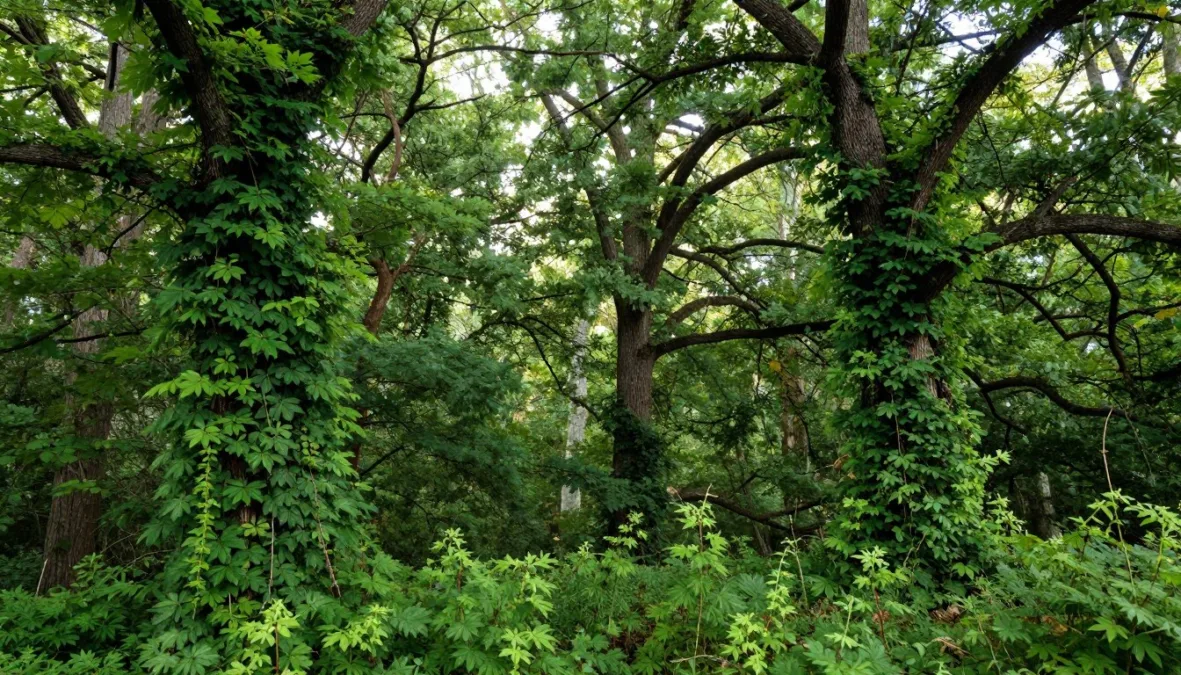
Invasive organisms disrupt native habitats, alter soil composition, clog waterways, and cost billions of dollars in agricultural and infrastructural losses every year. The top 10 invasive species in the US represent non-native plants, insects, aquatic creatures, and mammals that spread aggressively without natural predators to keep populations in check. Effective containment relies on early detection, biological controls, mechanical removal, and coordinated reporting across regional borders.
A species receives the invasive designation only when its introduction causes measurable economic, environmental, or public health harm. Understanding the origins, transport routes, and behaviors of these organisms helps land managers and residents protect vulnerable ecological communities.
Distinguishing Invasive Organisms From Native Species
Biologists categorize an organism as invasive when it is non-native to a specific ecosystem and causes ecological, financial, or physical harm. Native species can occasionally produce population surges or cause localized nuisances, but they maintain established ecological relationships with regional predators, competitors, and pathogens.
True invasive species arrive outside their natural geographic range through accidental shipping transport, deliberate horticultural trade, or releases from captivity. Without co-evolved checks and balances, these organisms outcompete endemic wildlife for food, nesting cavities, moisture, and sunlight.
- Co-evolved naturally with regional predators and food webs
- Provides ecological services despite periodic boom cycles
- Self-regulates through localized disease, weather, and competition
Native Abundant Wildlife
- Introduced through human activity across geographic barriers
- Lacks specialized natural predators in the recipient habitat
- Displaces endemic taxa and degrades structural soil or water systems
Invasive Alien Organisms
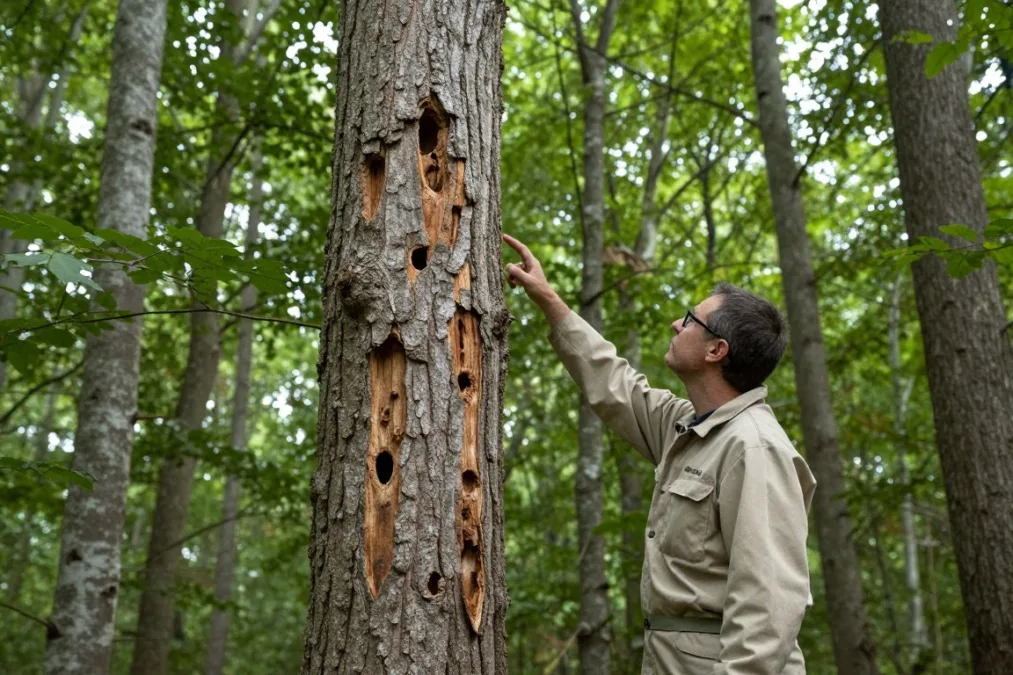
Field monitoring helps biologists track structural habitat shifts caused by introduced pests.
1. Feral Swine (Sus scrofa)
Feral swine, also known as wild boars, razorbacks, or feral pigs, descend from domesticated swine introduced by European settlers alongside Eurasian wild boars imported for hunting. These highly adaptable omnivores now occupy dozens of states across the South, West, and Midwest. Their continuous rooting, trampling, and wallowing strip native vegetation and accelerate riverbank erosion.
Beyond landscape destruction, feral pigs destroy commercial agricultural crops including corn, soybeans, and peanuts. They prey directly on ground-nesting birds, reptiles, and amphibians while transmitting dangerous diseases such as pseudorabies, swine brucellosis, and classical swine fever to domestic livestock herds and wildlife.
Feral swine wallowing contaminates freshwater creeks with agricultural pathogens, threatening municipal watersheds and creating severe health risks for both domestic livestock and people.
State natural resource departments and federal agricultural agencies employ corral trapping, aerial surveillance, and targeted culling to limit herd expansion. Wildlife managers advise private landowners against amateur hunting clubs, which often encourage illegal releases and exacerbate herd dispersal into uncolonized woodlands.
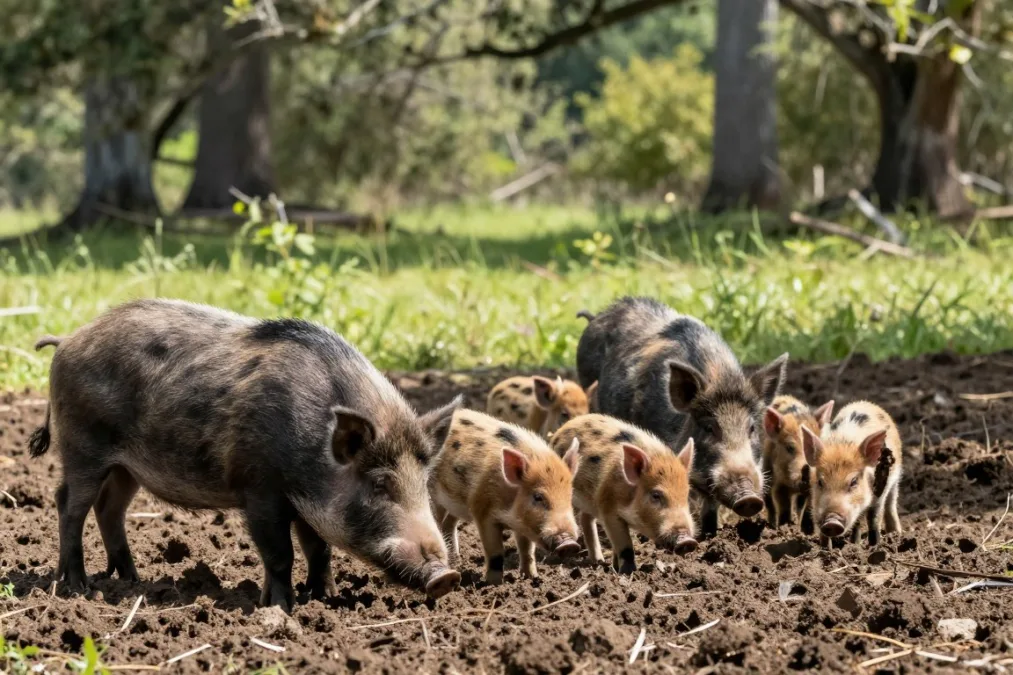
Rooting behavior by wild pigs leaves deep trenches that destabilize soil integrity.
2. Emerald Ash Borer (Agrilus planipennis)
The emerald ash borer is a jewel beetle native to northeastern Asia, northern China, and eastern Russia. First detected in North America near Detroit during the summer of 2002, the beetle arrived in the United States via solid wood packing materials used in international cargo. It has since spread to more than thirty-five states, devastating native ash trees in rural forests and urban park systems.
Adult beetles nibble ash foliage, causing minimal harm, but their larvae feed on the inner bark and phloem tissue just beneath the surface. These winding larval galleries disrupt the tree’s vascular network, blocking the transport of water and vital nutrients. Infested ash trees exhibit canopy dieback, epicormic sprouting, and distinctive D-shaped exit holes, with tree mortality typically following within a few years of infestation.
| Factor | Vulnerability | Ecological Impact |
| Ash Canopy | Critical | Extensive canopy loss opens forest floors to aggressive weed invasions. |
| Urban Forests | Severe | Municipalities face high removal expenses for hazardous dead street trees. |
| Native Seedlings | Moderate | Depleted seed banks threaten the long-term presence of ash species in wetlands. |
Quarantines restrict the movement of untreated firewood, nursery stock, and timber products across county lines. Forestry organizations release host-specific parasitoid wasps, such as Tetrastichus planipennisi, to prey on developing larvae, while property owners protect valuable individual trees through trunk micro-injections of systemic emamectin benzoate.
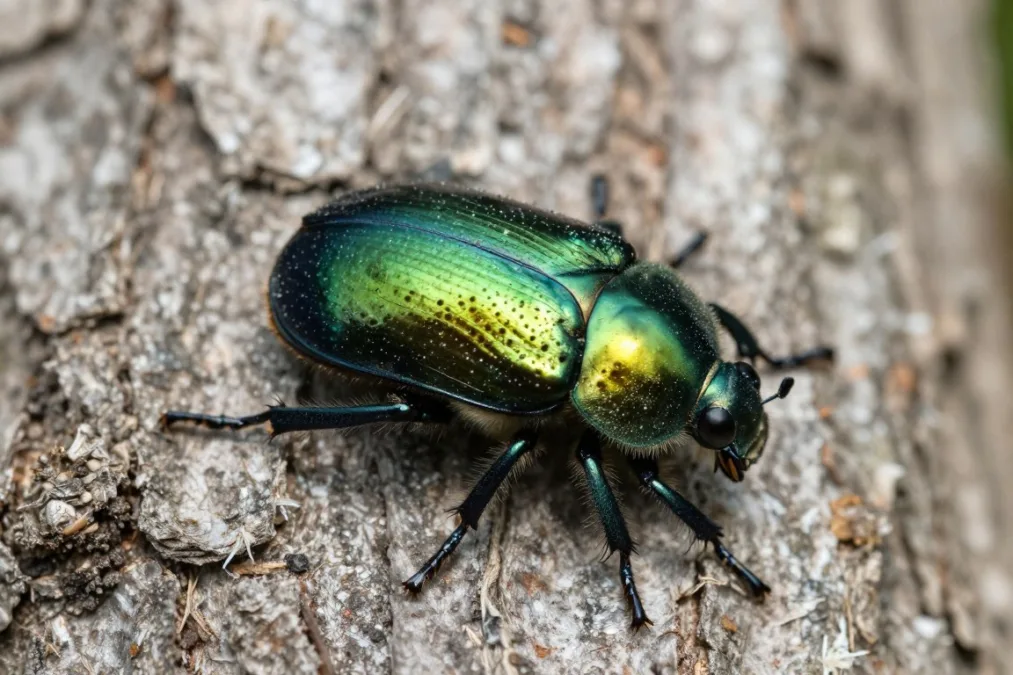
The iridescent wood-boring insect continues to threaten forest ash populations across North America.
3. Zebra Mussel (Dreissena polymorpha)
Originating in the freshwater lakes and basins of southern Russia and Ukraine, the zebra mussel arrived in the Great Lakes region during the late 1980s through ballast water discharges from transoceanic ships. These fingernail-sized bivalves quickly colonized every Great Lake, spreading into the Mississippi River basin, adjacent river tributaries, and Western water reservoirs via recreational watercraft.
Zebra mussels form dense colonies by attaching to hard underwater surfaces with strong byssal threads. They encrust water intake conduits, hydroelectric cooling valves, bridge pillars, and boat hulls. By filtering immense quantities of plankton, massive mussel colonies strip the water column of foundational food resources needed by native fish, triggering dramatic declines in regional aquatic food webs.
Mussel colonies filter microscopic organisms out of the water column so thoroughly that increased water clarity promotes toxic blue-green algae blooms along nearshore environments.
Control strategies emphasize thorough decontamination of civilian watercraft through the Clean, Drain, and Dry initiative. Industrial facilities and municipal utilities run chemical pipelines, copper ion treatments, and mechanical pressure scraping to keep water pipelines and cooling conduits functional.
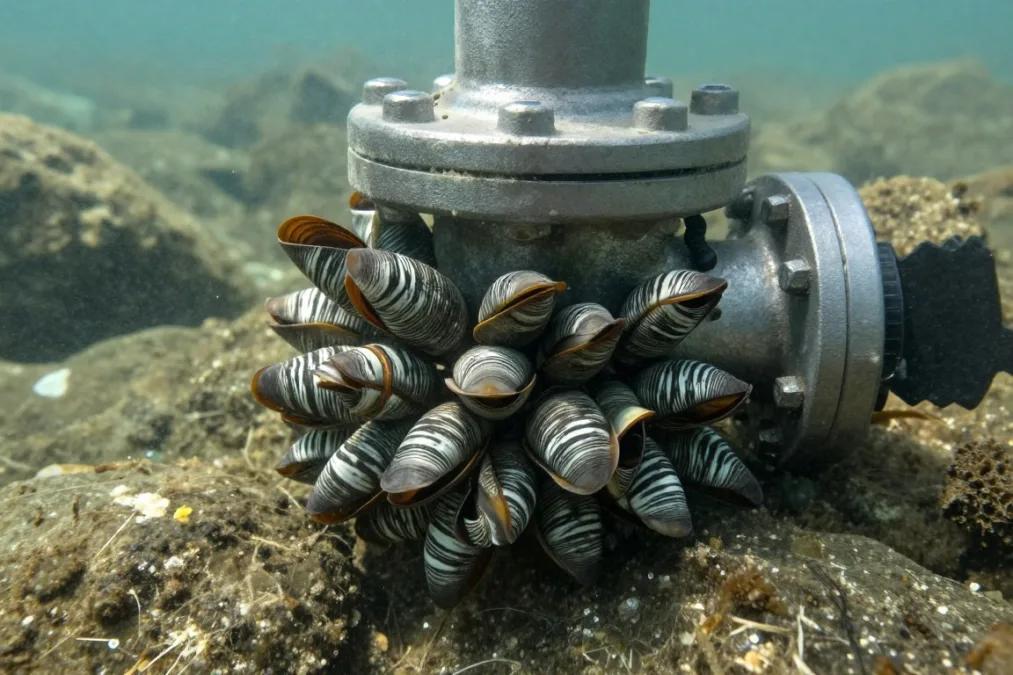
Dense clusters of striped mussels cling to infrastructure and intake pipes.
4. Kudzu (Pueraria montana var. lobata)
Native to eastern and southeastern Asia, kudzu was introduced to the United States as an ornamental plant at the 1876 Philadelphia Centennial Exposition. Agricultural agents later encouraged widespread planting during the mid-twentieth century for livestock pasture forage and soil erosion control on steep highway embankments. The hardy, semi-woody vine found optimal growing conditions across the humid southeastern states.
Kudzu spreads rapidly across roadsides, utility corridors, and forest borders through vegetative runners and rooting stem nodes. Its thick canopy of broad leaves blankets mature trees, utility poles, and abandoned structures, starving underlying flora of direct solar radiation. The sheer weight of mature vines pulls down branches and snaps structural timber during windstorms.
- Covers thousands of acres of timberland, preventing commercial forest regeneration
- Breaks utility lines and topples poles during periods of heavy seasonal growth
- Harbors the fungal pathogen known as soybean rust, posing indirect threats to row crops
Management involves recurring mechanical mowing, prescribed grazing with goats, and focused applications of broadleaf herbicides over multiple growing cycles. Eradication demands patience because the plant stores expansive carbohydrate reserves inside massive underground root crowns that resprout following standard foliar clearing.
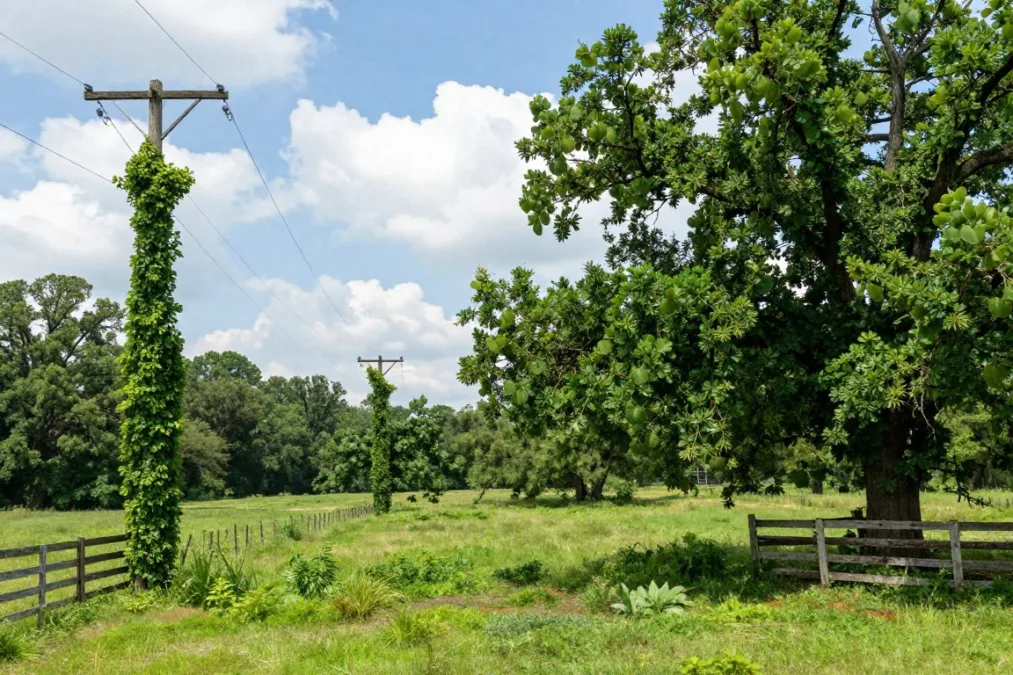
The aggressive deciduous vine climbs and smothers native tree canopies across the South.
5. Asian Carp (Invasive Carp Species)
The term Asian carp refers to four related carps native to eastern Asia: the silver carp (Hypophthalmichthys molitrix), bighead carp (Hypophthalmichthys nobilis), black carp (Mylopharyngodon piceus), and grass carp (Ctenopharyngodon idella). Fish hatcheries and wastewater treatment facilities imported these species during the 1960s and 1970s to clean aquaculture ponds and manage nuisance aquatic vegetation. Seasonal floodwaters along the Mississippi and Illinois rivers subsequently allowed them to escape into public watersheds.
These fish multiply rapidly, consuming vast quantities of plankton, aquatic snails, and submerged vegetation. Silver carp and bighead carp outcompete native filter feeders like paddlefish and gizzard shad. Silver carp also jump out of the water when startled by boat engines, causing equipment damage and severe physical injuries to recreational boaters.
State agencies promote commercial harvest programs under the consumer name copi, processing the protein-rich fish for institutional dining, pet food, and fertilizer.
The United States Army Corps of Engineers and regional partnerships operate underwater electrical dispersal barriers near Chicago to prevent schools from establishing reproducing colonies in the Great Lakes. Biologists also monitor environmental DNA (eDNA) in regional channels to identify new entry pathways before fish schools arrive.
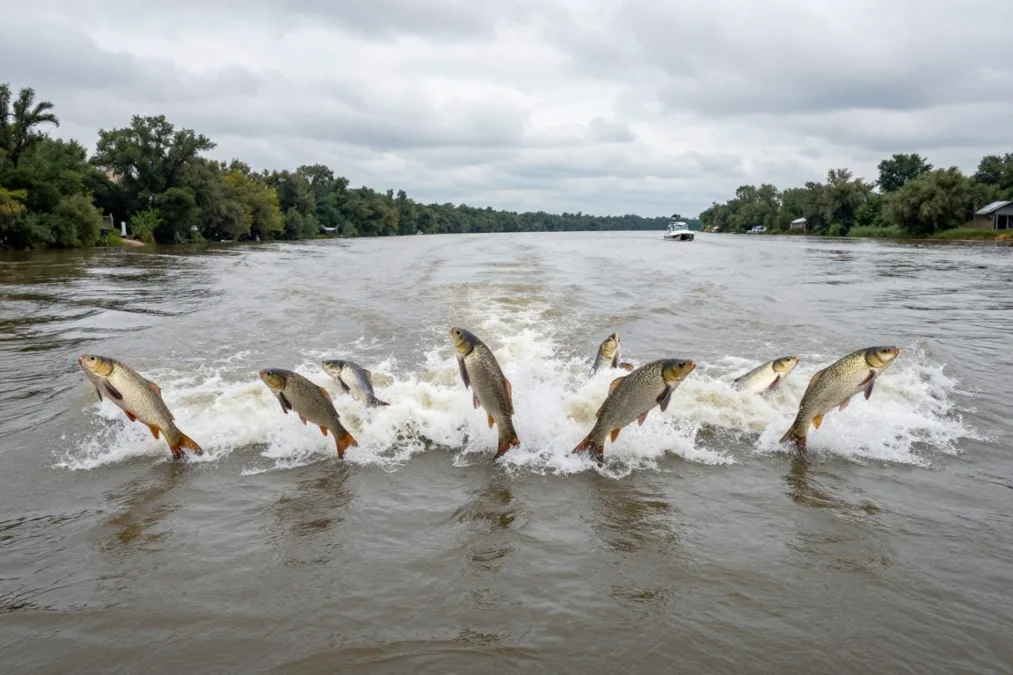
Startled silver carp leap high out of river waters when triggered by motor vibrations.
6. Spotted Lanternfly (Lycorma delicatula)
The spotted lanternfly is a planthopper indigenous to China, Vietnam, and parts of India. It was first observed in Berks County, Pennsylvania, having arrived hidden on stone slab shipments imported from overseas. Since its initial identification, this planthopper has expanded across Mid-Atlantic, Midwestern, and Appalachian agricultural valleys.
The insect feeds on more than seventy plant species, with strong preferences for the invasive tree of heaven (Ailanthus altissima), cultivated grapevines, apple orchards, and hardwood timber. As nymphs and adults feed on plant sap, they secrete a sticky, sugary excretion called honeydew. This fluid accumulates on leaves, fruit, and patios, fueling the growth of dense black sooty mold that halts photosynthesis and degrades commercial crops.
Early Nymph
Appears wingless with white spots on a shiny black body, feeding on tender foliage during late spring.
Late Nymph
Develops bright red coloration with black bars and white spots before molting into winged adulthood.
Adult Hopper
Displays gray-spotted forewings over scarlet underwings, laying mud-like egg masses on vertical surfaces.
Control methods include scraping and destroying the gray, putty-textured egg masses from tree trunks and stone surfaces during winter months. Vineyard operators apply systemic insecticides, trap feeding nymphs with sticky bands, and systematically remove wild tree of heaven groves to reduce core breeding reservoirs.
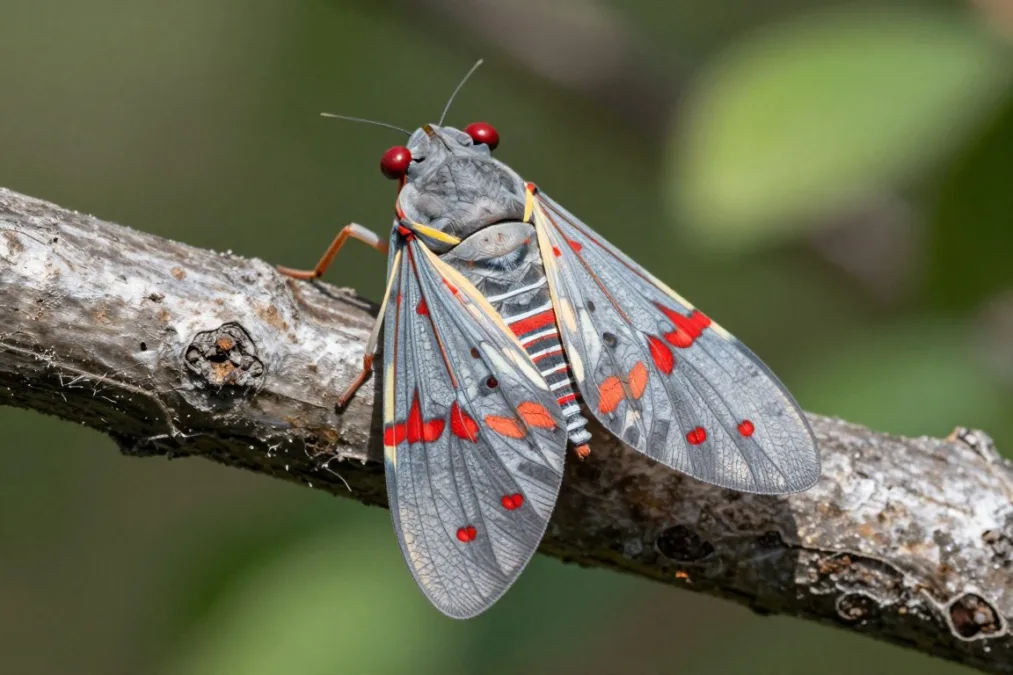
The distinctive planthopper threatens commercial vineyards, stone fruit orchards, and hardwood timber.
7. Burmese Python (Python bivittatus)
Native to the marshes, tropical jungles, and river valleys of Southeast Asia, the Burmese python established breeding populations across southern Florida following accidental escapes and irresponsible pet releases during the late twentieth century. Hurricanes, including Hurricane Andrew, destroyed breeding facilities in the Everglades region, releasing large numbers of snakes directly into marshlands. The apex predator now occupies vast portions of Everglades National Park and Big Cypress National Preserve.
These massive constrictors possess voracious appetites, preying on a wide variety of native mammals, birds, and occasional alligators. Ecologists have documented severe population crashes among native mid-sized mammals across the Everglades, with marsh rabbits, foxes, and raccoons disappearing from many surveyed corridors. Pythons also prey on federally protected species, such as wood storks and Key Largo woodrats.
Everglades wildlife inventories note steep drops in marsh rabbit, opossum, and raccoon sightings across primary python territory compared to pre-invasion levels.
Florida natural resource agencies and national park rangers employ contracted python contractors to remove wild constrictors year-round. Wildlife researchers also track radio-tagged male sentinel snakes during mating periods to discover and eliminate hidden female clutches deep within the sawgrass.
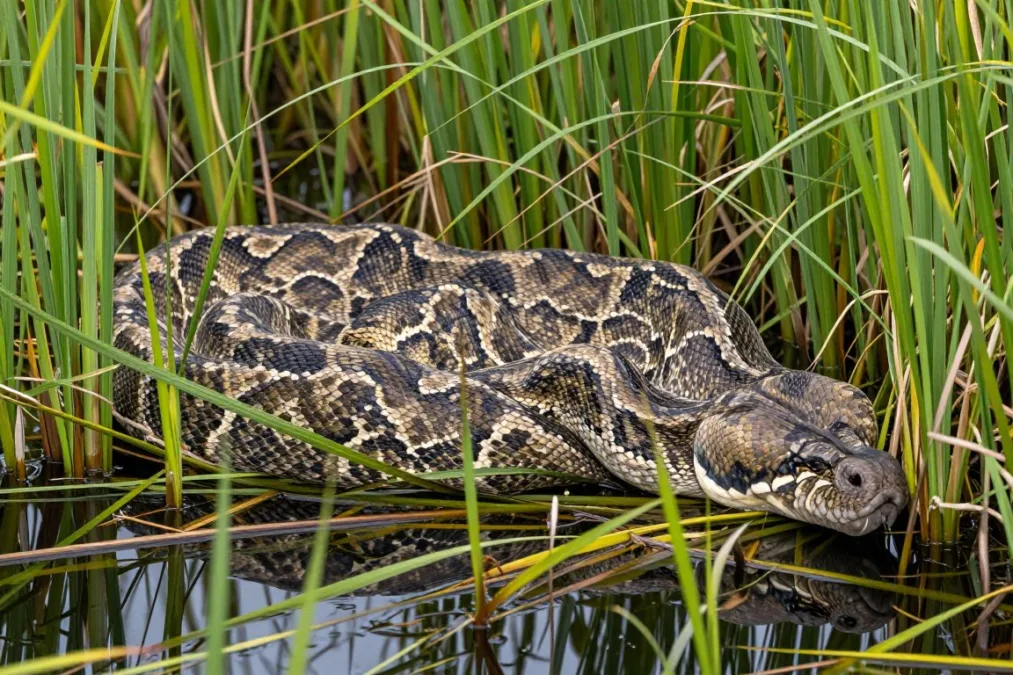
The Southeast Asian apex predator disrupts natural mammal food webs in sub-tropical wetlands.
8. European Starling (Sturnus vulgaris)
The European starling originated throughout Europe, northern Africa, and western Asia. Its introduction to North America traces directly to deliberate releases in New York City’s Central Park during the early 1890s by enthusiasts attempting to introduce all birds mentioned in William Shakespeare’s works. From those initial flocks, starlings multiplied and expanded across the entire continental landmass, with wild populations numbering into the hundreds of millions.
Starlings gather in massive winter flocks known as murmurations that roost in urban neighborhoods, commercial feedlots, and fruit orchards. These flocks eat grain intended for dairy and beef cattle while contaminating agricultural feed supplies with droppings that harbor bacterial diseases, such as histoplasmosis and salmonella. Starlings are aggressive cavity nesters that drive native woodpeckers, bluebirds, and swallows out of their natural nesting holes.
- Evicts endemic songbirds and woodpeckers from hollow tree cavities and nest boxes
- Spreads structural bird droppings that corrode bridge steel and degrade building masonry
- Creates bird-strike hazards for commercial aviation near metropolitan runways
Landowners manage starling infestations by closing structural gaps on barns and installing specialized exclusion nets over commercial fruit trees. Conservationists deploy targeted nest boxes with species-specific entrance holes to provide nesting opportunities for native bluebirds while keeping larger starlings out.
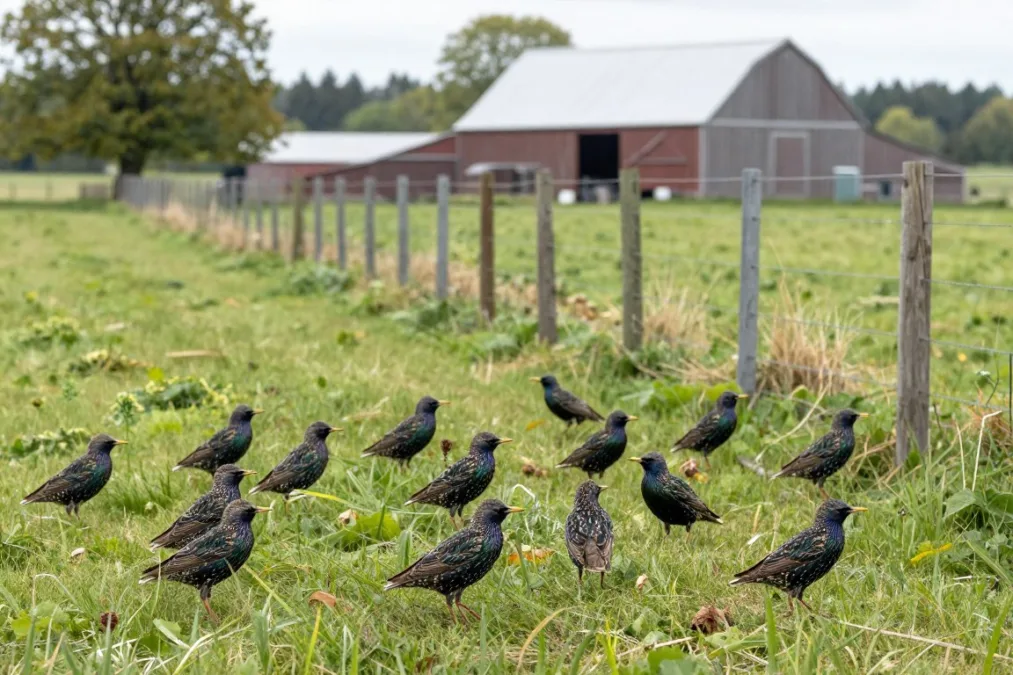
Aggressive competition for tree cavities displaces native songbirds from established habitats.
9. Nutria (Myocastor coypus)
The nutria, or coypu, is a large semi-aquatic rodent native to southern South America. Fur farmers imported the animals to California, Washington, and the Gulf Coast during the early twentieth century to establish captive breeding colonies for pelt harvesting. Collapsing pelt markets and accidental storm escapes allowed nutria to establish feral colonies in the bayous, coastal marshes, and river deltas of Louisiana, the Chesapeake Bay, and the Pacific Northwest.
Nutria consume aquatic plants down to their basal root systems, an activity known as eat-outs. By severing the root network that binds coastal marsh mud together, nutria cause fragile wetlands to wash out into open water channels. Their extensive burrows also weaken agricultural irrigation dikes, drainage canals, and protective earthen flood levees.
Nutria tail bounty programs in southern states encourage recreational trappers to participate directly in coastal wetland conservation efforts.
Eradication campaigns have succeeded in sensitive regions like the Chesapeake Bay through intensive trapping, GPS tracking, and detector dog patrols. Continuing suppression in the Gulf Coast relies on incentive harvest payments alongside regular perimeter inspections of river dikes and drainage berms.
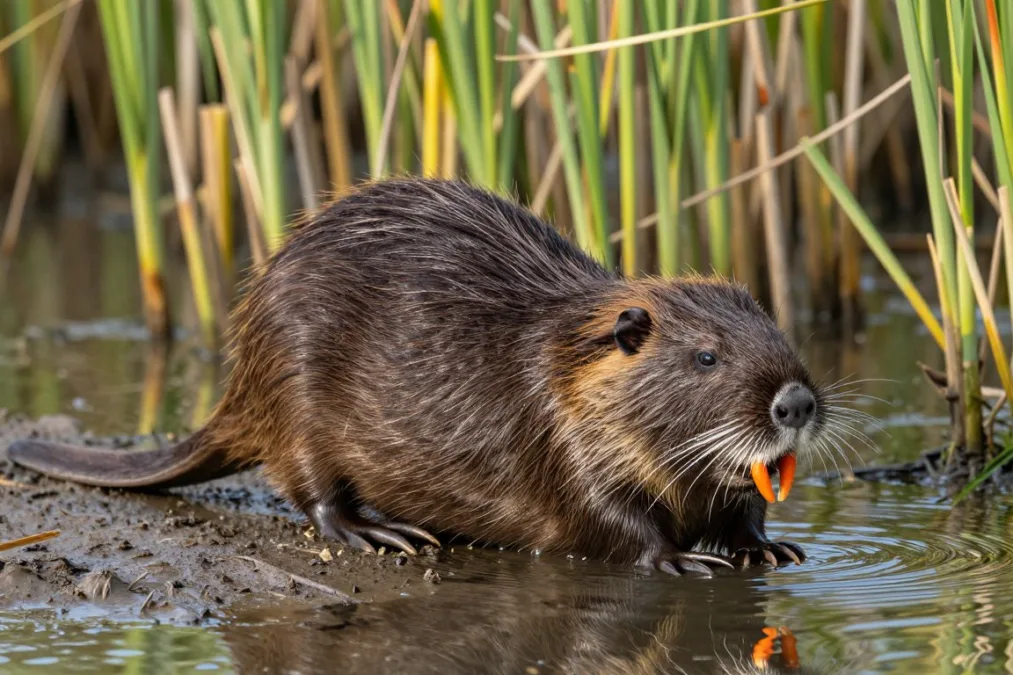
The semi-aquatic rodent’s heavy feeding habits weaken the root systems of coastal wetlands.
10. Red Imported Fire Ant (Solenopsis invicta)
Native to the central interior of South America, the red imported fire ant entered the United States through the commercial port of Mobile, Alabama, around the 1930s inside ship cargo ballast. The ants quickly colonized warm soils across the South and Southwest, with isolated populations appearing in parts of California. They thrive in open pastures, suburban lawns, roadside shoulders, and warm agricultural fields.
Fire ants build large, dome-shaped earthen mounds that ruin agricultural mowing machinery and combine headers. Unlike native ants that bite, fire ants latch on with their mandibles and inject an alkaloid venom via abdominal stingers, causing burning pustules on livestock, pets, and people. They kill ground-nesting birds, newly hatched reptiles, and beneficial native invertebrates while attacking electrical equipment, frequently causing short circuits in air conditioner relays and utility junctions.
Fire ant venom triggers severe allergic reactions and anaphylaxis in sensitive individuals, requiring immediate medical intervention after multiple stings.
Control programs employ a two-step management strategy featuring broadcast bait applications followed by spot drenching of active mounds. Biological controls, such as the introduction of decapitating phorid flies (Pseudacteon species) and microsporidian pathogens, assist in weakening competitive pressure from supercolonies.
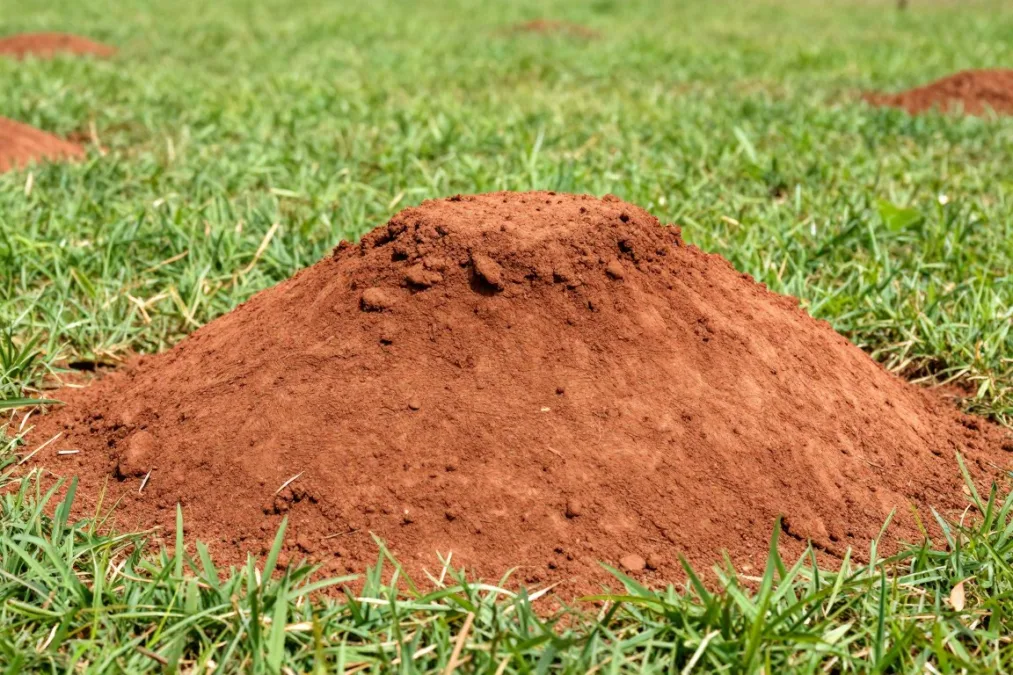
Raised dirt mounds cause damage to farm equipment and disrupt domestic pasture lands.
Frequently Asked Questions
What is the difference between an invasive species and a non-native species?
A non-native species lives outside its historical geographic range but does not necessarily disrupt its new environment. An invasive species is a non-native organism whose population growth causes direct economic, ecological, or physical harm to native habitats and human communities.
How do invasive insects spread across state borders so quickly?
Insects frequently hitchhike unnoticed in untreated firewood, nursery stock, landscaping mulch, and commercial freight palettes. Moving firewood from an infested area into an uncolonized campsite is one of the primary pathways for long-distance pest transfers.
Why cannot natural predators simply keep invasive species under control?
Invasive species arrive without the specialized insects, predators, fungi, or viruses that naturally regulated their numbers back in their home continents. Native predators in the new region frequently fail to recognize the foreign organism as a viable food source.
What should people do if they spot a suspected invasive species?
Take clear photos of the organism and record the precise geographic coordinates before touching or moving anything. Report the sighting promptly to your state department of agriculture, local university extension office, or regional wildlife resources agency.
Stopping the Spread Through Citizen Action
Halting the expansion of invasive species requires vigilance from boaters, hikers, gardeners, and pet owners. Cleaning outdoor gear, buying local firewood, choosing native landscape plants, and never releasing exotic pets into the wild help protect American ecosystems from permanent disruption.
Simple preventive habits like inspecting boat hulls, reporting strange insects to county extension agents, and planting indigenous regional flora support ecological balance across public lands.

Priyanka Pandey
Senior Research Editor · Top10Sense
Priyanka specializes in tech, consumer products, and digital trends. She combines hands-on testing, vendor interviews, and database research to create trustworthy “Top 10” rankings. Her work has been referenced by industry blogs and brand report pages.