Terrestrial locomotion reaches its highest velocity among specialized quadrupeds adapted for immediate pursuit or rapid evasion. Across grasslands and savannahs, the fastest animals on land share elongated limbs, highly flexible spines, enlarged respiratory channels, and specialized foot surfaces that maximize ground traction.
Ecological pressures dictate whether a species develops explosive acceleration over short ground distances or sustained cardiovascular endurance across open terrain. Habitat structure, predatory strategies, and the physiological trade-offs between muscle mass and energy consumption determine these distinct survival mechanics.
Velocity, Survival, and Measurement Challenges
Locomotor velocity directly dictates survival outcomes by governing foraging success and predator avoidance. Carnivores depend on bursts of acceleration to close distances before prey can react, while grazing herbivores rely on early detection and sustained speed to outdistance attackers.
Quantifying animal velocity presents persistent field challenges due to changing terrain, variable observation tools, and the physiological context of the sprint. Documented estimates frequently vary because researchers use different measurement methods, ranging from radar guns and vehicle pacing to high-speed satellite telemetry and calibrated multi-camera video analysis.
Physical condition, tailwinds, and running surface also introduce measurable performance variations. A sprint across flat, sun-baked earth yields higher peak velocities than an escape run across broken scrubland or soft mud.
Field studies distinguish between short-burst sprinting and sustained aerobic velocity. Short-burst sprinters generate rapid anaerobic force for fleeting chases, whereas cursorial runners maintain lower top speeds over many continuous miles.
True terrestrial locomotion excludes aerial flight and gravity-assisted dives. Birds like the peregrine falcon achieve unmatched velocities while descending through the air, yet their ground running capabilities remain modest. This ranking focuses exclusively on animals that generate propulsion through limbs pushing directly against solid ground.
The Open Plains Record Holders: Cheetah and Pronghorn
The upper tier of terrestrial velocity features two distinct evolutionary lineages that developed extreme speed in response to open grassland ecology. Both animals display lean musculoskeletal frameworks, but their internal mechanics reflect differing investments in anaerobic sprint force versus prolonged aerobic pacing.
1. Cheetah (Acinonyx jubatus)
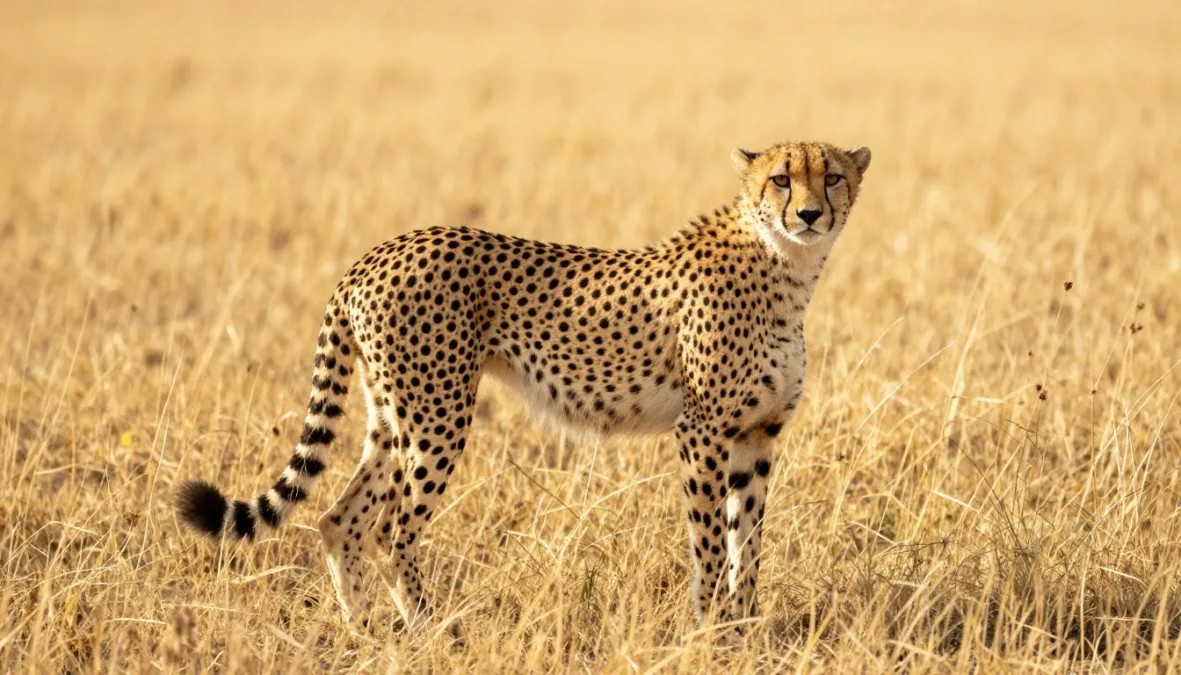
The cheetah stands as the undisputed champion of land acceleration, native to eastern and southern African savannahs as well as isolated fragments of central Iran. Widely documented maximum velocities reach approximately 60 to 70 miles per hour (97 to 113 kilometers per hour) during brief hunting runs.
A slender frame, deep chest, lightweight skull, and long legs reduce aerodynamic drag and rotational inertia. Semi-retractile claws function like natural running spikes, providing continuous traction into firm soil during violent direction shifts. A muscular tail serves as an active counterweight, stabilizing sudden turns at maximum stride.
Extreme velocity requires rapid spinal flexion and extension. The cheetah alternates between contracting its spine to pull all four paws beneath the torso and stretching flat to achieve a stride length exceeding twenty feet. This extreme physical effort generates intense heat and lactic acid accumulation, restricting sprints to short bursts lasting only a few hundred yards.
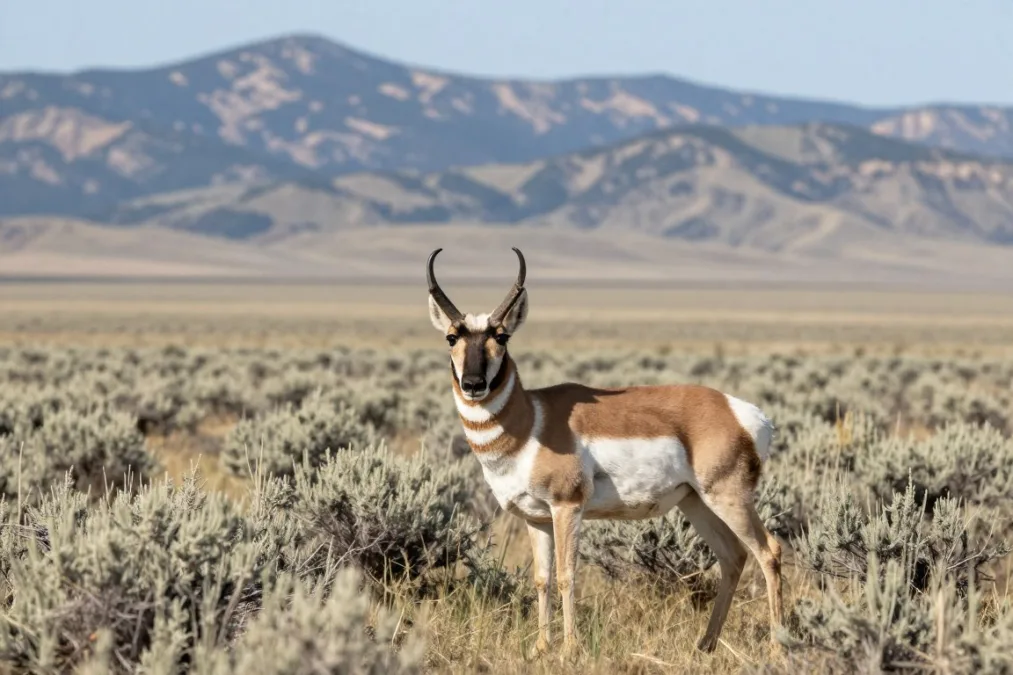
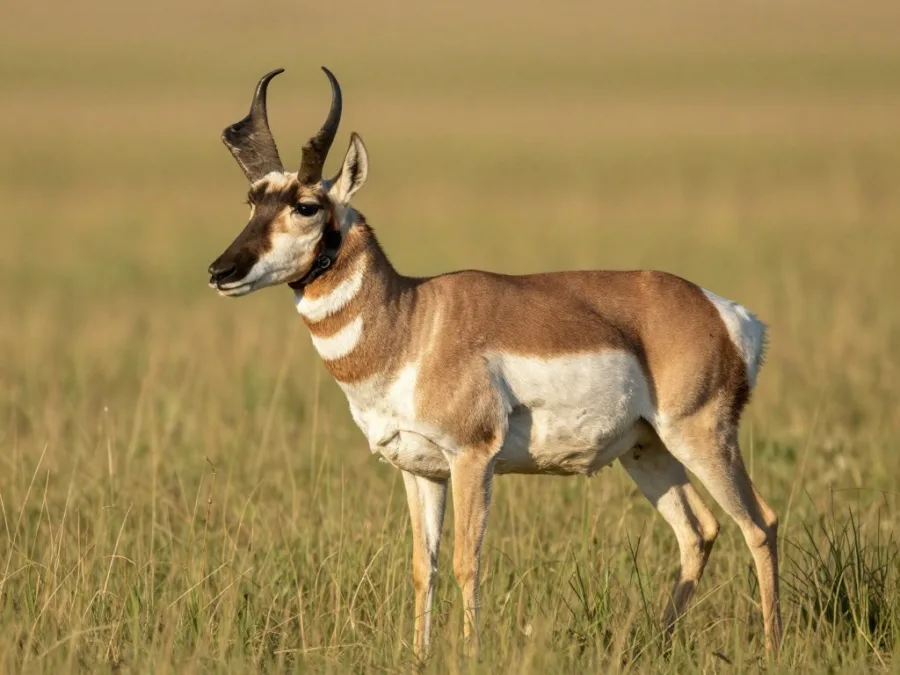
The pronghorn maintains exceptional speed over sustained distances across the North American plains.
2. Pronghorn (Antilocapra americana)
Occupying the grasslands and sagebrush deserts of western North America, the pronghorn registers documented top speeds of approximately 55 miles per hour (88 kilometers per hour). Unlike the African cheetah, the pronghorn can sustain a pace above 30 to 40 miles per hour (48 to 64 kilometers per hour) for several miles.
The species features an enlarged windpipe, exceptionally large lungs, and a massive heart that rapidly cycles oxygenated blood through dense muscle tissue. Pointed, cushioned hooves absorb harsh ground impact without bruising skeletal joints. Slender limb bones minimize limb weight, reducing the metabolic cost of high-frequency leg cycling.
Biologists identify this extraordinary capability as an evolutionary ghost adaptation. Millions of years of predatory pressure from the extinct American cheetah drove the pronghorn to develop sustained speeds far beyond the capabilities of modern predators like gray wolves or cougars.
While the cheetah relies on lightning-fast acceleration to subdue quarry within seconds, the pronghorn pairs rapid initial flight with an unmatched respiratory capacity suited for cross-country endurance.
High-Velocity Antelopes: Springbok, Thomson’s Gazelle, and Blackbuck
Medium-sized bovids across African and Asian plains rely on agility and sustained sprinting to escape coordinated carnivore attacks. These species showcase remarkable muscular power coupled with unpredictable zig-zagging trajectories that frustrate pursuers.
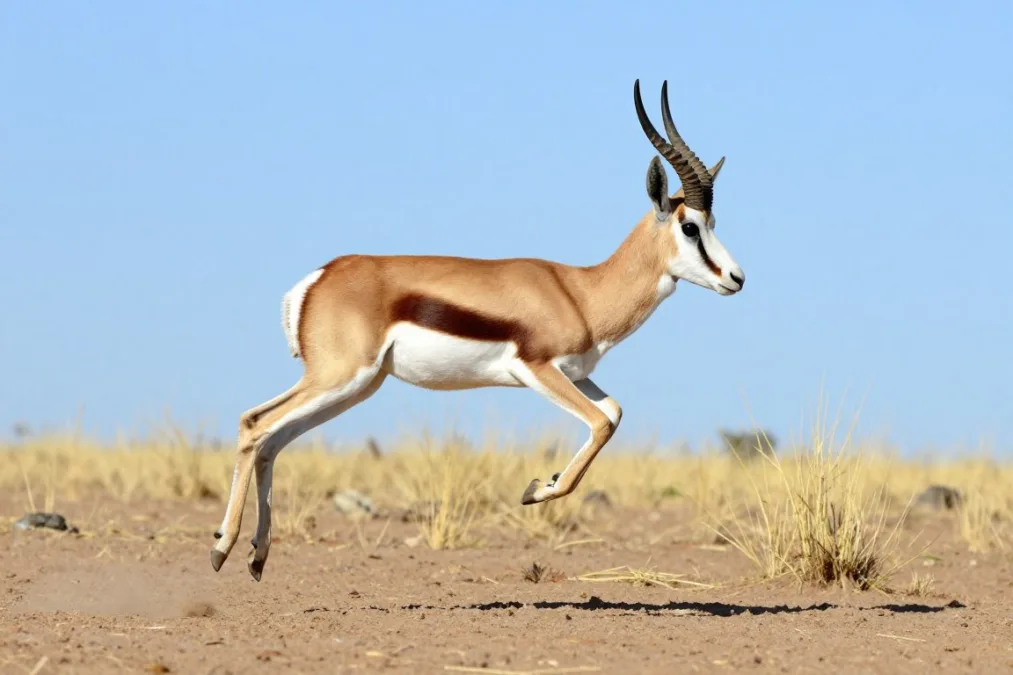
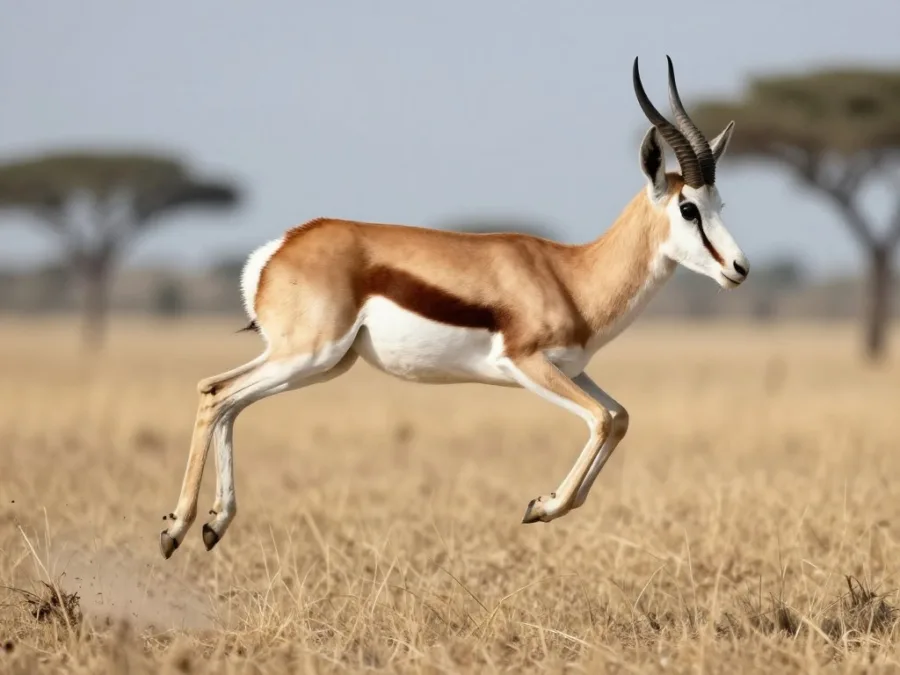
Springbok display specialized leaping behavior alongside rapid open-ground running speeds.
3. Springbok (Antidorcas marsupialis)
Native to the arid shrublands, grasslands, and salt pans of southern Africa, the springbok attains maximum speeds near 55 miles per hour (88 kilometers per hour). It displays slender legs, a pale face, lyre-shaped horns, and a dorsal fold of skin that unfurls white crested hair during arousal.
The springbok achieves rapid travel through powerful hindquarter contractions and lightweight distal limb anatomy. It is famous for pronking, a vertical leaping motion where the animal bounces into the air with an arched back and stiff legs. This display signals physical vigor to stalking predators while establishing high momentum before an escape dash.
4. Thomson’s Gazelle (Eudorcas thomsonii)
Inhabiting the open plains and short grasslands of the Serengeti and East African savannahs, Thomson’s gazelle clocks top running speeds around 50 miles per hour (80 kilometers per hour). Recognizable by a dark horizontal side stripe and fawn-colored coat, this gazelle is the primary hunting target for African apex predators.
Its speed stems from high muscle-tendon elasticity in the lower leg segments. Strong Achilles tendons store elastic strain energy on every downward footfall and release it during push-off. This energy storage system allows the gazelle to match the speed of larger predators while maintaining tight maneuvering radius.
5. Blackbuck (Antilope cervicapra)
The blackbuck thrives on the open scrub plains and dry grasslands of the Indian subcontinent. Capable of reaching top speeds of roughly 50 miles per hour (80 kilometers per hour), it relies on pure velocity to outpace cursorial hunters in open environments.
Adult males feature spiraling ringed horns and sharp black-and-white territorial coloration. The blackbuck pairs continuous stride frequency with rapid leaps, utilizing keen visual acuity across flat terrain to identify threats at extensive distances before initiating rapid flight.
- Specialized elastic tendons store mechanical energy during rapid bounding across dry soils.
- Broad horizontal pupils and lateral eye placement grant nearly complete panoramic vision while sprinting.
- Hoof morphology disperses soil impact forces evenly across two digits to minimize joint trauma.
Savannah Powerhouse Runners: Blue Wildebeest and Lion
Speed among heavier savannah quadrupeds requires greater muscular power to overcome physical inertia. The interplay between massive herbivores and social feline predators has refined sprint speeds among species weighing hundreds of pounds.
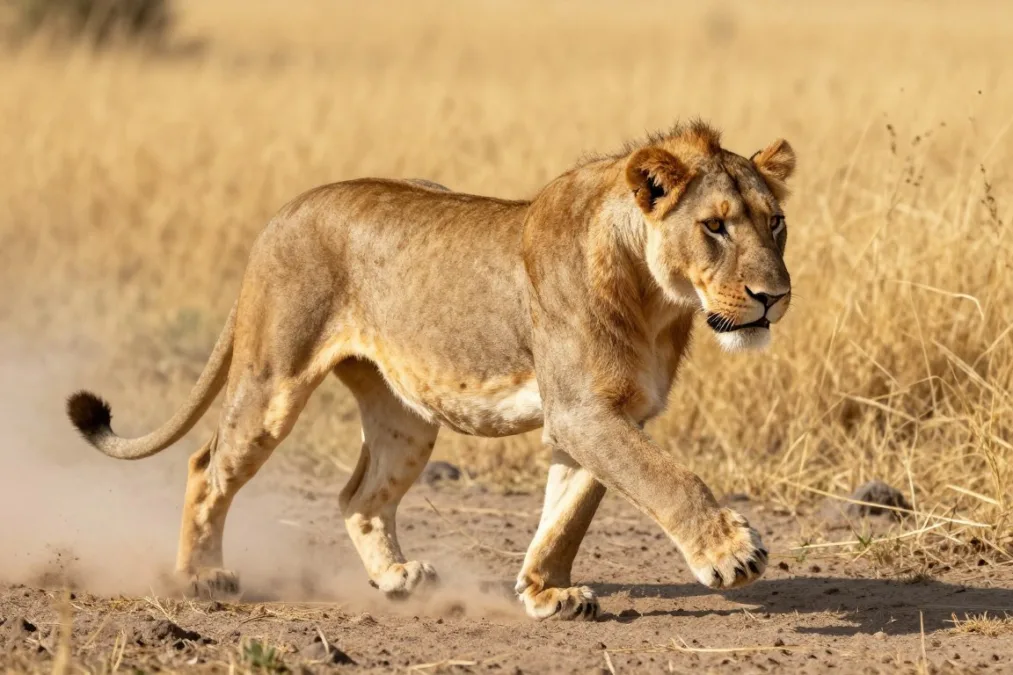
A lioness uses sudden bursts of muscular force to ambush fleeing ungulates over short distances.
6. Blue Wildebeest (Connochaetes taurinus)
Roaming the acacia woodlands and short-grass plains of eastern and southern Africa, the blue wildebeest achieves top velocities around 50 miles per hour (80 kilometers per hour). Marked by a high-shouldered profile, broad muzzle, and dark brindle stripes, this heavy antelope balances substantial body mass with surprising quickness.
A disproportionately muscular forequarter and robust neck support rapid forward propulsion across long distances. Herds build sustained momentum across uneven ground during the annual migration. High muscular endurance helps the wildebeest evade lion prides and hyena clans during river crossings and flatland grazing.
7. Lion (Panthera leo)
The lion occupies African savannahs, scrublands, and open woodlands, with an isolated relict population in the Gir Forest of India. Top sprint speeds reach approximately 50 miles per hour (80 kilometers per hour) for short, explosive attacks.
Lions carry heavy, muscular forelimbs and broad paws equipped with retractile claws designed to grapple prey rather than sustain foot traction over distance. Because the lion has a relatively small heart compared to its overall body mass, it tires quickly. Stalking behavior brings the lion within striking range so that rapid muscular acceleration can overwhelm prey within fifty yards.
Herbivore Endurance
Large ungulates utilize continuous aerobic cycles, long stride lengths, and lean bone structures to run down attackers across open terrain.
Ambush Acceleration
Heavier carnivores rely on dense fast-twitch muscle fibers, low profiles, and sudden bursts to secure prey before exhaustion sets in.
Pursuit and Agility Specialists: African Wild Dog, Plains Zebra, and Brown Hare
Beyond the premier fifty-mile-per-hour tier, several land species rely on distinct combinations of agility, endurance pacing, and sudden directional cutting to outmaneuver rivals.
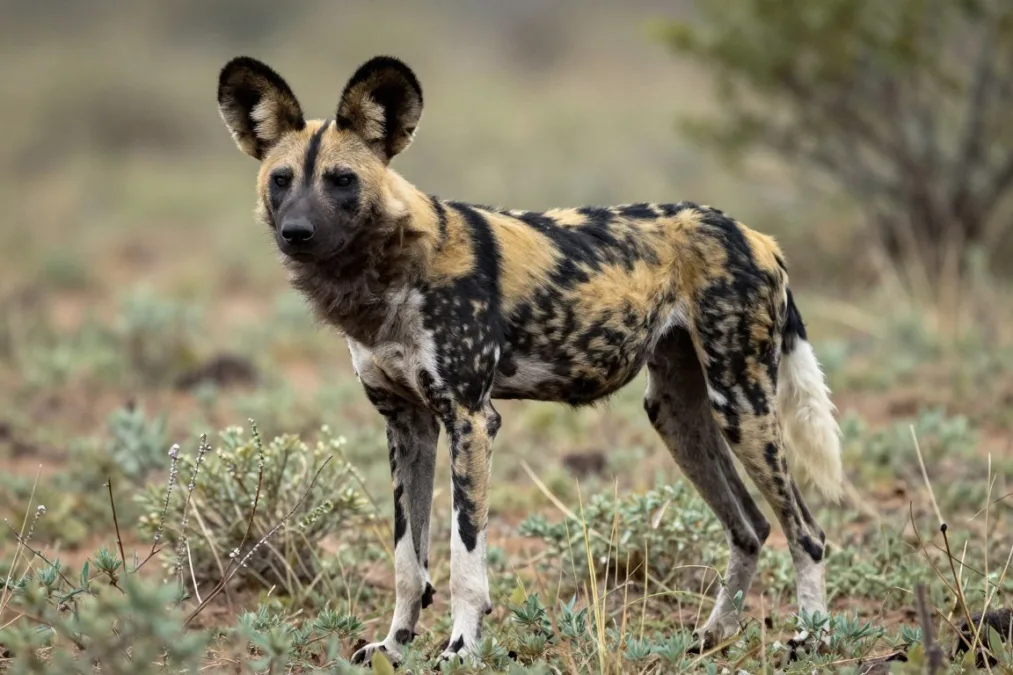
African wild dogs rely on cardiovascular stamina and cooperative pacing during open pursuits.
8. African Wild Dog (Lycaon pictus)
Roaming the grasslands and woodlands of sub-Saharan Africa, the African wild dog clocks peak burst speeds of 44 to 45 miles per hour (70 to 72 kilometers per hour). It is characterized by large rounded ears, a mottled calico coat, and the absence of dewclaws on its front paws.
The species is an endurance specialist that maintains speeds above 35 miles per hour (56 kilometers per hour) over protracted pursuits. Deep-chested anatomy, broad nasal cavities, and exceptional lung surface area prevent early oxygen depletion. Pack members alternate lead positions to tire fleeing antelopes over several miles.
9. Plains Zebra (Equus quagga)
Inhabiting the open savannahs and grasslands of eastern and southern Africa, the plains zebra reaches maximum speeds of 40 to 43 miles per hour (64 to 70 kilometers per hour). Distinctive black-and-white vertical striping patterns confuse predators during group flight.
A single rigid hoof digit on each foot provides a stable mechanical platform that withstands heavy ground impacts. Dense core musculature and high aerobic stamina allow the plains zebra to sustain defensive flight against lions and spotted hyenas while delivering powerful defensive kicks.
10. Brown Hare (Lepus europaeus)
Widespread across European fields, temperate open pastures, and agricultural land, the brown hare achieves peak speeds of approximately 45 miles per hour (72 kilometers per hour). Distinctive traits include long black-tipped ears, large amber eyes, and long rear legs.
Elongated hind limbs and flexible foot pads enable powerful leaps and sudden ninety-degree turns without loss of momentum. The hare outruns foxes and birds of prey by combining pure ground speed with sudden zig-zag maneuvers that break pursuit trajectories.
- Cooperative pursuit packs exhaust solitary prey through sustained cardiovascular pressure.
- Large hindquarter lever arms maximize force delivery during sudden direction reversals.
- Unpaired central hoof digits reduce rotational joint strain under continuous high-speed trotting.
Comparing Documented Terrestrial Speeds
Evaluating land velocity across diverse species reveals the distinct mechanical tradeoffs between explosive burst sprinting and long-range stamina. The table below outlines the documented performance metrics, scientific classifications, and primary habitat profiles for the ten fastest land animals.
| Animal | Top Speed | Scientific Name | Primary Locomotion Adaptation |
| Cheetah | 70 mph / 113 km/h | Acinonyx jubatus | Spinal flexion and non-retractile claw traction |
| Pronghorn | 55 mph / 88 km/h | Antilocapra americana | Enlarged heart and sustained aerobic ventilation |
| Springbok | 55 mph / 88 km/h | Antidorcas marsupialis | Elastic leg tendons and vertical bounding pronks |
| Thomson’s Gazelle | 50 mph / 80 km/h | Eudorcas thomsonii | Tight turning radius and tendon energy storage |
| Blackbuck | 50 mph / 80 km/h | Antilope cervicapra | Bounding strides and panoramic threat detection |
| Blue Wildebeest | 50 mph / 80 km/h | Connochaetes taurinus | Muscular forequarters for sustained herd pacing |
| Lion | 50 mph / 80 km/h | Panthera leo | Explosive ambush bursts with muscular forelimbs |
| African Wild Dog | 45 mph / 72 km/h | Lycaon pictus | High-capacity cardiovascular endurance pursuit |
| Brown Hare | 45 mph / 72 km/h | Lepus europaeus | Elongated hind legs for rapid zig-zag cutting |
| Plains Zebra | 43 mph / 70 km/h | Equus quagga | Solid single-hoof shock absorption and stamina |
Disparities in top speed illustrate how natural selection tailors musculoskeletal architecture to habitat demands. While savannah carnivores prioritize high acceleration over short trajectories, steppe and plains grazers maintain higher speed thresholds to defend against cursorial hunting strategies.
Biomechanical Adaptations Behind Land Speed
Extreme speed requires coordinated physical adjustments across every internal system, from skeletal leverage and limb proportions to muscular fiber composition and oxygen processing. The fastest land animal, the cheetah, pairs an ultra-flexible vertebral column with non-retractile claws that function like athletic spikes, providing constant purchase during explosive strides.
Among endurance runners like the pronghorn, the respiratory apparatus scales to exceptional dimensions. The windpipe, bronchi, and alveoli process air at high volumes, while blood carrying high hemoglobin concentrations supplies working muscles without building oxygen debt.
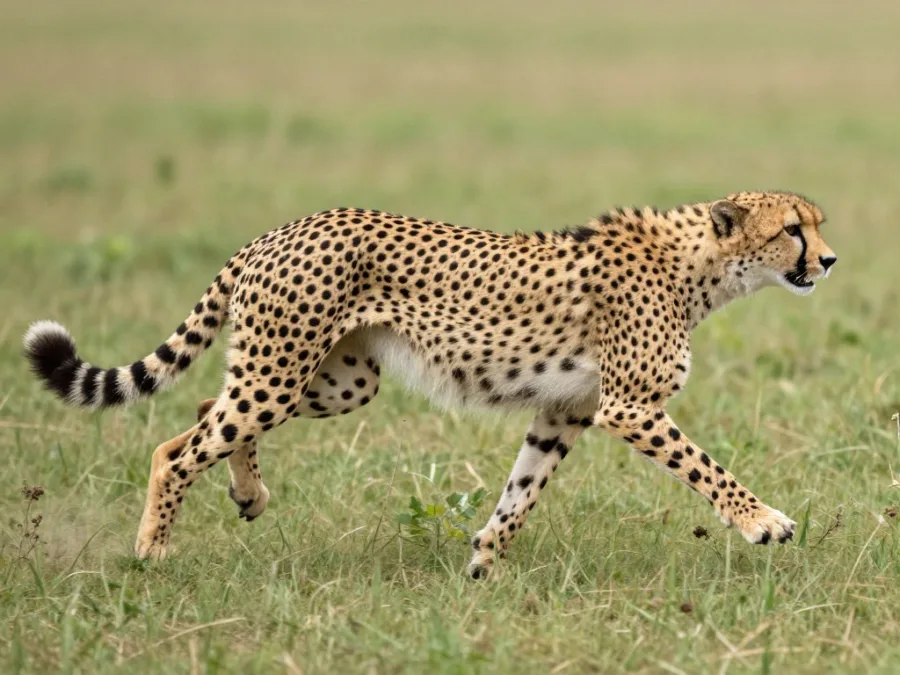
Dynamic Spinal Extension
A highly flexible vertebral column acts like an internal spring, alternately coiling to tuck paws and extending to maximize stride length.
Cardiovascular Pacing
Massive hearts and enlarged lung volumes deliver sustained oxygen flow, allowing select ungulates to maintain rapid speeds over miles.
Elastic Tendon Recoil
Long lower-limb tendons store kinetic force on impact and snap back during departure, reducing the energy cost of rapid bounding strides.
Lightweight extremities represent another universal principle of fast terrestrial locomotion. Shifting heavy muscle mass close to the central torso keeps lower limbs light, minimizing the energy required to swing legs back and forth during high-velocity running.
Frequently Asked Questions
How are animal top speeds measured accurately in the wild?
Researchers measure animal running speeds using GPS tracking collars, calibrated drone footage, radar guns, and high-speed video arrays set across measured running courses. Pacing animals alongside field vehicles has also been used, though modern satellite telemetry provides far more precise velocity calculations.
What is the difference between burst speed and sustained speed?
Burst speed relies on anaerobic muscle metabolism to generate peak force over brief periods lasting under sixty seconds, while sustained speed depends on aerobic cardiovascular systems that supply oxygen over continuous distances. The cheetah exemplifies burst velocity, whereas the pronghorn excels at sustained aerobic running.
Why are flying animals excluded from land speed rankings?
Flying animals rely on aerodynamic lift, air currents, and gravitational acceleration during dives rather than mechanical force applied directly to the ground. The peregrine falcon reaches extreme speeds during vertical stoops, but its physical running mechanics on flat earth remain modest compared to quadrupeds.
How does human running speed compare to the fastest land animals?
Peak human sprint velocity reaches roughly 27 miles per hour during short sprints by elite athletes, which falls substantially below all top ten terrestrial animals. Human endurance relies on bipedal cooling through sweat glands rather than explosive quadrupedeal sprint velocity.
Summary of Terrestrial Speed Records
The cheetah remains the fastest animal on land, relying on a hyper-flexible spine, semi-retractile traction claws, and rapid anaerobic acceleration to dominate open-plains pursuits. Across all running species, the pronghorn’s sustained aerobic ventilation stands out as the most impressive adaptation, allowing it to maintain high-velocity flight across vast terrain long after pure sprinters would succumb to muscle fatigue.

Priyanka Pandey
Senior Research Editor · Top10Sense
Priyanka specializes in tech, consumer products, and digital trends. She combines hands-on testing, vendor interviews, and database research to create trustworthy “Top 10” rankings. Her work has been referenced by industry blogs and brand report pages.