

India’s economic landscape is witnessing a remarkable transformation led by a new generation of young billionaires. These visionaries, many under 35, are disrupting traditional industries and creating wealth through innovation, technology, and bold entrepreneurship. From quick commerce and fintech to renewable energy and artificial intelligence, these young minds are not just accumulating personal wealth but also solving real-world problems at scale.
The emergence of these young billionaires signals a significant shift in India’s business ecosystem, where age is no longer a barrier to extraordinary success. Let’s explore the journeys, achievements, and wealth creation strategies of the top 10 young Indian billionaires in 2025.
India’s Young Billionaire Landscape: A Quick Overview
India’s young billionaires are leading the country’s economic revolution through technology and innovation
The 2025 M3M Hurun India Rich List reveals a fascinating trend: India now boasts more young billionaires than ever before. The average age of India’s billionaires has dropped significantly over the past decade, with several entrepreneurs achieving billionaire status before turning 30.
These young wealth creators predominantly come from tech-enabled sectors, with fintech, e-commerce, and quick commerce leading the charge. What sets them apart is their ability to identify market gaps and scale solutions rapidly, often achieving unicorn status within just a few years of launching their ventures.
| Rank | Name | Age | Net Worth (2025) | Primary Source |
| 1 | Kaivalya Vohra | 22 | ₹4,480 crore ($540 million) | Zepto (Quick Commerce) |
| 2 | Aadit Palicha | 23 | ₹5,380 crore ($650 million) | Zepto (Quick Commerce) |
| 3 | Rohan Gupta | 26 | ₹1,140 crore ($137 million) | SG Finserve (Financial Services) |
| 4 | Shashvat Nakrani | 27 | ₹1,340 crore ($162 million) | BharatPe (Fintech) |
| 5 | Trishneet Arora | 30 | ₹1,820 crore ($220 million) | TAC Security (Cybersecurity) |
1. Kaivalya Vohra (22) – India’s Youngest Billionaire

At just 22 years old, Kaivalya Vohra holds the distinction of being India’s youngest billionaire. As the co-founder and CTO of Zepto, he has revolutionized India’s quick commerce landscape with a promise of delivering essentials in under 10 minutes.
Education and Early Life
Kaivalya completed his early education in Mumbai, where he displayed exceptional aptitude for computer engineering. A Stanford University dropout, he chose to pursue his entrepreneurial vision rather than complete his formal education – a decision that paid off remarkably.
The Zepto Revolution
Founded in 2021 alongside Aadit Palicha, Zepto emerged from a simple observation during the pandemic: people needed essentials delivered quickly and reliably. What began as a solution to a temporary problem evolved into a business valued at over $5 billion by 2025.
Under Kaivalya’s technical leadership, Zepto has implemented cutting-edge inventory management systems and AI-driven logistics that optimize delivery routes in real-time. His focus on technology has enabled Zepto to maintain its 10-minute delivery promise while scaling across major Indian cities.
“Technology isn’t just about writing code; it’s about solving real human problems at scale. That’s what drives us at Zepto.”
2. Aadit Palicha (23) – Visionary CEO

At 23, Aadit Palicha serves as the CEO of Zepto, steering the company’s strategic direction and fundraising efforts. With a personal net worth of ₹5,380 crore ($650 million), he ranks as India’s second-youngest billionaire in 2025.
Academic Excellence to Business Leadership
Aadit’s academic journey includes a perfect score in the International Baccalaureate program at GEMS Modern Academy in Dubai. Like his co-founder, he left Stanford University’s Computer Science program to focus on building Zepto – trading theoretical knowledge for practical business building.
Strategic Vision
As CEO, Aadit has been instrumental in securing over $900 million in funding across multiple rounds, negotiating with global investors, and articulating Zepto’s vision for transforming urban retail. His leadership has expanded Zepto’s presence to more than 20 cities across India by 2025.
What distinguishes Aadit is his ability to balance aggressive growth with operational efficiency. Under his guidance, Zepto has maintained strong unit economics while scaling rapidly – a rare achievement in the quick commerce space.
3. Rohan Gupta (26) – Fintech Innovator

Rohan Gupta, at 26, has established himself as a significant player in India’s financial services sector. As the head of SG Finserve, he has built a fortune of ₹1,140 crore ($137 million) by modernizing supply chain financing for small and medium enterprises.
Educational Foundation
Rohan holds an International Baccalaureate diploma and a Bachelor’s in Business Administration, which provided him with a strong foundation in finance, management, and analytical thinking. His formal education in business principles has proven valuable in navigating the complex financial services landscape.
Revolutionizing SME Financing
At SG Finserve, Rohan has pioneered digital solutions that extend working capital to previously underserved small businesses. By integrating technology with traditional financial services, he has created a more accessible financing ecosystem for India’s vast SME sector.
His company’s innovation lies in its risk assessment algorithms that evaluate businesses based on their digital footprint and transaction history rather than traditional collateral. This approach has unlocked financing for thousands of small businesses that were previously excluded from formal credit channels.
4. Shashvat Nakrani (27) – Fintech Revolutionary

At 27, Shashvat Nakrani has transformed how millions of Indian merchants accept digital payments. As the co-founder of BharatPe, he has built a personal fortune of ₹1,340 crore ($162 million) while democratizing financial technology for small businesses.
From IIT to Entrepreneurship
Shashvat studied Textile Technology at IIT Delhi but left in his third year to pursue his entrepreneurial vision. His technical education at India’s premier engineering institute gave him the problem-solving skills that would later prove crucial in developing BharatPe’s technology platform.
Empowering Small Merchants
BharatPe’s innovation lies in its interoperable QR code system that allows small merchants to accept payments from any UPI app through a single QR code. This seemingly simple solution addressed a significant pain point for India’s vast network of small retailers.
Under Shashvat’s leadership, BharatPe has expanded beyond payments to offer merchant loans, invoice financing, and digital banking services. By 2025, the company serves over 10 million merchants across India, fundamentally changing how small businesses operate in the digital economy.
5. Trishneet Arora (30) – Cybersecurity Prodigy

Trishneet Arora, 30, stands out as India’s cybersecurity wunderkind. As the founder of TAC Security, he has built a global cybersecurity company valued at over $1 billion, with a personal net worth of ₹1,820 crore ($220 million).
Self-Taught Expertise
What makes Trishneet’s story remarkable is his unconventional educational path. Having left formal schooling after 8th grade, he pursued self-directed learning in cybersecurity and ethical hacking. Through online courses, hacking competitions, and hands-on practice, he developed expertise that now protects some of the world’s largest organizations.
Global Cybersecurity Impact
TAC Security provides vulnerability management and risk assessment solutions to Fortune 500 companies and government agencies worldwide. The company’s AI-driven platform, ESOF (Enterprise Security on One Framework), helps organizations identify and remediate security vulnerabilities before they can be exploited.
By 2025, Trishneet’s company secures critical infrastructure across 15 countries, making him not just a billionaire but also a key player in global cybersecurity architecture. His journey exemplifies how specialized expertise can create extraordinary value, even without traditional educational credentials.
“In cybersecurity, curiosity is your greatest teacher. I was never the best student in school, but I was always the most curious about how systems could be broken and fixed.”
6. Aravind Srinivas (31) – AI Pioneer
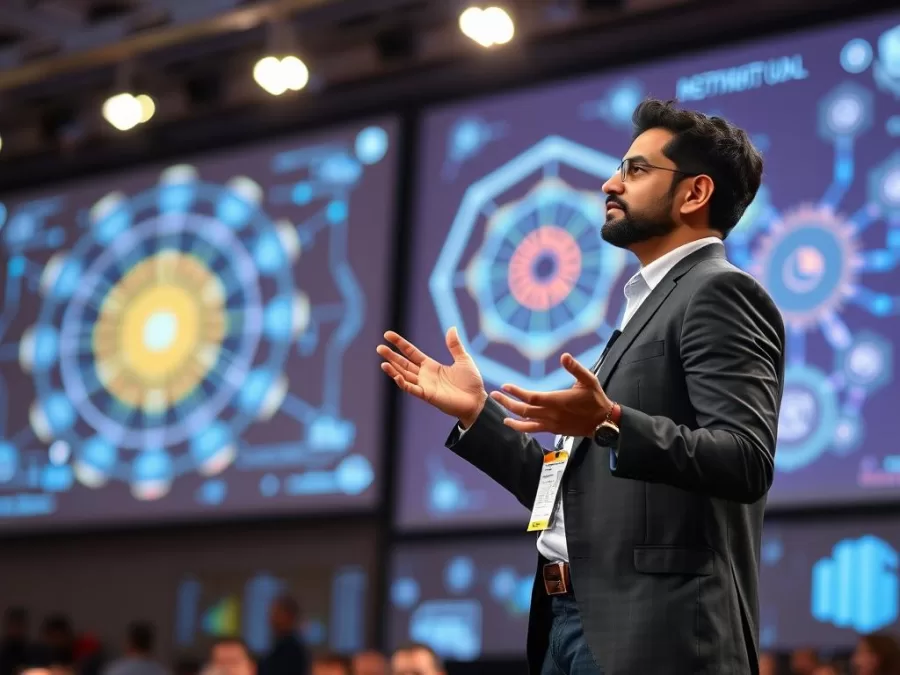
At 31, Aravind Srinivas has established himself as one of India’s foremost AI entrepreneurs. As the founder of Perplexity AI, he has built a company valued at over $5 billion, with a personal fortune of ₹21,190 crore ($2.6 billion).
Academic Excellence
Aravind’s journey combines academic rigor with entrepreneurial vision. He earned a dual degree in Electrical Engineering from IIT Madras, followed by a PhD in Computer Science at UC Berkeley, specializing in artificial intelligence and machine learning. This strong technical foundation has been crucial to his success in the competitive AI landscape.
Revolutionizing Information Access
Perplexity AI has transformed how people access information online through its AI-powered answer engine. Unlike traditional search engines that return links, Perplexity provides direct, comprehensive answers while citing sources – a paradigm shift in information retrieval.
By 2025, Perplexity has attracted over 100 million monthly active users globally, challenging established search giants. Aravind’s company represents India’s growing influence in the global AI race, demonstrating that Indian entrepreneurs can build world-class AI products that compete with Silicon Valley’s best.
7-10: Completing India’s Young Billionaire Circle
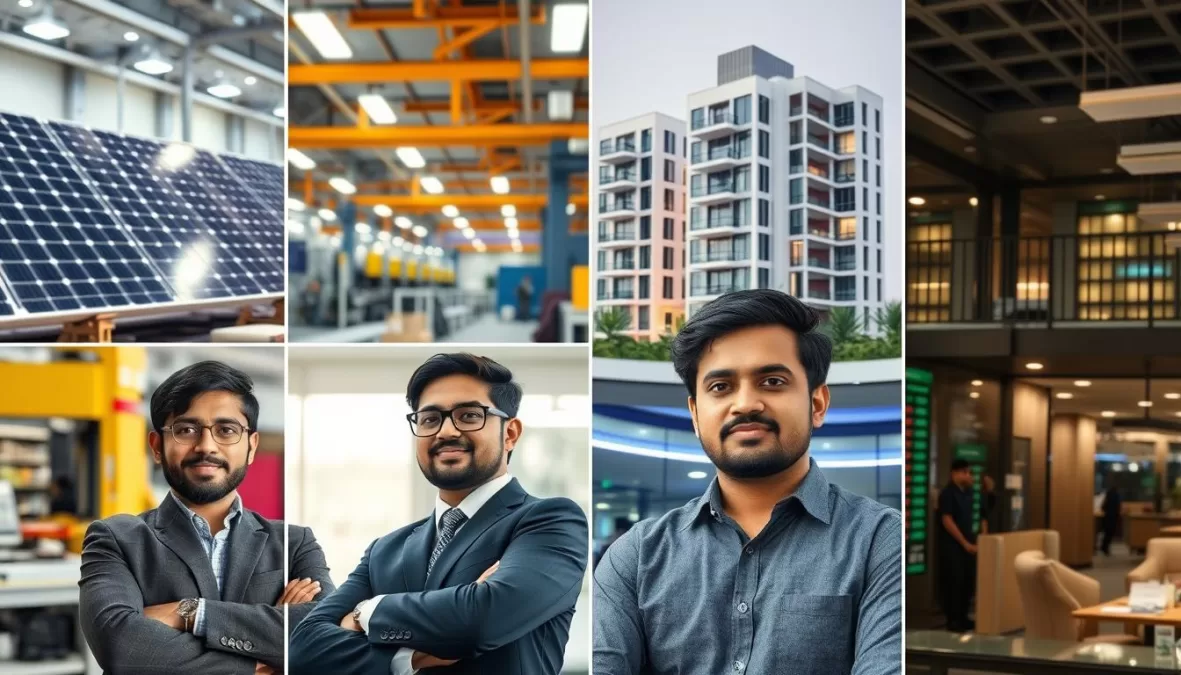
7. Aditya Kumar Halwasia (31)
Net Worth: ₹1,960 crore ($237 million)
Source: Cupid Ltd. (Healthcare Manufacturing)
Aditya’s leadership at Cupid Ltd. has transformed the company into a global supplier of healthcare and personal protection products. His finance education from Fordham University, New York, has helped him expand the company’s international reach and manage strategic investments effectively.
8. Hardik Kothiya (31)
Net Worth: ₹3,970 crore ($480 million)
Source: Rayzon Solar (Renewable Energy)
With a background in Civil Engineering, Hardik has built Rayzon Solar into one of India’s largest solar panel manufacturers. His company has been instrumental in advancing India’s renewable energy sector, producing sustainable solar panels that power homes and businesses nationwide.
9. Harsha Reddy Ponguleti (31)
Net Worth: ₹1,300 crore ($157 million)
Source: Raghava Constructions (Real Estate)
Harsha leads Raghava Constructions, overseeing large-scale real estate and infrastructure projects. His BBA from Symbiosis Centre for Management Studies and postgraduate diploma from the University of Warwick have equipped him with international management perspectives that he applies to India’s growing real estate sector.

10. Ritesh Agarwal (31) – Hospitality Disruptor
Completing our list is Ritesh Agarwal, the founder of OYO Rooms (rebranded as Prism), with a net worth of ₹14,400 crore ($1.7 billion). Ritesh’s journey from a small town in Odisha to global recognition exemplifies the power of vision and resilience.
After receiving the prestigious Thiel Fellowship, Ritesh built OYO into one of India’s most recognized startups, transforming budget hospitality across Asia. Despite pandemic-related challenges, he successfully repositioned the company by 2025, focusing on sustainable growth and profitability rather than just expansion.
“Success isn’t about avoiding failures; it’s about failing forward. Every setback contains the seeds of an even greater comeback.”
Industry Analysis: Where India’s Young Billionaires Are Making Their Mark
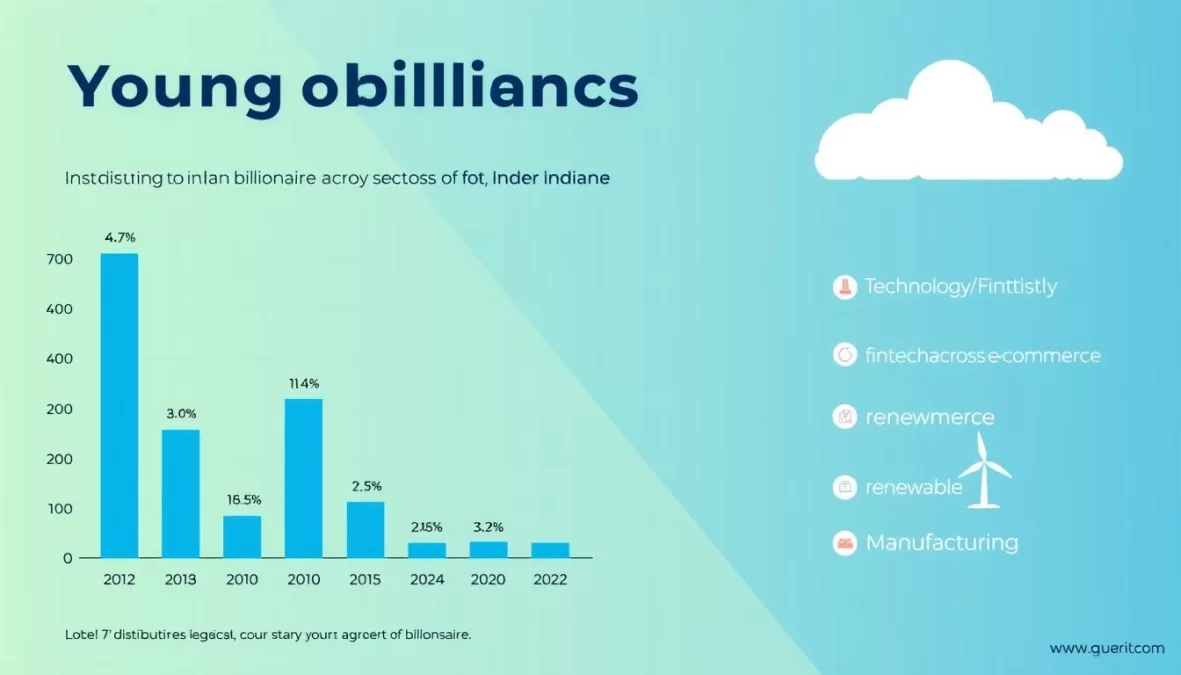
The sectoral distribution of India’s young billionaires reveals important trends about where wealth creation is happening most rapidly in the Indian economy:
Technology-Driven Sectors Lead
- Quick Commerce & E-commerce: Represents 30% of young billionaires, with Zepto and similar platforms disrupting traditional retail
- Fintech: Accounts for 25% of young billionaires, revolutionizing payments, lending, and financial services
- AI & Software: Growing rapidly, with 15% of young billionaires building AI-powered solutions
Emerging Wealth Sectors
- Renewable Energy: Solar and clean energy entrepreneurs represent 10% of young billionaires
- Cybersecurity: A growing niche with high-value companies addressing global security challenges
- Healthcare Technology: Combining healthcare delivery with digital solutions
What’s notable is the shift from traditional wealth-creating sectors like real estate and manufacturing toward technology-enabled businesses. This reflects India’s transition to a digital economy and the outsized returns possible when technology is applied to solve large-scale problems.
Evolution of India’s Young Billionaire Landscape: 2020-2025
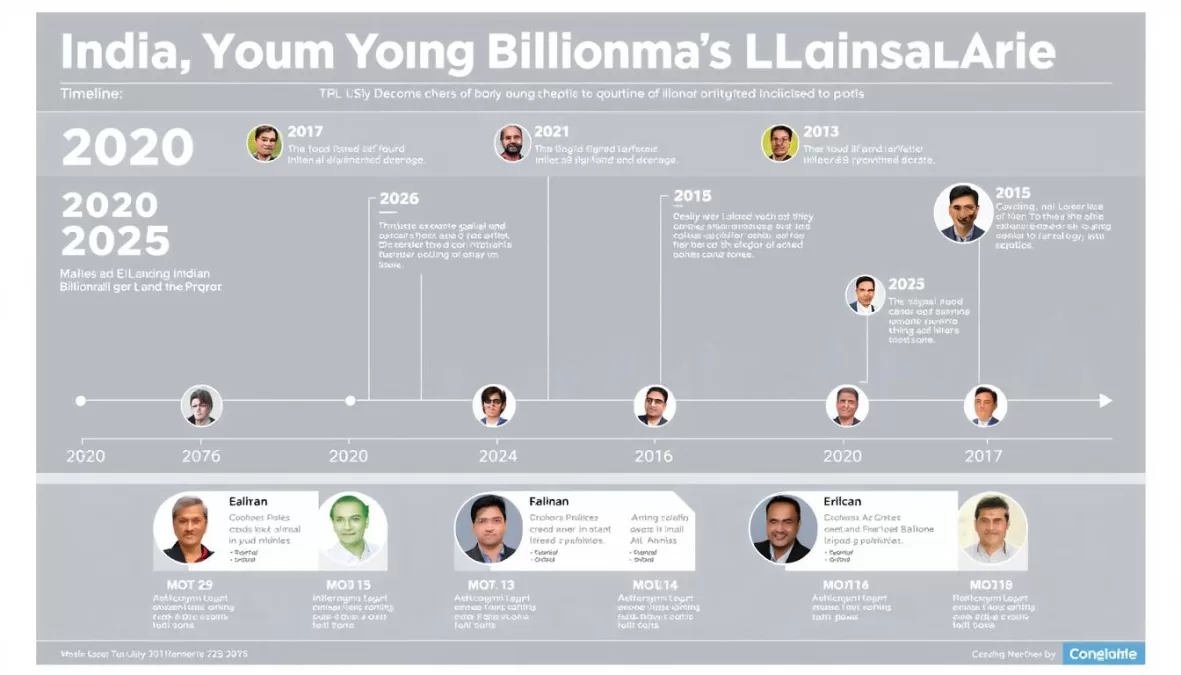
The composition of India’s young billionaire list has evolved dramatically over the past five years:
Key Trends (2020-2025)
| Trend | 2020 | 2025 | Significance |
| Average Age | 41 years | 28 years | Dramatic youth shift in wealth creation |
| Self-made vs. Inherited | 40% self-made | 90% self-made | Entrepreneurship over inheritance |
| Tech-enabled Businesses | 30% of billionaires | 80% of billionaires | Technology as wealth multiplier |
| First-generation Entrepreneurs | 25% | 70% | Democratization of opportunity |
| Female Representation | 5% | 15% | Slow but improving gender diversity |
The most significant change has been the dramatic decrease in the average age of billionaires, dropping from 41 in 2020 to just 28 in 2025. This reflects both the accelerated pace of wealth creation in the digital economy and the increasing willingness of young entrepreneurs to take risks.
Another notable trend is the shift from inherited wealth to self-made fortunes. In 2020, 60% of young billionaires had inherited significant wealth, while by 2025, 90% are self-made entrepreneurs who built their fortunes from scratch or with minimal starting capital.
Common Success Factors Among Young Indian Billionaires
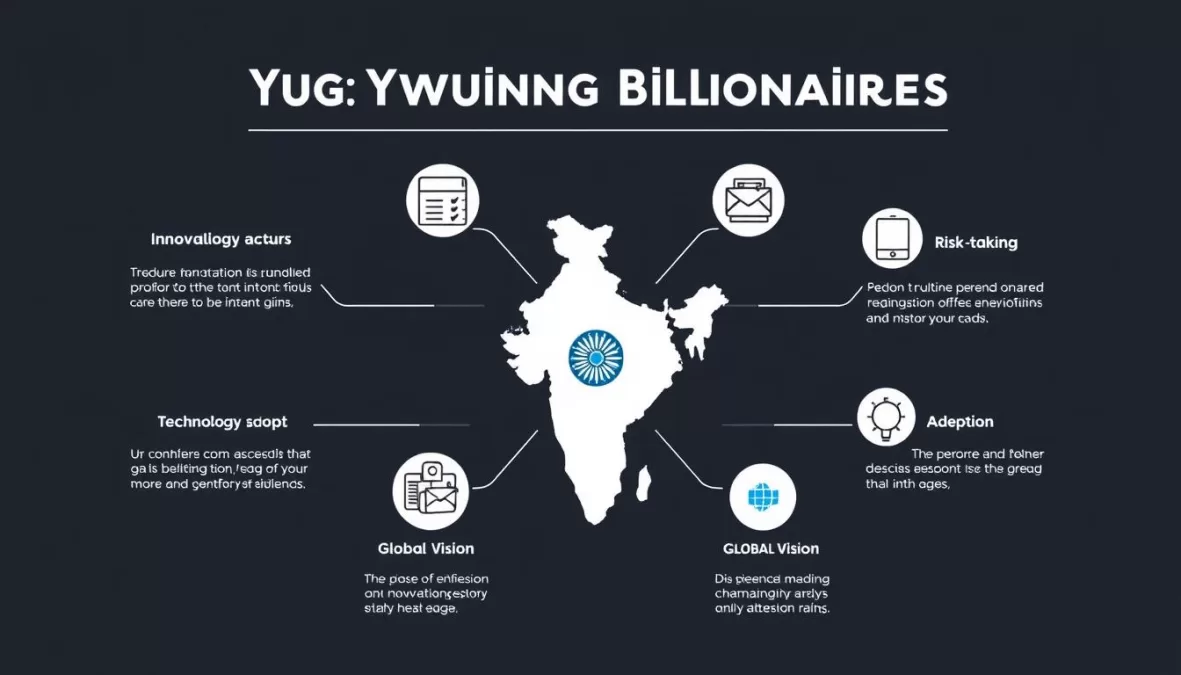
Despite their diverse backgrounds and industries, India’s young billionaires share several common traits and strategies that have contributed to their extraordinary success:
Problem-First Approach
Rather than starting with solutions, these entrepreneurs identified significant market gaps or inefficiencies. Zepto’s founders recognized the need for ultra-fast deliveries, while BharatPe addressed the fragmentation in digital payments for small merchants.
Technology as Leverage
All ten billionaires have used technology as a force multiplier, whether through AI at Perplexity, logistics optimization at Zepto, or cybersecurity at TAC. Their ability to apply technology to traditional problems has created outsized returns.
Rapid Scaling Mindset
These entrepreneurs built systems and raised capital with rapid scaling in mind. Rather than growing incrementally, they created infrastructure and processes that could handle 10x or 100x growth, allowing them to capture market share quickly.
Global Vision, Local Execution
While focusing on Indian markets, these billionaires built with global standards and ambitions. Companies like Perplexity AI and TAC Security serve global clients while maintaining strong Indian roots.
Capital Efficiency
Despite raising significant funding, these entrepreneurs have maintained capital discipline. They’ve balanced growth with unit economics, avoiding the trap of unsustainable expansion that plagued earlier startup generations.
Talent Magnetism
Each has demonstrated an ability to attract exceptional talent, often pulling experienced executives from established companies. Their vision and energy have made their startups desirable places to work despite the risks.
The Future of Wealth Creation in Young India

The stories of these top 10 young Indian billionaires in 2025 signal a profound shift in India’s economic landscape. They represent not just individual success stories but a broader transformation in how wealth is created and distributed in the world’s fastest-growing major economy.
Looking ahead, several trends are likely to shape the next generation of young billionaires in India:
- Deeptech Emergence: The next wave may come from deep technology sectors like quantum computing, biotech, and advanced materials
- Climate Solutions: Entrepreneurs solving climate challenges through innovative business models will likely create significant wealth
- Rural Innovation: As digital infrastructure reaches India’s villages, entrepreneurs focusing on the next 500 million users will find massive opportunities
- Global-First Startups: More Indian entrepreneurs will build for global markets from day one, accelerating wealth creation
What’s clear is that India’s entrepreneurial ecosystem has matured significantly, providing the capital, mentorship, and infrastructure needed to support ambitious founders. The success of these young billionaires will inspire countless others to pursue their entrepreneurial dreams, further accelerating India’s economic transformation.
As we’ve seen from these ten remarkable journeys, extraordinary success is increasingly accessible to those with vision, determination, and the ability to execute at scale. Age is no longer a barrier to building billion-dollar enterprises in India’s dynamic business landscape.
Ready to Build Your Financial Future?
Get expert guidance on investment strategies inspired by India’s youngest billionaires. Our financial advisors can help you apply wealth-building principles to your personal financial journey.

Priyanka Pandey
Senior Research Editor · Top10Sense
Priyanka specializes in tech, consumer products, and digital trends. She combines hands-on testing, vendor interviews, and database research to create trustworthy “Top 10” rankings. Her work has been referenced by industry blogs and brand report pages.