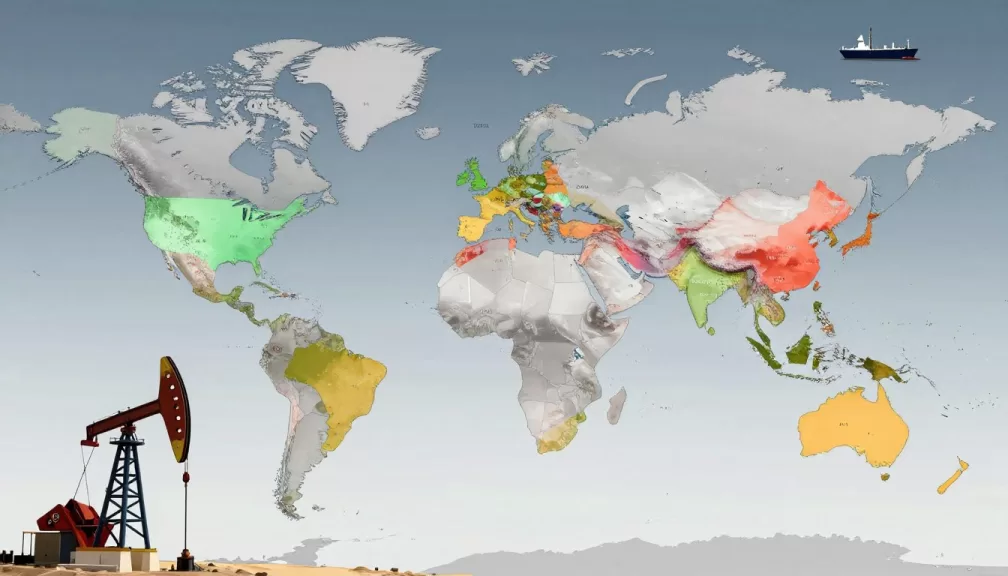

Understanding global religious demographics provides crucial insights into cultural, political, and economic trends worldwide. As we approach 2025, the Muslim population continues to grow as one of the world’s fastest-expanding religious groups. This comprehensive analysis examines the projected top 10 Muslim-majority countries based on the latest demographic research, highlighting key factors influencing these rankings and what they reveal about global population patterns.
Global Muslim Population Trends in 2025
The global Muslim population has experienced significant growth over recent decades. According to the latest Pew Research Center data, Muslims represent approximately 26% of the world’s population as of 2025, up from 24% in 2010. This growth rate is nearly twice that of the overall global population, which expanded by just 10% during the same period.
Several key factors drive this demographic shift. Muslim populations typically have higher fertility rates than other religious groups, with an average of 2.9 children per woman compared to the global average of 2.5. Additionally, Muslims have the youngest median age (24 years) of any religious group, meaning a larger proportion are in or entering their reproductive years.
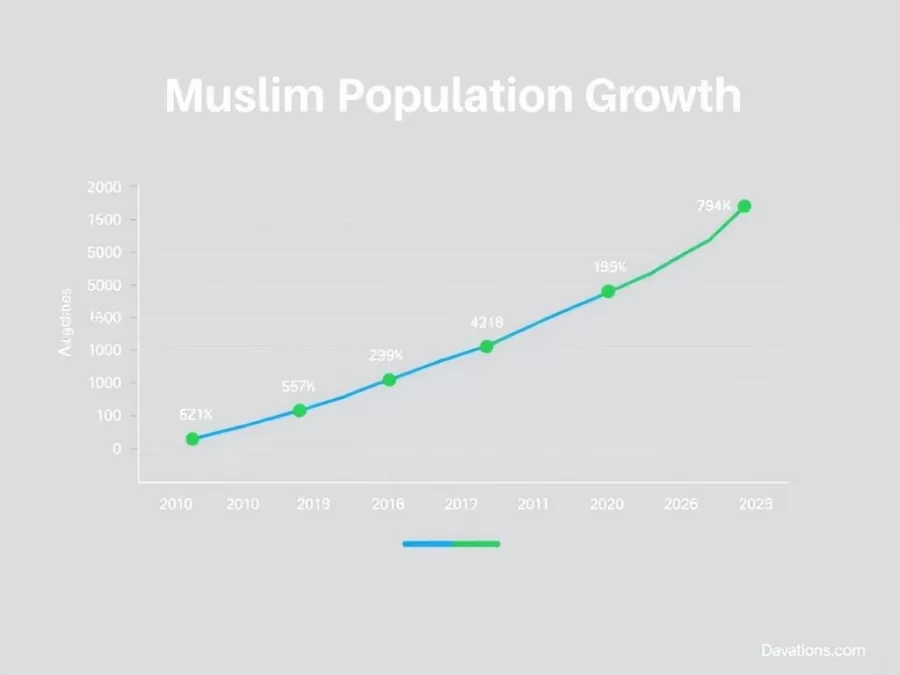
Regional distribution of Muslims continues to evolve, with the Asia-Pacific region remaining home to the largest share (59%) of the global Muslim population. However, sub-Saharan Africa has seen the most rapid growth, now hosting 18% of the world’s Muslims—an increase of 2 percentage points since 2010.
Migration patterns also influence these demographics, particularly in Europe and North America, where Muslim populations have grown by 6% and 52% respectively since 2010. These trends reflect both immigration from Muslim-majority countries and higher birth rates among Muslim communities in these regions.
| Region | Muslim Population (2025) | % of Global Muslims | Growth Since 2010 |
| Asia-Pacific | 1.18 billion | 59% | 19% |
| Middle East-North Africa | 420 million | 21% | 23% |
| Sub-Saharan Africa | 369 million | 18% | 34% |
| Europe | 45 million | 2% | 6% |
| North America | 5.9 million | 0.3% | 52% |
Top 10 Muslim Countries in the World 2025
Our analysis ranks countries based on the percentage of Muslims within their population rather than total Muslim population. This approach highlights nations where Islamic culture and traditions most strongly influence society, governance, and daily life. Based on 2025 projections from multiple demographic sources, here are the top 10 Muslim-majority countries in the world:

1. Morocco: 99.9%
Morocco leads the world with virtually its entire population practicing Islam. The North African nation’s religious homogeneity reflects centuries of Islamic influence since the Arab conquest in the 7th century. Moroccan Islam is predominantly Sunni of the Maliki school, with Sufism playing a significant role in religious expression.

2. Afghanistan: 99.7%
Afghanistan’s population is overwhelmingly Muslim, with Islam deeply embedded in the nation’s cultural identity and governance. The Taliban’s return to power in 2021 has reinforced strict interpretations of Islamic law. The majority practice Sunni Islam (85-90%), while a significant Shia minority (10-15%) exists primarily among the Hazara ethnic group.

3. Somalia: 99.7%
Somalia shares the second position with Afghanistan at 99.7% Muslim population. Islam arrived in Somalia in the early medieval period through Arab traders and has become central to Somali identity. The predominant form is Sunni Islam, with Sufism having historical significance. Religious practice in Somalia tends toward conservative interpretations.

4. Iran: 99.5%
Iran stands as the world’s largest Shia-majority nation, with approximately 90-95% of its Muslim population following Shia Islam. Since the 1979 Islamic Revolution, Iran has functioned as an Islamic republic with governance based on religious principles. The remaining Muslim population primarily practices Sunni Islam, concentrated among Kurdish and Baloch ethnic minorities.
5. Tunisia: 99.5%
Tunisia shares the fourth position with Iran at 99.5% Muslim population. The birthplace of the Arab Spring, Tunisia has navigated a complex relationship between Islamic traditions and secular governance. Tunisian Muslims predominantly follow Sunni Islam of the Maliki school, though the country is known for its relatively progressive approach to Islamic practice compared to other nations in the region.

6. Western Sahara: 99.4%
Western Sahara, a disputed territory in Northwest Africa, has a population that is 99.4% Muslim. The region’s religious practices are influenced by both Moroccan traditions and indigenous Sahrawi culture. Islam in Western Sahara blends orthodox Sunni practices with local customs, including elements of Sufism and traditional Berber beliefs.

7. Iraq: 99.1%
Iraq’s population is 99.1% Muslim, with a significant division between Shia (60-65%) and Sunni (32-37%) communities. This sectarian composition has influenced the nation’s political landscape, particularly following the 2003 US invasion. Iraq holds special significance in Islamic history as home to numerous holy sites, including the shrines of Imam Ali in Najaf and Imam Hussein in Karbala.
8. Yemen: 99.1%
Yemen shares the seventh position with Iraq at 99.1% Muslim population. The ongoing civil conflict has partially aligned with the country’s religious divisions between Zaidi Shias (approximately 35-40%) in the north and Shafi’i Sunnis (approximately 60-65%) in the south. Yemen has a rich Islamic architectural heritage, with the historic city of Sana’a featuring distinctive mosque designs.

9. Mauritania: 99.1%
Mauritania, officially the “Islamic Republic of Mauritania,” has a population that is 99.1% Muslim. Located in Northwest Africa, the nation has Islam as its state religion, with most citizens practicing Sunni Islam of the Maliki school. Mauritanian Islamic tradition incorporates elements of Sufism and is influenced by both Arab and indigenous African cultures.

10. Mayotte: 98.6%
Completing our top 10 is Mayotte, an overseas department of France located in the Indian Ocean between Madagascar and Mozambique. Despite its political connection to secular France, Mayotte’s population is 98.6% Muslim. Islam arrived in the Comoros archipelago (which includes Mayotte) as early as the 12th century through Arab and Persian traders. Most Muslims in Mayotte follow Sunni Islam with significant Sufi influences.
Want the complete dataset on Muslim populations worldwide?
Access our comprehensive spreadsheet with detailed Muslim population statistics for all countries, including historical trends and future projections through 2050.
Key Factors Influencing Muslim Population Rankings

Birth Rates and Fertility
Fertility rates play a crucial role in determining population growth and religious demographics. Muslim-majority countries typically have higher fertility rates than the global average, though these rates have been declining in recent decades. In 2025, the average fertility rate across the top 10 Muslim-majority countries is projected to be 3.2 children per woman, compared to the global average of 2.3.
Afghanistan and Somalia have particularly high fertility rates (around 5.5 and 5.9 children per woman, respectively), contributing to their high Muslim population percentages. In contrast, Iran has experienced one of the most dramatic fertility declines in history, from 6.5 children per woman in the 1980s to approximately 1.7 in 2025.
Migration Patterns
Migration significantly impacts religious demographics, particularly in regions experiencing conflict or economic challenges. Countries like Lebanon have seen their Muslim percentage increase due to refugee influxes from neighboring Syria. Conversely, nations like Oman have experienced a decrease in their Muslim percentage due to labor immigration from non-Muslim regions.
Internal migration within countries can also affect local religious distributions, particularly in nations with diverse religious populations like India, Nigeria, and Ethiopia. These movements often reflect economic opportunities, political pressures, or security concerns.

Conversion Rates
Religious conversion has a modest but measurable impact on Muslim demographics. While comprehensive data on conversion rates remains limited, research suggests that conversion to Islam occurs at varying rates across different regions. In sub-Saharan Africa, conversion between Christianity and Islam contributes to changing religious landscapes in countries like Tanzania and Nigeria.
Economic Influence of Top Muslim-Majority Nations
Beyond religious demographics, the economic strength of Muslim-majority countries significantly impacts their global influence. While our top 10 ranking focuses on the percentage of Muslim population, examining the economic standing of major Muslim economies provides additional context for understanding their role in the international community.
| Country | Estimated GDP (2025, USD Trillions) | Global GDP Ranking (2025) | OIC Ranking (2025) |
| Turkey | $1.44 | 17 | 1 |
| Indonesia | $1.43 | 18 | 2 |
| Saudi Arabia | $1.08 | 20 | 3 |
| United Arab Emirates | $0.55 | 30 | 4 |
| Bangladesh | $0.47 | 36 | 5 |
Notably, there is limited overlap between the countries with the highest percentage of Muslim population and those with the largest economies in the Muslim world. This divergence highlights the complex relationship between religious homogeneity and economic development. Countries like Turkey and Indonesia, while having lower percentages of Muslims than those in our top 10 list, wield significantly greater economic influence within the Organisation of Islamic Cooperation (OIC) and globally.

Stay Updated on Global Religious Demographics
Subscribe to our newsletter for the latest research, data, and analysis on religious populations worldwide. Receive quarterly updates on demographic trends, migration patterns, and economic developments in Muslim-majority countries.
Future Projections and Conclusion
Looking beyond 2025, demographic projections suggest continued growth in the global Muslim population, though at gradually decreasing rates as fertility levels continue to decline across Muslim-majority regions. By 2050, Muslims are expected to make up approximately 30% of the world’s population, according to Pew Research Center projections.
The countries with the highest percentage of Muslim population are likely to remain relatively stable, with nations in North Africa and the Middle East continuing to dominate the rankings. However, the distribution of the total Muslim population will continue to shift, with sub-Saharan Africa expected to host an increasing share of the world’s Muslims.

Economic development in Muslim-majority countries will continue to influence global power dynamics. Nations like Indonesia, Turkey, and Saudi Arabia are positioned to strengthen their economic standing, potentially increasing the collective influence of Muslim-majority states in international affairs.
Understanding these demographic and economic trends provides valuable insights for policymakers, businesses, and researchers interested in the evolving global religious landscape. As the Muslim population continues to grow and diversify, appreciating the nuances of different Muslim societies becomes increasingly important for fostering cross-cultural understanding and cooperation.
“The demographic future of the global Muslim population will be shaped by complex interactions between fertility rates, migration patterns, and socioeconomic development. While growth rates are slowing, Muslims will continue to increase as a share of the global population through mid-century and beyond.”
How are Muslim population percentages calculated?
Muslim population percentages are calculated using a combination of census data, demographic surveys, and statistical modeling. Researchers collect self-reported religious affiliation from national censuses where available. In countries where religion is not included in census questions, large-scale demographic surveys like those conducted by Pew Research Center provide representative samples. These data points are then used in demographic projection models that account for fertility rates, mortality rates, age structures, and migration patterns to estimate current and future religious compositions.
Why do some countries have nearly 100% Muslim populations?
Countries with nearly 100% Muslim populations typically have long histories of Islamic influence, often dating back centuries. In many cases, Islam became deeply embedded in national identity and cultural practices. Some nations have constitutional provisions establishing Islam as the state religion, with legal systems based on or influenced by Islamic law. Additionally, in certain countries, social and sometimes legal pressures discourage religious conversion or the practice of minority faiths, contributing to religious homogeneity.
How reliable are projections for 2025 and beyond?
Demographic projections for 2025 are generally considered reliable as they’re based on well-established demographic trends and recent data points. The closer the projection year is to the present, the more accurate the estimates tend to be. However, all projections contain some uncertainty, particularly regarding migration patterns which can change rapidly due to political or economic developments. Long-term projections (beyond 2030) have wider confidence intervals and should be interpreted as indicating general trends rather than precise figures.
Need Custom Demographic Analysis?
Our research team specializes in detailed religious demographic analysis for academic, business, and policy applications. Request a consultation for tailored insights on Muslim populations worldwide.

Priyanka Pandey
Senior Research Editor · Top10Sense
Priyanka specializes in tech, consumer products, and digital trends. She combines hands-on testing, vendor interviews, and database research to create trustworthy “Top 10” rankings. Her work has been referenced by industry blogs and brand report pages.